

Some mornings, you wake up already exhausted. The alarm hasn’t even finished its second ring and your brain is already running a list of everything that didn’t get done yesterday, everything that needs to happen today, and a mild, nameless dread about tomorrow. You drag yourself to the kitchen, make tea you’ll forget to drink, and somehow — somehow — you get the kids out the door. And then you collapse back onto the couch wondering how on earth you’re supposed to sustain this.
I’ve been there. Three kids deep, a household to run, a blog to write, and a partner who traveled for work more often than not. There were weeks when Sarah, Maya, and Leo were small where I genuinely could not tell the difference between being a functioning adult and simply acting like one. And for a long time, I thought the answer was to push harder, sleep less, and find some mythical productivity system that would finally make it all click.
It never clicked. Not until I stopped trying to optimize my energy and started learning how to restore it.
That’s what this article is about — a five-step reset routine that I’ve refined over years of trial, error, and some spectacularly bad decisions about self-care. This isn’t a morning routine you need a 5 a.m. wake-up for. It isn’t a wellness plan that costs money. It’s a reset — something you can come back to when you’ve hit a wall and need to find your footing again.
Why Mums Run Low on Energy (And Why It’s Not a Willpower Problem)
Before we get into the steps, I want to say something important: low energy in mothers is not a character flaw. It is a predictable, physiological, and emotional response to an enormous cognitive and emotional load that rarely gets acknowledged, let alone rewarded.
I used to think I was lazy. I’d look at other mums — the ones who seemed to have it together, the ones posting sunrise yoga photos and clean kitchens — and assume they just had more grit than me. What I’ve since learned, the hard way, is that those mums were either performing or they had support structures in place that I didn’t. Possibly both.
The science backs this up. Maternal mental load — the invisible, relentless mental work of managing a household and family — is a genuine energy drain that doesn’t show up in any job description but runs constantly in the background, like forty browser tabs that never close. Add broken sleep, poor nutrition (how many half-eaten toddler crusts have you called lunch?), and a cultural message that mums should be endlessly giving, and you have a recipe for chronic depletion.
5-Step Reset Routine for Productive Mums
So no, you’re not weak. You’re running a system that desperately needs a reboot. Here’s how to do it.
Step 1: Stop Before You Spiral — The 5-Minute Pause Reset
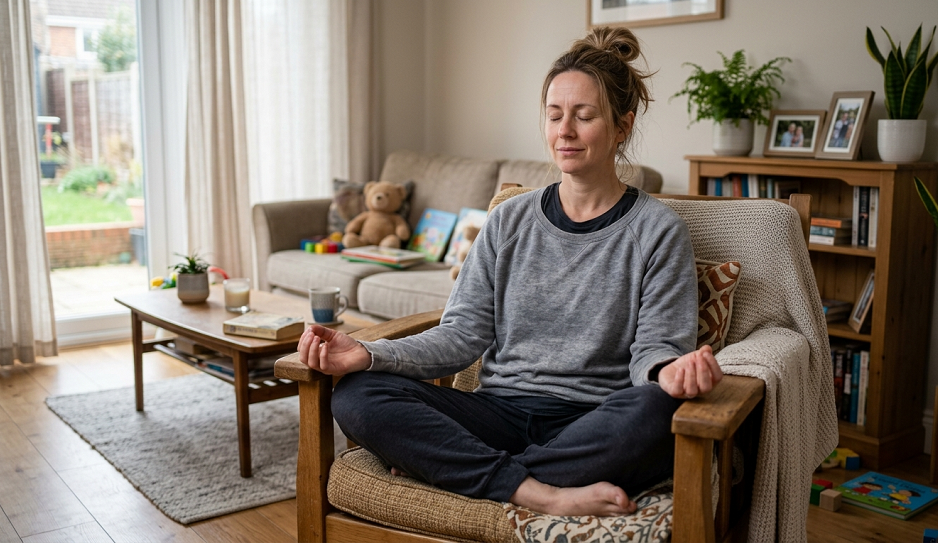
The very first step sounds almost insultingly simple: stop what you’re doing and do nothing for five minutes. I know. Bear with me.
When I was in the thick of raising three kids under ten, “stopping” felt like a luxury I could not afford. There was always something pulling at me — a permission slip, a sibling argument, a work deadline, a meal to start. The idea of pausing felt like falling behind. So I never stopped. And I kept running on fumes for years because of it.
Here’s what I’ve come to understand: a five-minute pause is not rest. It’s recalibration. It’s the equivalent of pressing Ctrl+Alt+Delete on a computer that’s frozen. You’re not fixing everything — you’re just clearing the queue enough to start functioning again. The mistake most mums make is waiting until they’re completely shut down before they allow themselves any kind of pause. By then, five minutes won’t cut it — you need a whole day, which you don’t have. Build the small pauses in before the shutdown.
What does this pause actually look like? Sit down — not on the edge of the bed while mentally composing a grocery list, but actually sit. Put your phone face-down. Focus on your breathing for five minutes. That’s it. No journaling prompt, no gratitude list, no meditation app unless you genuinely love those things. Just stop moving and let your nervous system realize that nothing terrible is happening right now.
I started doing this when Leo was about seven and going through a particularly intense phase of nighttime anxiety that meant I wasn’t sleeping properly. I had maybe twenty minutes between getting him settled and collapsing myself, and I used five of those minutes to just sit. It felt like nothing at first. After two weeks, it felt like everything. My brain started to feel slightly less like a washing machine mid-cycle. That’s all I needed to function better — not a total lifestyle overhaul, just five deliberate minutes of neutral.
Step 2: Feed Yourself Like You Matter — The Energy-First Nutrition Reset

Nutrition advice for mums tends to fall into two camps: either it’s a complicated meal prep system that requires a free Sunday afternoon you will never have, or it’s so vague it’s useless (“eat more greens!”). I’m going to be direct: most mums are running on caffeine and whatever’s leftover on their children’s plates, and this is a significant reason why energy stays low.
I’ve found that complex meal plans are a total waste of time for mothers in the thick of it, even if they look like the sensible option. The planning fatigue alone drains energy before you’ve cooked a single thing. Instead, what actually works — what I discovered after years of trying both — is what I call the Energy-First approach: identify three or four simple, high-protein snacks or meals you genuinely enjoy and can prepare in under ten minutes, and rotate them without guilt.
For me, it was Greek yogurt with a handful of nuts and some fruit, scrambled eggs on toast, a smoothie with protein powder, and a good soup I’d batch-cook on a Sunday. Nothing exciting. Everything functional. The key insight was that my brain needed consistent fuel, not perfect nutrition. The perfect became the enemy of the good for years until I let that go.
Beyond food, hydration is the silent saboteur. I cannot tell you how many afternoons I thought I was hitting an energy wall when I was simply dehydrated. A large glass of water in the morning before coffee, and another in the afternoon around the 3 p.m. slump, made a difference I genuinely wasn’t expecting. It sounds too simple to be real. It isn’t. Start there before you spend money on supplements.
One more thing I want to say plainly: please eat breakfast. I know mornings are chaos. I know the kids’ needs come first. But I spent years skipping breakfast and then wondering why I was snapping at everyone by 10 a.m. and exhausted by noon. A ten-minute breakfast — even just eggs or overnight oats — is not optional when you’re running this kind of operation. Treat it as part of the morning routine, as non-negotiable as getting the kids dressed.
Step 3: Move Your Body Without Punishing It — The Gentle Movement Reset

Exercise culture has done mums a tremendous disservice. Every fitness message aimed at mothers seems to carry an implicit undertone of “you need to earn back your body” or “push through the pain” or “no excuses.” I’ve watched friends burn themselves out trying to maintain grueling workout schedules on top of everything else, and then feel crushing guilt when they inevitably can’t sustain it. This is not helpful. This is harmful.
Here’s my honest opinion: high-intensity exercise when you are already running on empty is counterproductive. I’ve found it depletes the little reserve you have left, spikes cortisol, and leaves you more exhausted than when you started. I say this as someone who genuinely enjoys a hard workout when I’m rested. But when I’m depleted, a forty-five-minute boot camp session doesn’t restore me — it flattens me.
What does work, consistently, is gentle intentional movement for twenty to thirty minutes. A walk outside, particularly somewhere with trees or open sky, is my personal gold standard. Not a power walk. Not a podcast-in-ears, phone-in-hand distracted march. A real walk where you look at things and let your thoughts wander. When Sarah was in her difficult teenage years and I was carrying a lot of emotional weight around it, my daily twenty-minute walk was the one thing that kept me from losing my mind entirely. It cleared my head in a way that sitting with my thoughts never could.
Stretching also deserves more credit than it gets. A fifteen-minute morning stretch — nothing fancy, just moving through the major muscle groups while the kettle boils — releases physical tension that accumulates from broken sleep, carrying children, hunching over screens, and all the other physical demands of motherhood that nobody talks about. Tension stored in the body reads as fatigue. Release some of it and you’ll feel measurably more alert.
If you currently do no movement at all, please don’t leap to an ambitious new routine. Start with a ten-minute walk around the block three times a week. That’s it. Let it become easy before you build on it.
Step 4: Protect Your Sleep Like It’s a Bill That Has to Be Paid

Sleep is the most boring and most important item on this list. I’ve said this to every mum I know and I’ll keep saying it: no reset routine, supplement stack, or positive mindset practice will compensate for chronic sleep deprivation. Sleep is not a luxury you get around to when the kids are older. It is the foundational repair mechanism for everything — mood, immunity, cognitive function, emotional regulation, patience. All of it.
I am not naive about the reality. Babies don’t sleep. Toddlers don’t sleep. Anxious pre-teens definitely don’t sleep. There were years when full, uninterrupted sleep was simply not available to me, and I’m not going to pretend otherwise. But here’s what I learned: it’s not always about getting more sleep. Sometimes it’s about getting better sleep with what you have.
The single biggest change I made was cutting my screen time in the hour before bed. I resisted this for a long time because evening phone scrolling felt like the one quiet thing that was mine. What I didn’t realize was that it was actively wrecking the quality of sleep I did get. When I finally quit the evening scroll habit — replacing it with a book or just sitting quietly — I started waking up feeling more rested even on the same number of hours. The quality shift was real and noticeable within about ten days.
Beyond screens, a consistent bedtime matters more than most people want to hear. Going to bed at the same time each night — even on weekends, even when you want to stay up — regulates your circadian rhythm in a way that no sleep aid can replicate. I know this isn’t always possible. Aim for it four or five nights a week and you’ll still feel the benefit.
If your sleep is being disrupted by a baby or young child and there is genuinely no way around it right now, I want to say this gently: please ask for help. A partner swap for one full night of sleep per week. A grandparent for a Saturday morning lie-in. A friend who can take the baby for two hours so you can nap. Rest is not something you should be trying to earn or justify. It is a basic requirement, and asking for help to get it is not weakness — it’s intelligence.
Step 5: Do One Thing That Is Purely Yours — The Identity Reset

This step is the one mums most frequently skip, feel guilty about, or massively over-complicate. And I think it’s actually the most important one on the list for long-term energy restoration. Because what I’ve found, after raising three children and talking to hundreds of mothers through this blog, is that a significant portion of mum exhaustion is not just physical. It’s the slow erosion of a sense of self.
Motherhood is, in many ways, a beautiful and profound identity. I am not dismissing that. But it cannot be the only identity. When who you are becomes entirely defined by what you do for other people — when you genuinely cannot remember the last time you did something because you wanted to, not because it was needed — that is a form of depletion that no amount of sleep or nutrition will fix. You need to be a person, not just a function.
One thing. That’s all I’m asking for. One thing per week that is purely yours, that has no productive output, that nobody benefits from except you. For me, it has been gardening. It’s been reading fiction with no educational value whatsoever. It’s been a monthly dinner with one old friend where we talk about things that have nothing to do with children. These things sound small. Over time, they are the difference between a mum who is holding on and a mum who is genuinely well.
I’ve found that mums who skip this step — usually because they feel guilty spending time or money on themselves — are the ones who run out of road the fastest. The resentment builds quietly, and then it doesn’t build quietly anymore. Doing something for yourself is not selfish. It is what keeps you capable of continuing to do things for everyone else. Put the oxygen mask on, and mean it.
Real Talk: What Doesn’t Work and What Isn’t Worth Your Energy
I want to spend a moment being honest about the things that are widely recommended for mum energy that I’ve found to be, at best, ineffective and, at worst, actively demoralizing.
The 5 a.m. club. I’ve tried it. Most mums I know have tried it. For a small subset of naturally early-rising people, it genuinely works. For the rest of us who are already sleep-deprived, forcing ourselves to wake up earlier in the name of productivity is a fast track to more exhaustion with extra resentment. Unless your body is naturally inclined toward early rising, I’d skip this one entirely.
Hustle culture productivity systems. Time-blocking, habit stacking, and color-coded planners are not inherently bad. But applying a corporate productivity framework to the unpredictable, emotionally demanding reality of raising children is a recipe for feeling like you’re constantly failing a system that was never designed for your life. I’ve found that flexibility with a light structure works infinitely better than a rigid schedule that falls apart every Tuesday when someone gets sick.
Doing everything alone. This is the big one. The cultural myth that a good mother handles everything without needing support is one of the most damaging ideas I’ve ever encountered in parenting circles. Asking for help is not a sign of failure. Building a small support system — even just two or three people you can rely on in different ways — is one of the most practical energy-management strategies available. Don’t let pride or guilt rob you of this.
Quick Side Note: The Reset Reset
Here’s something nobody tells you — sometimes your reset routine will stop working. Life changes, the kids enter new phases, your own needs shift, and what restored you last year doesn’t cut it anymore. This happened to me when Maya started secondary school and everything that had been working suddenly felt hollow.
When that happens, it doesn’t mean you’ve failed. It means you need to revisit and adjust. Treat your reset routine as a living document, not a fixed prescription.
The Wrap-Up: You’re Not Failing. You’re Recalibrating.
Here is my parting wisdom, earned from years of mothering, making mistakes, and slowly, stubbornly, learning what actually works: the goal is not to be an energized, high-functioning productivity machine at all times. The goal is to have enough in reserve to show up for the people you love and the life you’re building — and to sometimes, genuinely, enjoy it.
Low energy is not a personal failing. It is feedback. Your body and mind are telling you that something needs tending to. The five steps in this routine — the pause, the food, the movement, the sleep, the thing that is yours — are not about becoming a different, better version of yourself. They’re about taking care of the person you already are, so she can keep going.
Be patient with yourself. I was a slow learner in every single one of these areas. But patient practice, without perfection as the standard, is what got me through raising three wildly different and completely wonderful kids into adulthood. It will get you through too.
Now I want to hear from you. Which step do you find hardest to stick to — and why? Is there something you’ve tried that worked in ways you didn’t expect? Drop your thoughts in the comments below. I read every single one, and your questions and suggestions genuinely shape what I write next. This space is as much yours as it is mine.