
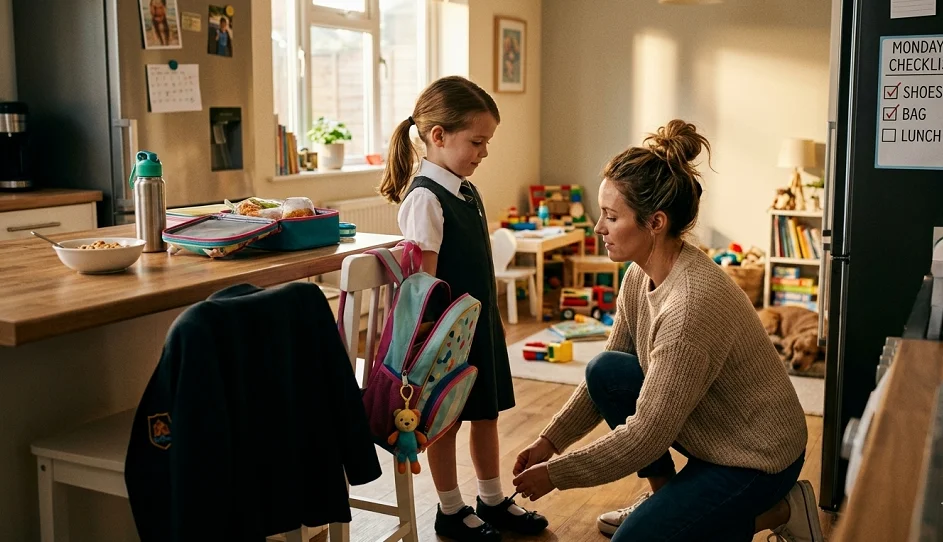
Seven-fifteen. Someone can’t find their left shoe. Someone else just remembered they need a poster board for a project due today. And the youngest is crying — not because anything is actually wrong, but because mornings have a way of making everything feel like the end of the world.
That was my house for years. Three kids, one husband who left for work before the sun came up, and a morning routine that felt less like a routine and more like a hostage negotiation with tiny, irrational people. If you’ve ever white-knuckled your way through the school-morning rush only to sit in your car afterward and cry into your coffee, first — I see you. Second — I’ve been exactly there.
What changed everything for me wasn’t a viral TikTok checklist or an expensive morning planner. It was slowing down on purpose. Radically, uncomfortably, almost annoyingly on purpose. That’s the heart of what I now call Slow Motherhood mornings — and once I stopped treating the morning like a race to be won, the tears (mine and theirs) mostly stopped too.
Here’s exactly what that looks like, step by step.
Step 1: The Night-Before Reset — Your Morning Actually Starts at 8 PM
I’ll be honest with you: I wasted years thinking the morning was where I needed to fix things. I’d wake up earlier, move faster, yell less, reward more. None of it worked, because I was trying to solve a problem at the wrong end of the timeline.
The morning is already over by the time you wake up. It was decided the night before. When Sarah was in third grade, I started doing something I called the “Ten-Minute Tidy and Tomorrow Talk” — and even the name makes me cringe a little now, but the habit stuck for over a decade across all three kids.
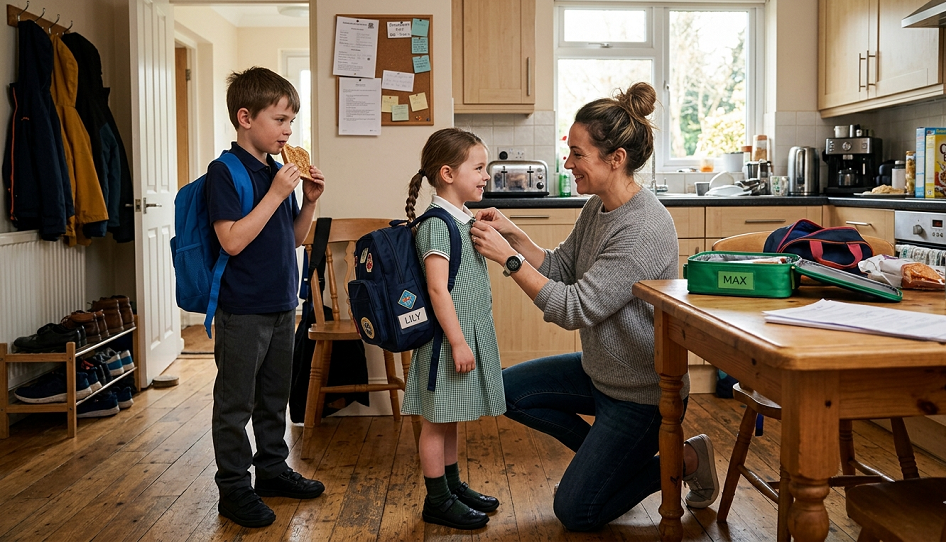
Here’s what it actually means in practice: ten minutes before bedtime, everything needed for the next morning gets placed by the front door. Backpack. Shoes. Permission slip. The library book that’s been missing for three weeks and suddenly materialized under the couch. Everything. Non-negotiable, not optional, done together.
The “Tomorrow Talk” part is even simpler — you ask your child one question: “Is there anything you need tomorrow that we haven’t already handled?” That’s it. You’d be stunned how often a quiet moment before bed surfaces the math worksheet that got stuffed into a couch cushion, or the gym bag that needs to be washed. It hands ownership to the child, gently, without it feeling like an interrogation. By the time morning comes, the foundation is already laid. There are no surprises. And mornings without surprises are mornings that actually have a fighting chance.
The extra bonus — and this one took me embarrassingly long to figure out — is that this habit teaches kids to think ahead. Not because you lectured them about responsibility, but because the routine itself built the muscle. Leo now does this instinctively at twenty-three. Routine becomes character.
Step 2: Build a “Soft Start” — Protect the First 15 Minutes Like Your Life Depends on It
The single biggest mistake I made as a young mom — and I see parents make it constantly — is treating waking up and getting ready as the same phase. They are not. The first fifteen minutes after a child opens their eyes are neurologically sacred. Their nervous system is still transitioning out of sleep. Shoving tasks, instructions, and decisions into that window is a total waste of energy, even if it looks like efficiency. You’re not moving faster. You’re just starting a conflict earlier.
The “soft start” is a protected window I stumbled into by accident. When Maya was about six, she went through a phase of waking up absolutely inconsolable every single morning. We saw a pediatric sleep specialist who said something that rearranged how I thought about mornings forever: “Children’s brains need transition time, not task time.”
So I stopped talking at her for the first fifteen minutes. No “good morning, time to get dressed, did you brush your teeth, what do you want for breakfast” machine-gun sequence. Instead, I let her wake up slowly. She came downstairs, there was something calm on in the background — quiet music, never the news — and a small glass of juice or water waiting. No demands. Just presence.
Within two weeks, the morning meltdowns cut in half. Not because I fixed anything dramatic. Because I stopped triggering her nervous system before it was ready. This works for toddlers, it works for tweens, and between you and me, it works for adults too. My own soft start now includes coffee made the night before on a timer and ten minutes of sitting without my phone. That’s it. Those ten minutes are the difference between me being a regulated adult and me snapping at everyone before 7 AM.
The practical implementation: set your alarm 20 minutes earlier than you think you need to. Use the first 10 for your own soft start before anyone else is awake. Protect it. That quiet, unhurried version of you is the parent everyone in your house actually needs.
Step 3: Anchor the Routine with “Morning Zones” — Stop Relying on Verbal Reminders
Here’s something that will save your voice, your sanity, and your relationship with your children simultaneously: stop telling them what to do every morning and start building a system that tells them for you.
I used to narrate the entire morning like a sportscaster. “Leo, shoes. Sarah, your hair. Maya, breakfast is getting cold, please come eat, I said come eat, WHY IS NO ONE EATING.” It was exhausting for everyone, and it was training my kids to be dependent on my reminders rather than their own internal sense of what needed to happen. That’s a problem that compounds over time.
Morning Zones are my answer to this. The concept is simple: each child has a visual, physical anchor for each stage of the morning. For younger kids, this is literally a picture chart on the wall — wake up, bathroom, dressed, breakfast, backpack check, out the door. For older kids, it can be a whiteboard checklist they maintain themselves. The rule is: the chart is the boss, not me.
When Sarah was in fifth grade, she made her own morning zone chart in bubble letters with stickers and proudly hung it on the back of her bedroom door. She followed it more religiously than any chart I ever made, because she owned it. That’s not a coincidence — ownership is the secret ingredient most parenting systems skip. When kids design part of the system, they feel accountable to it in a way they never will to your instructions.
The zones also solve the multi-child household problem beautifully. With three kids at different ages and different schools, I couldn’t possibly manage each person’s morning individually. The zones made everyone self-managing within their own rhythm. I moved from director to support staff. And honestly? Support staff has a much better morning than the director.
Step 4: Redesign Breakfast — Let Go of “The Perfect Morning Meal”
Breakfast is where most morning routines collapse. I know this because it’s where mine collapsed, repeatedly, for about four years.
I had this image in my head — the Norman Rockwell fantasy of a hot, nourishing, everyone-sitting-together family breakfast. I have discovered the hard way that chasing that image during a school morning is a recipe for chronic stress, and I say this as someone who genuinely loves cooking. The expectation of a meaningful morning meal, every day, on a schedule, was not enriching my family’s life. It was making me resentful by 7:30 AM.
What I replaced it with was what I call “no-drama breakfasts” — and this is the one area where I’ll push back hardest if you resist me. The goal of a school-morning breakfast is fuel and calm, not nutrition theater. You are not failing your children if breakfast is whole grain toast with peanut butter and a banana. You are not a bad mother if your kid grabs a yogurt and eats it in the car. The elaborate egg scramble with fresh vegetables is a weekend gift, not a weekday standard.
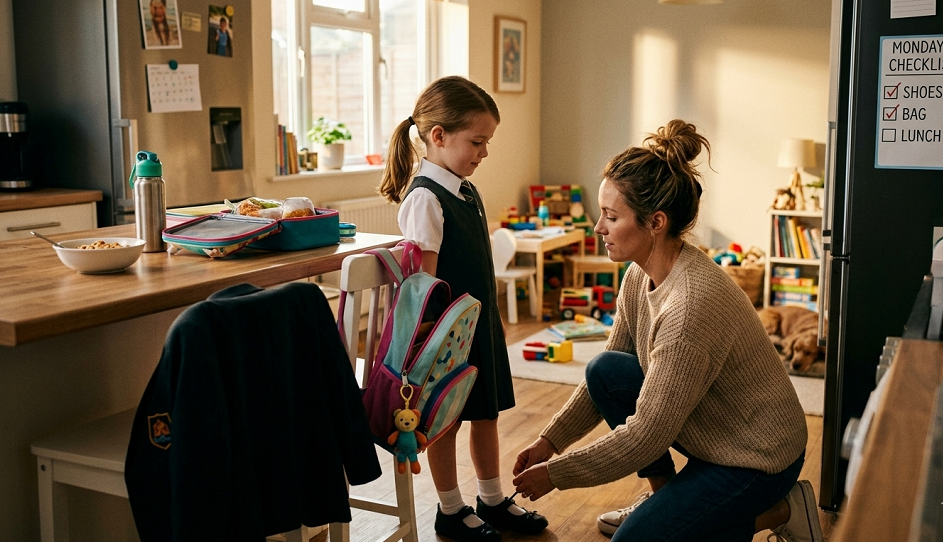
I set up a “breakfast station” in my kitchen — a low shelf or designated cabinet section with grab-and-go options that met my nutritional baseline. The kids could make their own choices within those options starting around age five. Was every choice perfect? No. Did Maya go through a phase of eating only cereal and apple slices every single morning for three months? Yes. Did she survive? Thriving, currently completing her master’s degree.
The deeper shift here is releasing the idea that every morning moment needs to be optimized. Slow Motherhood is specifically about not trying to maximize everything. A peaceful, independent breakfast where your child feels capable of feeding themselves is worth infinitely more than a hot meal served in a tense, rushed atmosphere. The nervous system your child arrives at school with matters more than the specific protein content of what they ate.
Step 5: Build in a “Goodbye Ritual” — Two Minutes That Change Everything
The transition out the door is the most underestimated part of the morning routine. Most of us treat it as a finish line — get them out, close the door, exhale. What I’ve found, with all three of mine at different stages, is that how a child leaves the house sets the emotional temperature for their entire school day.
A “Goodbye Ritual” doesn’t need to be elaborate. It needs to be consistent and warm and brief. Ours evolved over the years but always included three things: a physical touch (hug, forehead kiss, fist bump — whatever the child’s preference was at that age), one genuine positive statement, and the same send-off phrase every single day. Ours was “I love you, have a great one.” Leo still texts it to me sometimes, and he’s twenty-three.
The psychological basis for this is solid — attachment research consistently shows that predictable, warm transitions reduce separation anxiety and help children self-regulate during the day. But beyond the research, I can tell you from watching my own kids: the mornings they left with that ritual intact, they came home lighter. The mornings it got rushed or skipped because we were running late, there was often a harder afternoon.
I want to be real with you here: some mornings the ritual is a squeeze and a “love you, go” said at a jog toward the car. That counts. It doesn’t have to be a ceremony. It has to be a signal — you are loved, you are seen, go be yourself out there. That signal, delivered consistently over years, is one of the most powerful things you can do as a parent without spending a single dollar.

Real Talk: What’s Not Worth the Effort
I have to include this section because every “5 Steps to a Better Morning” article tends to leave out the part where the author tells you what they actually stopped doing. Here’s my honest list.
Morning meetings are a total waste of time for most families. I tried it — sitting everyone down the night before for a “family morning planning session.” My kids looked at me like I had suggested we do taxes together for fun. It lasted six days. Most kids do not want a structured conversation about logistics. They want the system to just work quietly around them.
Reward charts for morning routines backfire fast. I’ve seen this with my own kids and heard it from hundreds of readers over the years. Sticker charts for morning tasks create external motivation where you need internal habits. The moment the novelty wears off — usually week three — you’re left with a child who won’t brush their teeth unless there’s a sticker involved. Build the routine instead. The reward is the smooth morning itself.
Waking kids up with sound and light, not voice, is the one “hack” that actually holds up. A sunrise alarm clock or even just opening the curtains and turning on music before you speak to them works better than any amount of cheerful “good morning!” shouting from the hallway. Their brains need that sensory transition before language hits them. This isn’t Instagram parenting advice — it’s just basic neuroscience.
And finally: trying to fix the morning during the morning doesn’t work. If your routine is broken, the fix happens at dinner the night before and on the weekend when you redesign the system. Troubleshooting at 7:15 AM under pressure is like trying to fix the plane while it’s in the air. Do the maintenance on the ground.
The Parting Wisdom
Slow Motherhood mornings are not about doing less. They’re about doing the right things at the right time — and trusting that a morning built on calm and connection will serve your child more than one built on speed and control.
The version of parenthood that I chased for too many years — perfectly timed, beautifully executed, everyone happy and ready — was a fantasy that cost me real presence with my real children. The goal was never a perfect morning. The goal was a child who left the house feeling loved and capable. Everything else is logistics.
You are not failing. You are learning. Those are different things, and the fact that you’re reading this at all tells me everything I need to know about the kind of parent you are.
What does your current morning routine look like — and which part feels most broken right now? Drop your questions or ideas in the comments below. I read every single one, and sometimes the best advice in this community comes from parents helping other parents. Tell me what’s going on in your house.