
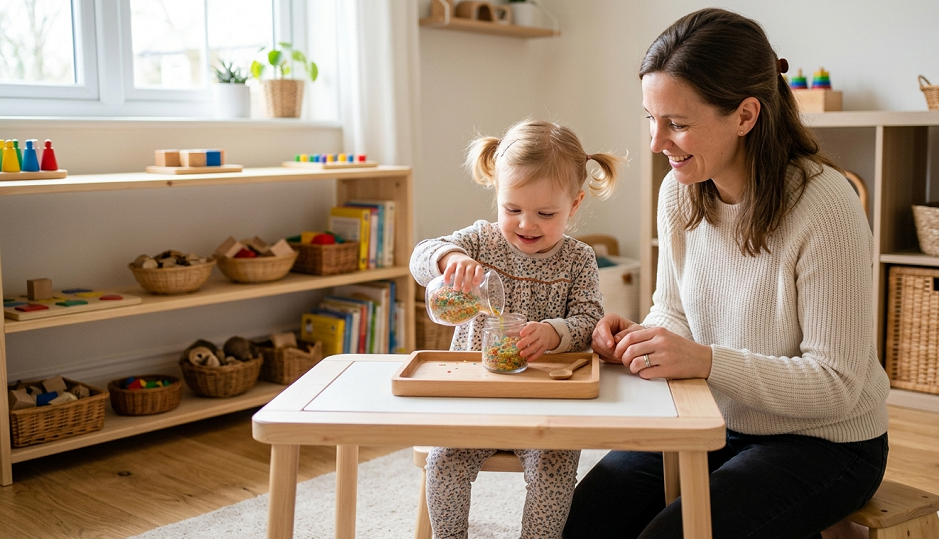
I remember a Tuesday morning about twenty years ago. My son, who was just hitting that “I do it!” phase, decided that my morning coffee prep was a team sport. At the time, I had two older daughters already swirling around the kitchen, and the sheer volume of “help” I was receiving felt less like a blessing and more like a high-stakes obstacle course.
I’ll be honest with you: I didn’t always handle it with the grace I write about now. There were mornings where I’d look at the spilled coffee grounds on the floor and feel that familiar tightening in my chest—that “I’m failing at this” or “I just need five minutes of peace” feeling. If I could go back and sit with my younger self in that flour-dusted kitchen, I’d tell her to take a breath. I’d tell her that the mess wasn’t a sign of chaos, but a sign of a tiny human trying to figure out how the world works.
When my kids were little, I used to think that “educational activities” had to involve expensive wooden toys or meticulously planned lesson charts. I spent way too much time scrolling through catalogs (yes, we had those back then!) looking for the “perfect” Montessori materials. What I eventually learned—mostly by watching my kids ignore the expensive toys in favor of the cardboard box they came in—is that Montessori isn’t a brand. It’s a mindset. It’s about recognizing that a two-year-old doesn’t want to be entertained; they want to be included.
The “Why” Behind the Montessori Magic
At two years old, your child is hitting a developmental milestone often called the “sensitive period” for order and functional movement. In plain English? They are obsessed with how things fit together and how they can exert control over their environment.
When a toddler has a meltdown because you wouldn’t let them pour the milk, it’s rarely about the milk. It’s about their deep, biological drive to master a skill. Montessori principles focus on “Practical Life” skills. This isn’t just about chores; it’s about building confidence, fine motor skills, and hand-eye coordination.
By giving a two-year-old a “job,” you aren’t just keeping them busy so you can fold the laundry. You’re telling them, “You are a capable, contributing member of this family.” That sense of belonging is the cornerstone of emotional intelligence. It’s the difference between a child who feels like a burden and a child who feels like a partner.
My son is in his twenties now, and he still talks about the “important jobs” he had in our house. Those tiny moments of pouring water or matching socks laid the foundation for the capable man he is today.
15 Low-Prep Montessori Activities for Your 2-Year-Old
The best part about these ideas? You probably have everything you need in your kitchen or junk drawer right now. No “tapestries” of learning required—just real life.
1. The Sock Match-Up
This was a staple in our house. When I was drowning in laundry with three kids, I’d dump the basket of clean socks on the rug.
- How-To: Show your toddler how to find two socks that look the same. Don’t worry if they aren’t perfect at it.
- The Goal: Visual discrimination and focus.
- Action Steps: * Start with just 3-4 pairs.
- Exaggerate the “search” (“Hmm, where is the blue stripe?”).
- Let them “toss” the completed pairs into a basket.
2. Water Pouring Station
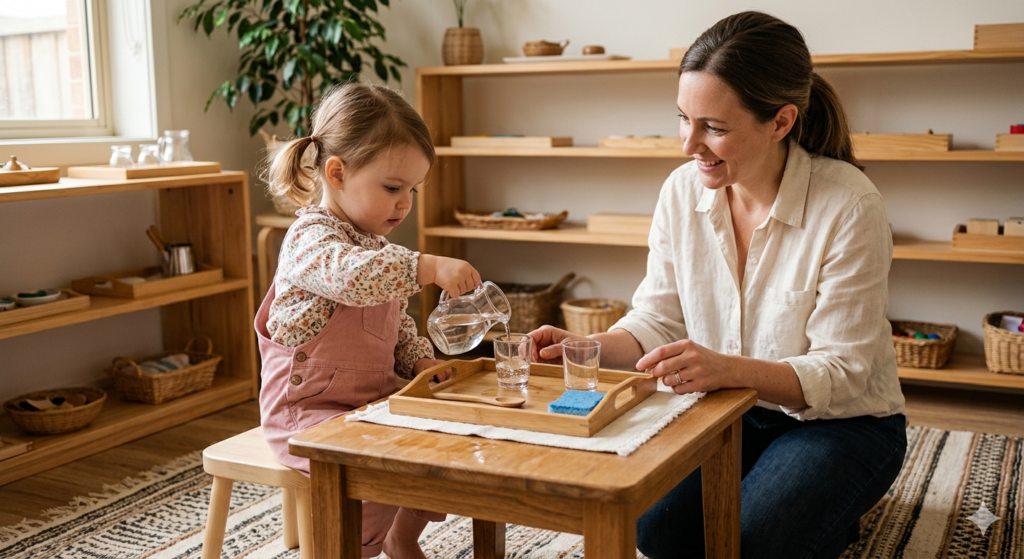
If your toddler is obsessed with your water glass, give them their own.
- How-To: Put a tray down (to catch the inevitable spills) with two small pitchers. Fill one with a tiny bit of water.
- The Goal: Precision and “crossing the midline” (a big deal for brain development).
- Action Steps:
- Use clear containers so they can see the water level.
- Keep a small sponge nearby for them to “clean up” spills.
- Add a drop of food coloring to make the water “special.”
3. Spice Jar Smelling
Two-year-olds are sensory explorers. My daughters used to love this while I was making dinner.
- How-To: Take 3-4 distinct-smelling spices (cinnamon, rosemary, vanilla). Let them smell and talk about the scents.
- The Goal: Language development and sensory refinement.
- Action Steps:
- Keep the lids on tight unless you’re supervising!
- Ask “Does this smell sweet or spicy?”
- Connect it to what you’re cooking (“This cinnamon is going in the oatmeal”).
4. The “Big Box” Painting
Forget the easel. If you have a shipping box, you have a Montessori masterpiece.
- How-To: Put the child inside the box with a few washable crayons or a brush and a tiny bit of water (water painting is mess-free!).
- The Goal: Spatial awareness and boundaries.
- Action Steps:
- Tape the flaps down so it’s sturdy.
- Let them draw on the “walls.”
- When they’re done, the “studio” just folds up.
5. Colander Pipe Cleaners
This looks like nothing to us, but to a two-year-old, it’s a high-stakes engineering project.
- How-To: Hand them a kitchen colander and a pack of colorful pipe cleaners. Show them how to poke the wires through the holes.
- The Goal: Fine motor strength and patience.
- Action Steps:
- Encourage them to make “grass” or “spiders.”
- Vary the thickness of the pipe cleaners if you can.
- This is a great “quiet time” activity for when you need to make a phone call.
6. Fruit Scrubbing
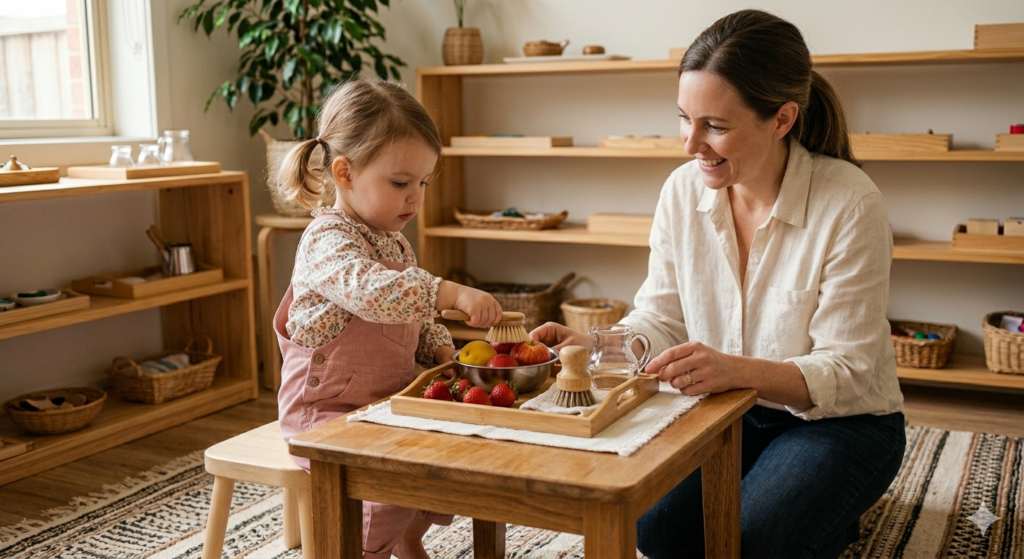
My kids always ate more fruit when they helped “prepare” it.
- How-To: Give them a bowl of water, a small vegetable brush, and some sturdy produce like apples or potatoes.
- The Goal: Functional movement and a sense of contribution.
- Action Steps:
- Provide a small stool so they can reach the sink.
- Show them how to dry each piece with a towel.
- It’s okay if they end up a bit wet—it’s just water!
7. Sorting the Cutlery
This is the ultimate “low-prep” chore that kids actually love.
- How-To: Take the (non-sharp!) spoons and forks out of the dishwasher and let your toddler put them in the tray.
- The Goal: Categorization and mathematical thinking.
- Action Steps:
- Remove all knives first for safety.
- Demonstrate: “Spoons go in the spoon house.”
- High-five them for every successful sort.
8. Window Washing with Water
Toddlers love to mimic adult movements.
- How-To: Give them a small spray bottle (just water!) and a microfiber cloth. Point to a smudge on a glass door and let them go to town.
- The Goal: Gross motor control and following a sequence.
- Action Steps:
- Use a spray bottle that fits their small hand.
- Show them the “circular” motion.
- Don’t worry about streaks—the goal is the effort, not the shine.
9. Peeling Hard-Boiled Eggs
This was a favorite Sunday morning activity when my kids were little.
- How-To: Gently crack the shell for them first, then let them pick the pieces off.
- The Goal: Pincer grasp development.
- Action Steps:
- Make sure the eggs are fully cooled.
- Have a “trash bowl” ready for the shells.
- Celebrate the “reveal” of the smooth egg inside.
10. The Mystery Bag
This one is great for waiting rooms or car rides.
- How-To: Put 5 familiar objects (a spoon, a ball, a toy car) in an opaque drawstring bag. Have them reach in and guess what they’re touching without looking.
- The Goal: Stereognostic sense (learning through touch).
- Action Steps:
- Use objects with very different shapes.
- Let them “describe” what they feel: “Is it hard? Is it round?”
- Switch roles and let them pick items for you to guess.
11. Scooping Beans or Rice
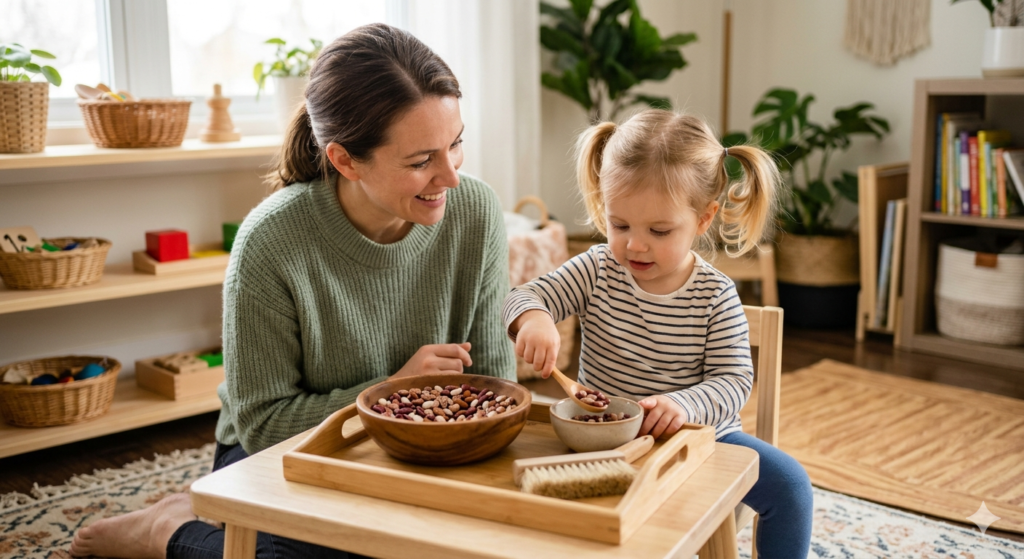
Transferring items from one bowl to another is surprisingly soothing for a toddler.
- How-To: Two bowls, one spoon, and a handful of dried beans or rice.
- The Goal: Concentration and hand-eye coordination.
- Action Steps:
- Put this on a tray to contain the “runaway” beans.
- Encourage them to get every single bean into the second bowl.
- Safety Note: Always supervise with small items that could be a choking hazard.
12. Leaf Collecting
If you can get outside, do it. Nature is the best Montessori classroom.
- How-To: Give them a small basket and go for a “slow walk.” Let them pick up leaves, stones, or sticks.
- The Goal: Observation skills and connection to nature.
- Action Steps:
- Follow their pace, not yours. If they want to look at a bug for 5 minutes, let them.
- Bring the “treasures” home to display on a shelf.
- Talk about the colors and textures.
13. Animal Rescue (Tape Play)
This is a “sanity saver” when you need to get dinner on the table.
- How-To: Tape some plastic toy animals to a cookie sheet using painter’s tape. Tell your toddler the animals need to be “rescued.”
- The Goal: Finger strength and problem-solving.
- Action Steps:
- Use painter’s tape (it’s easy for little fingers to peel).
- Cheer when an animal is “freed.”
- This keeps them busy for a surprisingly long time.
14. Sponging a Table
If you have a spill, don’t rush to clean it. Let them do it.
- How-To: Show them how to dip a sponge in a bowl, wring it out (this is the hard part!), and wipe a surface.
- The Goal: Strengthening hand muscles and independence.
- Action Steps:
- Focus on the “wringing” motion—it’s great for pre-writing strength.
- Use a small, toddler-sized sponge.
- Accept that the table might still be a little wet.
15. The “Walking on the Line” Game
Dr. Montessori used this to help children develop balance and poise.
- How-To: Use painter’s tape to make a straight (or curvy!) line on the floor. Ask them to walk “on the bridge” without falling off.
- The Goal: Equilibrium and body control.
- Action Steps:
- Start with a short, straight line.
- Add a “challenge” like carrying a small bell without making it ring.
- Join in! They love seeing you try it too.
The Long View: Raising Humans, Not Puppets
I look at my three adult children now—all through college, all finding their own paths—and I realize that those chaotic mornings in the kitchen weren’t “stolen time.” They were the work.
My daughters are now organized, capable women who can handle a crisis with a level head. My son is patient and observant. I’m convinced that’s partly because I stopped trying to “manage” them and started letting them do. I stopped seeing their help as a mess to be cleaned and started seeing it as a person being built.
When you’re in the thick of it—when there’s rice on the floor and your two-year-old is insisting on “washing” the windows for the fifth time today—remember that you are playing the long game. You aren’t just teaching them to pour water; you’re teaching them that their effort matters. You’re teaching them that they can try, fail, and try again in a safe space.
You aren’t failing because your house isn’t a museum. You’re succeeding because your house is a workshop. Take it easy on yourself today. Grab a cup of coffee (even if it’s lukewarm), and remember: they’re only two once. The mess will fade, but the confidence you’re building in them right now? That’s for life.