
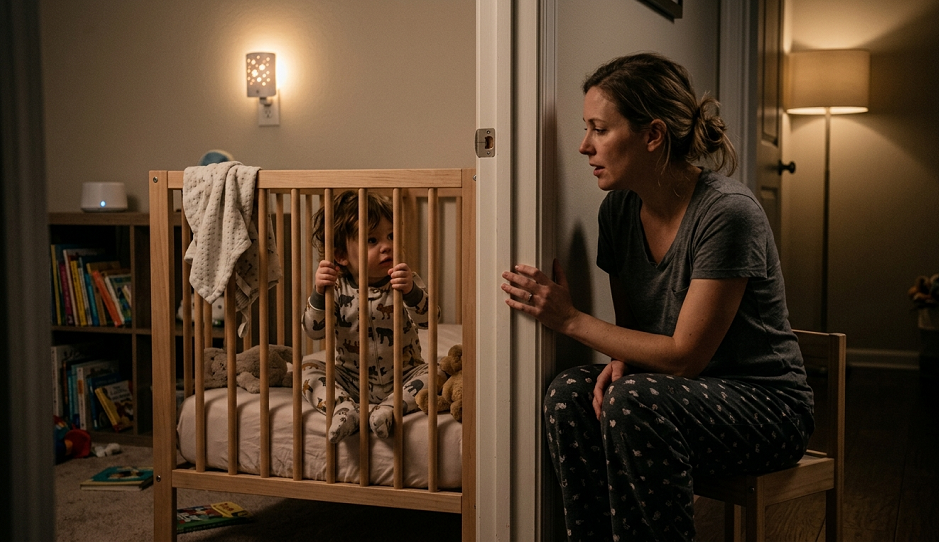
The day Leo decided naps were a relic of his “babyhood” is etched into my memory like a battle scar. He was exactly twenty-six months old. Sarah and Maya were already in elementary school, and that two-hour window in the afternoon was my only chance to breathe, fold laundry, or drink a cup of coffee while it was actually hot. I remember putting him down, hearing the usual protests, and then—silence.
I thought I’d won. I sat down with my book, feeling like a parenting champion. Forty minutes later, I walked past the hallway and noticed the linen closet door was slightly ajar. There was Leo, sitting on a pile of fresh towels, systematically unrolling every roll of toilet paper we owned. He wasn’t tired. He was energized by his own rebellion.
If you are currently staring at a two-year-old who treats their crib like a cage and their nap time like a personal insult, I see you. You aren’t failing, and your child isn’t “broken.” You are simply transitioning into a new season of parenting that requires a different kind of rhythm. It’s exhausting, yes, but we can get through it without losing our minds.
Mastering the 2-Year-Old Sleep Schedule Without Naps
When your toddler stops napping, the biggest mistake I see parents make is trying to keep the same bedtime they had before. I’ve found that holding onto an 8:00 PM bedtime when your child has been awake since 7:00 AM is a recipe for a nightly meltdown. Their little nervous systems just can’t handle thirteen hours of continuous stimulation.
The “Early Bedtime Pivot” is my absolute go-to strategy. If the nap is gone, bedtime moves up. I’m not talking fifteen minutes; I’m talking a full hour or more. When Leo dropped his nap, we moved his bedtime to 6:30 PM. It felt absurd at first—the sun was still out!—but the alternative was a child who screamed through dinner and fell asleep in his spaghetti.
You have to be firm here. Other parents might tell you that an early bedtime will make them wake up at 4:00 AM. In my experience, that’s a myth for most kids. Sleep begets sleep. An overtired toddler produces cortisol and adrenaline, which actually makes it harder for them to stay asleep. By moving the schedule up, you catch that “sleep wave” before they become “wired and tired.”
I’ve discovered the hard way that trying to “force” a nap through power struggles is a total waste of time. It ruins your relationship and leaves everyone crying. Instead, we shift the focus to a predictable, sun-up to sun-down rhythm. We wake at the same time, eat at the same time, and hit the pillow early. This consistency tells their internal clock exactly what to expect, even without the midday break.
Creating a Successful Quiet Time Routine for Toddlers
Just because your child isn’t sleeping doesn’t mean you don’t deserve a break. I am a fierce advocate for “Quiet Time.” This is a non-negotiable hour in our house. Even after Sarah, Maya, and Leo were well into their school years, we kept this rhythm. It’s the only way I stayed sane.
To make this work, you have to set physical boundaries. I used a color-changing clock—the kind that turns green when it’s okay to come out. For a two-year-old, you start small. Put them in their safe, child-proofed room with a specific basket of “Quiet Time Only” toys. These shouldn’t be loud electronic toys; think board books, soft dolls, or those water-reveal coloring mats.
The key is that you are not “putting them to bed.” You are inviting them to rest their body. I always told Leo, “You don’t have to sleep, but your feet have to stay on your rug and your voice has to stay at a whisper.” It took about two weeks of me calmly leading him back to his room every time he popped out, but eventually, he got it. He learned how to be alone with his thoughts, which is a massive developmental win.
I’ve found that “Room Time” is a total waste of time if you haven’t burned off enough physical energy in the morning. If we stayed inside all morning, Quiet Time was a disaster. But if I got them to the park or let them run laps in the backyard, they were much more willing to sit quietly for forty-five minutes. It’s about balancing the “big movements” with the “still moments.”
Optimizing the Toddler Bedroom Environment for Better Sleep
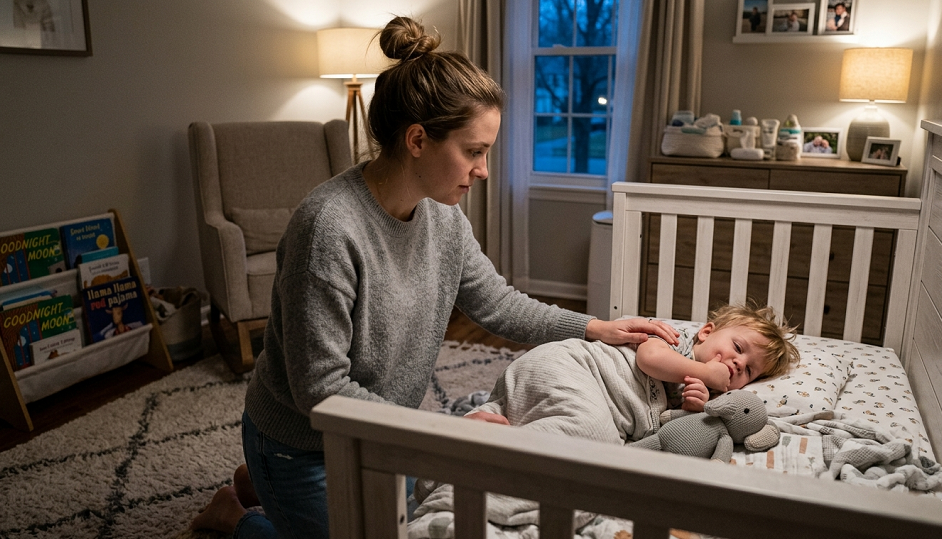
If your toddler is skipping naps, their bedroom needs to be a sensory vacuum. At two years old, their brains are like sponges, soaking up every light and sound. I used to think a cute nightlight and some soft music were helpful. I was wrong. For a non-napping toddler, any distraction is an excuse to stay awake.
Invest in real blackout curtains. I’m not talking about the “room darkening” ones that still let a glow in around the edges. I mean the heavy-duty ones that make the room feel like a cave. When Leo hit that two-year-old sleep regression, even a sliver of afternoon sun was enough to convince him that the party was still going on.
White noise is your best friend. A consistent, low-frequency hum drowns out the sounds of the rest of the house. It signals to their brain that the world is “turned off.” Maya was particularly sensitive to noise; if she heard a floorboard creak or the dishwasher start, she was up and running. A loud white noise machine saved our lives.
Keep the toy situation in the bedroom minimal. If their room looks like a toy store, they are going to play. We moved all the “exciting” toys to the living room and kept only a few stuffed animals and books in the bedroom. This makes the environment boring. And when it comes to toddlers who are trying to skip sleep, boring is beautiful.
The Importance of Morning High-Sensory Input
If you want a toddler to survive a day without a nap without becoming a “threenager” six months early, you have to front-load their sensory needs. I call this the “Morning Burn.” Between 8:00 AM and 11:00 AM, my kids were outside. Rain or shine, we were moving.
We did “heavy work.” For a two-year-old, this means pushing a toy shopping cart filled with books, climbing on the low rungs of a jungle gym, or even just helping me carry the laundry basket. This kind of proprioceptive input—the feeling of pressure on the joints and muscles—is incredibly grounding for a child’s nervous system.
I’ve discovered that passive entertainment, like watching cartoons in the morning, actually makes the no-nap slump worse. It overstimulates their eyes but leaves their bodies restless. If Sarah watched too much TV in the morning, she was a wreck by 2:00 PM. If we went for a walk and looked at bugs, she was much more stable.
You’re aiming for a “tired but happy” state by lunchtime. If they’ve had enough fresh air and physical exertion, they might still skip the nap, but they won’t be vibrating with nervous energy. They’ll be able to handle the transition to Quiet Time because their body has actually done the work it was designed to do.
Nutritional Foundations for the Non-Napping Toddler
What your child eats has a direct impact on how they handle the afternoon “witching hour.” When Leo stopped napping, I noticed he would get a massive sugar crash around 3:00 PM. If he’d had a juice box or a sugary snack earlier, he would become inconsolable.
Focus on “long-burn” foods. I’m talking about proteins and healthy fats. For lunch, I’d give them avocado, turkey rolls, or full-fat Greek yogurt. These foods keep their blood sugar stable. A stable blood sugar means fewer meltdowns when the inevitable afternoon fatigue hits.
I’ve found that “grazing” all day is a total waste of time. It prevents the child from ever feeling truly full or truly hungry, which messes with their body’s internal cues. We stuck to a firm schedule: Breakfast at 7:30, Snack at 10:00, Lunch at 12:00, Snack at 3:30, and Dinner at 5:30.
A quick side note: Watch out for hidden sugars in “toddler snacks.” Even some organic fruit leather can spike their energy and lead to a crash that looks like a sleep tantrum. Stick to whole foods as much as possible, especially during this transition phase. It’s amazing how much a handful of walnuts or a piece of cheese can stabilize a grumpy two-year-old.
Baby Sleeping Schedule Chart
It’s one thing to talk about a rhythm, but it’s another to see it laid out on paper. When I was navigating this with my three, I practically had to tape a schedule to the fridge just so my husband and I stayed on the same page.
If your two-year-old has officially retired their nap, your day is going to look a lot different. We are shifting from a “split day” (where the nap is the center of the world) to a “continuous flow” that focuses on managing energy levels so they don’t hit a wall at 5:00 PM.
I’ve found that a visual guide helps keep everyone’s blood pressure lower. Here is the ideal “No-Nap” schedule that worked for Sarah, Maya, and Leo during those chaotic toddler years.
The Ideal “No-Nap” Toddler Routine
| Time | Activity | Purpose |
| 7:00 AM | Wake Up & Protein Breakfast | Setting the internal clock and stabilizing blood sugar. |
| 8:30 AM | Outdoor / High-Energy Play | The “Morning Burn”—essential for physical tire. |
| 10:30 AM | High-Protein Snack | Preventing the mid-morning hunger crash. |
| 12:00 PM | Lunch | Refueling for the second half of the day. |
| 1:00 PM | Quiet Time (The “Rest Stop”) | Mandatory rest in a dark, quiet room with low-stimulation toys. |
| 2:30 PM | Low-Key Activity | Sensory bins, playdough, or puzzles to ease back into the afternoon. |
| 3:30 PM | Afternoon Snack | Avoiding the “Witching Hour” irritability. |
| 5:00 PM | Early Dinner | Getting calories in before they are too tired to chew. |
| 6:00 PM | The Bedtime Bridge | Bath, books, and soft lighting only. |
| 6:30 PM | Lights Out | The Early Pivot to ensure 12+ hours of sleep. |
I’ve discovered that if you miss that 6:30 PM window, you often enter the “Second Wind Zone.” This is where they suddenly seem energetic but are actually just running on pure stress hormones. Once they hit that zone, you’re looking at an 8:30 PM bedtime and a very long, loud night.
A quick side note: This schedule is a framework, not a cage. If you’re at the park and they’re having the time of their lives at 10:30 AM, stay! Just make sure you adjust the rest of the day to keep that early bedtime sacred.
Does your current daily rhythm look anything like this, or are you struggling with a specific “dead zone” in the afternoon?
Real Talk: When the Schedule Falls Apart
Here is the truth: some days, everything will go wrong. You’ll have the perfect morning, the perfect lunch, and the perfect Quiet Time, and your toddler will still have a meltdown because you cut their toast into triangles instead of squares.
I’ve found that trying to “reason” with a tired two-year-old is a fool’s errand. They aren’t using their logical brain in that moment; they are operating purely out of their “lizard brain.” When the no-nap day goes sideways, the best thing you can do is lower your expectations.
If they are losing it at 4:00 PM, put them in a warm bath. It’s a sensory “reset.” The water changes their body temperature and provides a soothing tactile experience. It can often buy you another hour of peace before dinner.
Also, don’t get sucked into the “car nap” trap unless you’re desperate. I used to drive Leo around just to get him to sleep for twenty minutes. I’ve discovered that this usually backfires. A twenty-minute “power nap” at 4:30 PM is enough to fuel them until 10:00 PM. Unless you want to be up all night, it’s usually better to just push through the grumpiness and get to an early bedtime.
Parting Wisdom from the Trenches
The transition away from naps feels like the end of an era because it is. It’s okay to mourn that time you used to have for yourself. But remember, this is a sign that your child is growing and their brain is maturing. They are becoming more capable of staying engaged with the world for longer stretches.
Be patient with them, and be even more patient with yourself. You are doing the hard work of building a foundation of security and rhythm that will serve them for years. Sarah, Maya, and Leo are all grown now, and I promise you, I don’t remember the laundry I didn’t fold during those missed naps. I remember the way they looked when they finally drifted off to sleep at 6:30 PM, peaceful and safe.
What is the biggest challenge you’re facing with your toddler’s sleep right now? Drop a comment below and let’s figure it out together!