
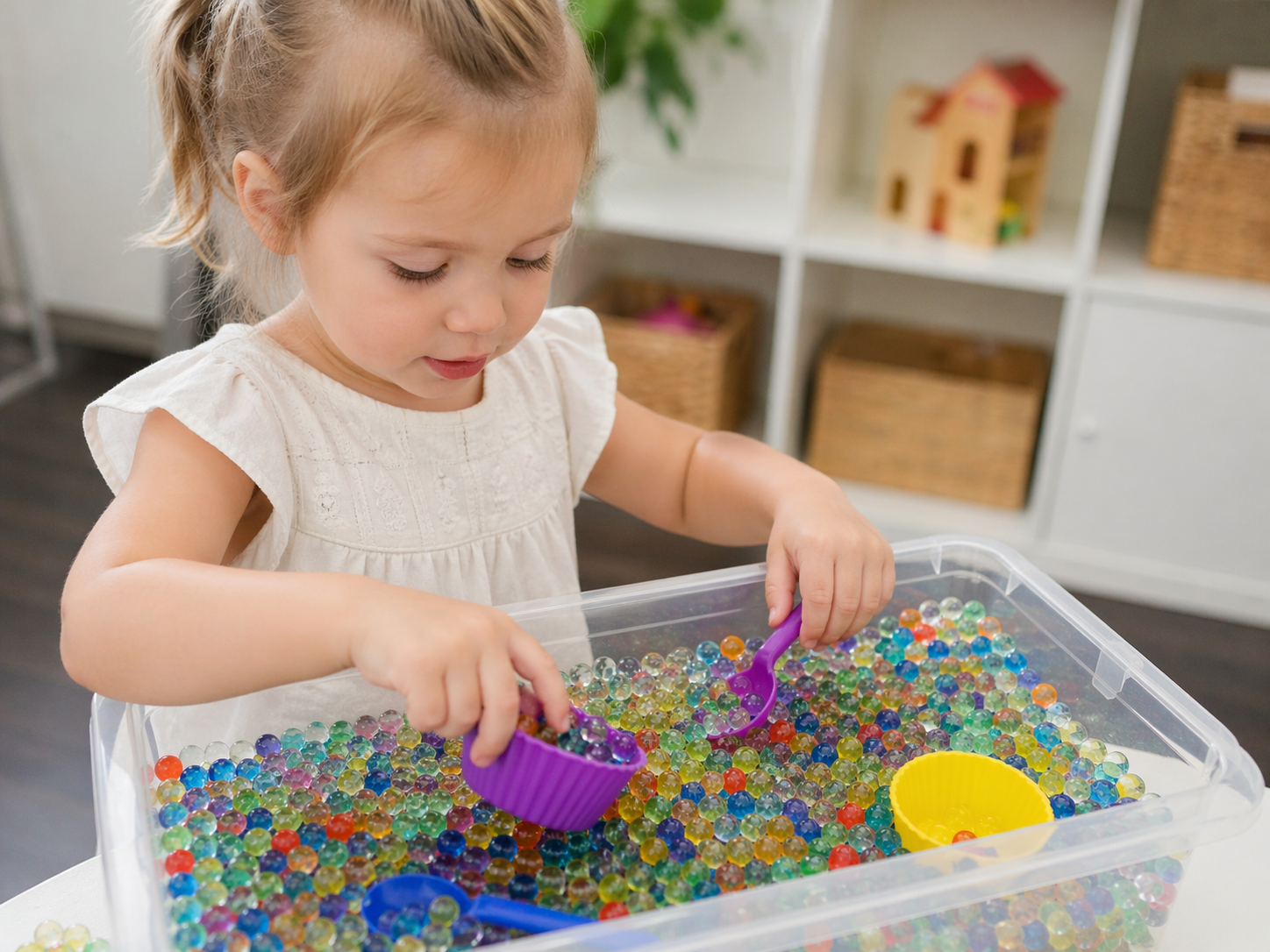
I remember the afternoon my son Leo, then four, decided that our living room rug needed to be “fertilized.” He had dumped an entire sensory bin of dyed green rice into the deep shag carpet. My daughters, Sarah and Maya, were “helping” by grinding the grains in with their heels. I stood there, vacuum in hand, realizing that while sensory play is great for brain development, rice is the absolute bane of my existence. It bounces, it hides, and it somehow finds its way into your socks three months later.
If you’re tired of picking rice out of floorboard cracks, you aren’t alone. After raising three very different kids, I’ve learned that the “standard” advice isn’t always the best advice. We need fillers that engage the senses without making us want to resign from parenting. Here are 11 creative sensory bin bases that aren’t rice:
1. The Magic of Dried Chickpeas
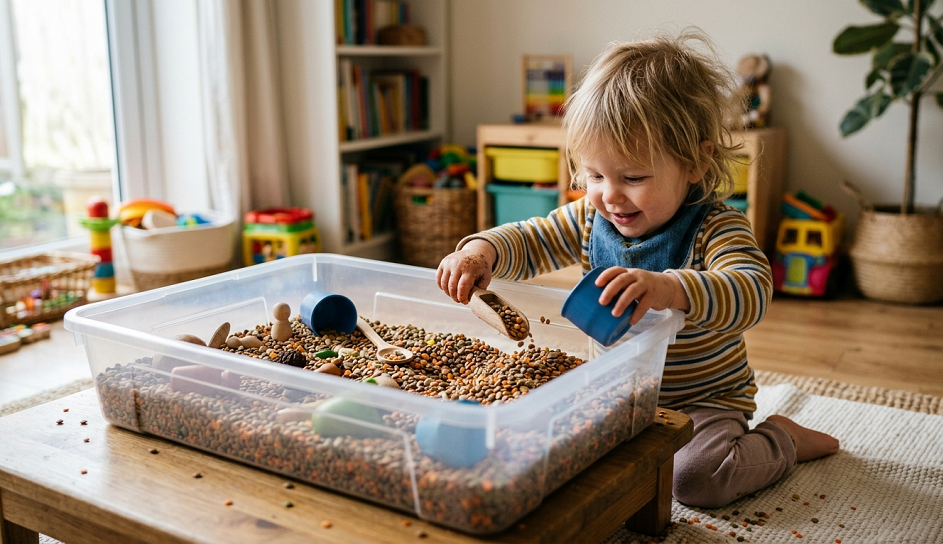
I used to think chickpeas were just for hummus, but Sarah proved me wrong during one rainy Tuesday when we were stuck inside. These legumes are, in my humble opinion, the gold standard of sensory fillers. They have a weight and a “clink” that rice simply can’t compete with. When they hit the bottom of a plastic bin, it sounds like music, not just a mess.
I’ve found that chickpeas are far superior because they don’t static-cling to everything. You can dye them with a little acrylic paint or food coloring and vinegar, and they hold the pigment beautifully. Unlike rice, which gets dusty and weirdly sticky if a child has damp hands, chickpeas stay smooth. They are also large enough for a toddler to actually grasp, which works those fine motor skills much harder than tiny grains.
When Maya was little, she would spend forty minutes—an eternity in toddler time—just pouring chickpeas from a metal pitcher into a funnel. The tactile feedback is incredible. They roll, they bounce just enough to be fun but not enough to disappear under the fridge, and they feel cool to the touch. It’s a grounding experience for a high-energy kid who needs to center themselves.
One tip I’ve discovered the hard way: don’t bother with the “shaking in a baggie” method for coloring them if you want vibrant results. Put them in a large bowl, add your pigment, and stir with a big spoon. It ensures every nook and cranny of the bean is covered. If you’re patient enough to let them dry overnight on a cookie sheet, they won’t stain your child’s hands, which is a victory in any parent’s book.
2. Whole Rolled Oats for Texture
I’m going to be very opinionated here: quick oats are a total waste of time. They turn into a powdery, sneezing mess within five minutes of play. However, thick, whole-rolled oats? That’s a different story. They have a soft, flaky texture that is incredibly soothing. When Leo was going through his “I must touch everything” phase, a bin of oats was the only thing that kept him from pulling the cat’s tail.
The beauty of oats is the “scoopability.” They hold their shape in a measuring cup much better than sand or rice. I like to hide “treasures” like small plastic dinosaurs or polished stones at the bottom. The kids have to sift through the layers, and the sound of the oats rustling is much quieter than other fillers, which is a godsend if you have a headache.
I’ve found that adding a sprinkle of cinnamon to the oats turns it into a multi-sensory experience. It smells like a bakery, and it’s completely taste-safe. This was vital when Maya was a “mouther”—you know, the kid who thinks everything is a snack. If she took a nibble of a cinnamon-scented oat, it wasn’t a trip to poison control; it was just a dry breakfast.
Cleaning up oats is also significantly easier than rice. They tend to clump together slightly due to their flat shape, so a quick sweep with a broom actually catches them. They don’t roll away like little marbles. If you have a child who struggles with loud noises, the “hush” of an oat bin is a much better choice than the clatter of hard beans or plastic beads.
3. Water Beads: The Sensory Giant
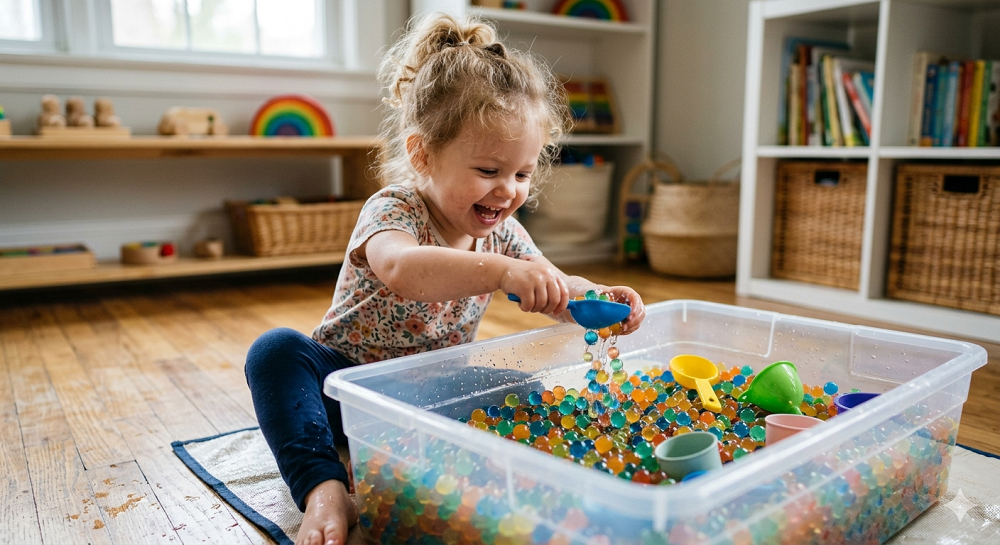
Some parents are terrified of water beads, and I get it. They look like candy and they bounce like rubber balls. But if your kids are past the “eating the toys” stage, water beads are a sensory experience that nothing else can replicate. They are squishy, slippery, and strangely addictive to touch. I’ve caught myself running my hands through them long after the kids went to bed.
I prefer the clear ones because you can play “I Spy.” If you fill a bin with clear beads and water, and then drop in some colorful waterproof toys, the toys “disappear” until the child reaches in to find them. It’s like a magic trick that teaches spatial awareness and object permanence. Sarah used to call them “dragon eggs,” and she’d spend hours sorting them by color using jumbo tweezers.
One thing I’ve learned the hard way: do not buy the cheapest brand you find online. The low-quality beads shatter into a jelly-like pulp the moment a kid squeezes them too hard. Spend the extra three dollars on the high-quality, “non-toxic” brands that have some structural integrity. You want them to be bouncy and firm, not a bin full of colorful mush.
Hydrating them is half the fun. Start them in the morning and let the kids watch them grow. It’s a science lesson disguised as play. Just a quick side note: never, ever wash these down the drain. Unless you want to pay a plumber a king’s ransom to remove a “jelly monster” from your pipes, always dispose of them in the trash or let them dehydrate back to their tiny size for storage.
4. Dried Pasta Shapes
Pasta is the most versatile tool in the parenting shed. I’m not talking about boring spaghetti; I’m talking about rotini, bowties (farfalle), and those giant shells. Each shape offers a different tactile sensation. The ridges on rotini are great for little fingers to explore, and bowties are perfect for “fancy” tea parties.
I’ve discovered that dyeing pasta is much more satisfying than dyeing rice. Because pasta has more surface area and interesting shapes, the colors look more vibrant. I once made a “rainbow galaxy” bin for Leo using purple, blue, and black dyed pasta with some glitter. He was mesmerized. The different shapes also make for excellent “sorting” games, which is a stealthy way to teach math skills.
Don’t just dump them in a bin and walk away. Give them tools. A pair of tongs and a piece of string can turn a bin of penne pasta into a jewelry-making station. This kept Maya busy for hours when I was trying to fold laundry. It builds that pincer grasp that is so important for later writing skills, and it costs about ninety-nine cents a box.
The sound of pasta is also distinct. It’s a “clack-clack” rather than a “tink-tink.” My kids always preferred the heavier sound of pasta hitting a wooden bowl. It feels more substantial. And if a few pieces escape the bin? They’re big enough to see and pick up easily. No more stepping on a stray grain of rice and wondering if it’s a crumb or a bug.
5. Kinetic Sand: The Clean Alternative
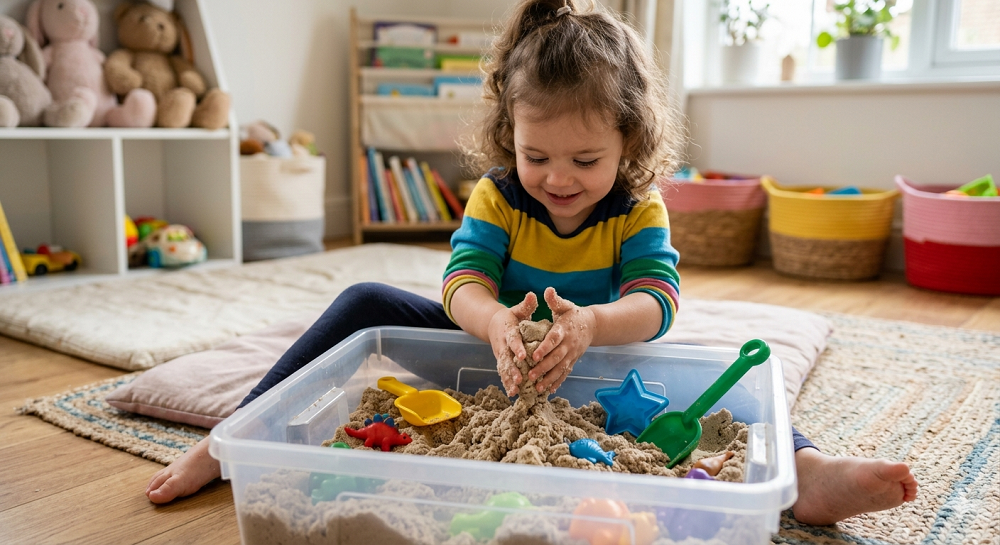
If you hate real sand because it gets in ears and under fingernails, kinetic sand is your new best friend. It’s “squeezable” sand that sticks to itself and nothing else. It feels like wet beach sand but stays dry to the touch. I’ve found that this is the best filler for kids who need a high level of sensory input but have “sensory defensiveness” toward messy textures.
I’m a firm believer that you should buy the name-brand version here. I tried a DIY recipe once involving flour and baby oil, and it was a greasy disaster that ruined a perfectly good Tupperware container. The real stuff has a “flow” to it that is almost hypnotic. When you cut it with a plastic knife, it crumbles in slow motion. It’s incredibly calming for a frustrated toddler.
In our house, the kinetic sand bin was the “construction site.” Leo would bring in his small excavators and dump trucks. Because the sand holds its shape, he could actually build roads and mounds that didn’t collapse immediately. It encouraged a level of complex play that loose fillers like rice just can’t provide.
A quick side note: keep the hair and pet fur away from this stuff. Because it’s slightly tacky, it will pick up every stray Golden Retriever hair in a five-mile radius. I kept ours in a bin with a very tight lid and made sure the kids washed their hands before they dove in. If you keep it clean, it lasts for years. We had the same batch through Sarah’s entire preschool era.
6. Dried Corn Kernels (Feed Corn)
Forget the popcorn kernels from the grocery store; go to a farm supply store and buy a bag of “deer corn” or feed corn. It’s dirt cheap and the kernels are much larger and more “rustic.” It has a beautiful golden color and a heavy, satisfying weight. I used this for what I called the “Autumn Bin,” and it was a seasonal staple in our home.
The texture of corn is very different from beans or rice. It’s flatter and has a smoother surface. It feels wonderful to run your hands through. Maya used to love “burying” her hands and then wiggling her fingers to feel the corn move against her skin. It provides a deep-pressure sensation that can be very regulating for kids who are feeling overwhelmed.
I’ve found that corn is the best filler for “farm” play. Add some plastic cows, a little fence, and a tractor, and you have a miniature world. The kids can “feed” the animals or transport the “crops.” It’s a fantastic way to encourage imaginative storytelling. Leo would narrate entire sagas of a farmer named Bob who was constantly losing his tractor in the corn.
One warning: feed corn can be a bit dusty. I always gave mine a quick rinse in a colander and let it dry in the sun before putting it in the bin. This removes that fine corn-dust that can make kids (and parents) sneeze. Once it’s clean, it’s a sturdy, long-lasting filler that can take a lot of abuse.
7. Shredded Paper and Crinkle Cut
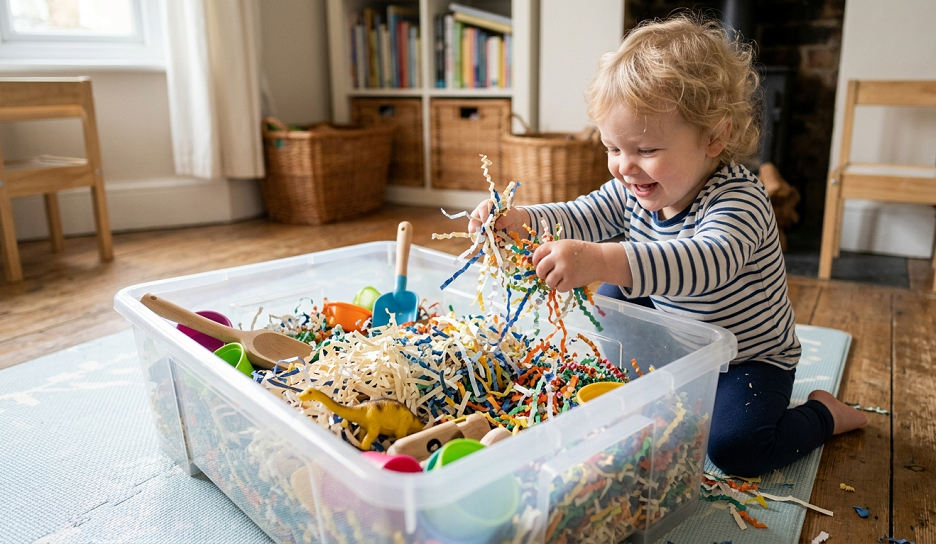
If you want a filler that is virtually weightless and entirely “mess-free” in the traditional sense, look no further than your paper shredder or the gift wrap aisle. Shredded paper, especially the “crinkle cut” variety used in gift baskets, is a blast. It’s bouncy, colorful, and creates a “nesting” environment that kids adore.
I used to go to the office supply store and buy the big bags of colorful crinkle paper. It’s a total waste of time to try and shred enough paper yourself to fill a bin; you’ll just burn out your shredder motor. The store-bought stuff is stiffer and holds its volume better. It’s perfect for a “bird’s nest” theme or a “jungle” theme with green paper.
Sarah loved this because she could hide things “deep” inside the paper. Unlike dense fillers, paper allows you to bury large items that a child has to “excavate.” We would hide “dinosaur eggs” (plastic Easter eggs) in the green shredded paper, and she would use a magnifying glass to find them. It’s a great way to practice visual tracking and focus.
The “Real Talk” here: paper is the easiest to clean up but the hardest to keep in the bin. It tends to “float” out as kids play. However, picking up a handful of paper strips is much easier than vacuuming up a thousand tiny seeds. If you’re having a “low energy” parenting day, the paper bin is the one to pull out. It’s low-stress and high-engagement.
8. Aquafaba Foam (Chickpea Water)
This is for the brave parents who don’t mind a little bit of a “wet” mess in exchange for pure, unadulterated joy. Aquafaba is the liquid left over in a can of chickpeas. If you whip it with a hand mixer and a little cream of tartar, it turns into a thick, stiff foam that looks exactly like shaving cream but is 100% edible and safe.
I’ve found that shaving cream is a bit of a gamble because it can irritate sensitive skin and stings if it gets in the eyes. Aquafaba foam is the superior alternative. It’s fluffy, it holds peaks, and you can dye it with food coloring. When Leo was two, he would sit at the kitchen table with a tray of this foam and just “paint” with his hands. It’s a massive sensory win.
To make it a true sensory bin, I’d put the foam in a large tub and add “ocean” animals or “cloud” figurines. The kids love the way the foam feels as it disappears between their fingers. It’s a fleeting texture—it doesn’t last forever—which actually teaches kids something about the temporary nature of certain things. It’s a “pop-up” play experience.
Yes, it’s sticky. Yes, you will need to wipe down the table and probably the floor. But the look of pure wonder on a child’s face when they realize they can “touch a cloud” is worth the five minutes of cleanup. I usually saved this for the day before I planned to mop the floors anyway. Work smarter, not harder.
9. Dried Lentils: The “Micro” Filler
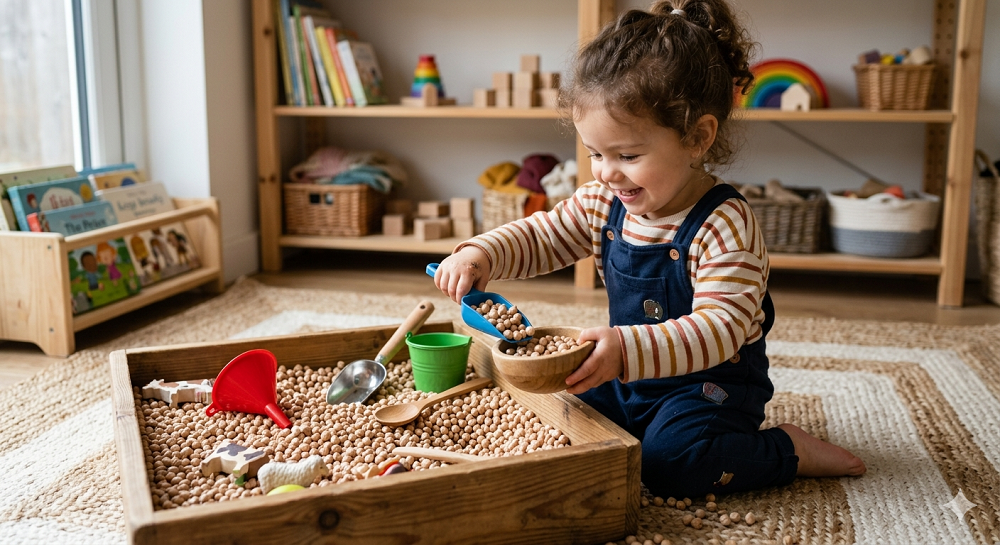
If you like the idea of a small grain but hate rice, lentils are your best bet. They are flat, disc-shaped, and have a very smooth texture. They come in beautiful natural colors—red, green, brown, and black. A “monochrome” bin of black lentils with some “space” toys and silver glitter is one of the most visually stunning things you can set up.
I’ve found that lentils pour more “fluidly” than rice. They act almost like a liquid when you have a lot of them. This makes them perfect for practicing pouring and measuring. Maya used to love using a funnel with lentils; they slide through so easily and make a gentle “patter” sound. It’s very meditative.
One reason I prefer lentils is their nutritional “safety.” While I don’t encourage kids to eat the fillers, lentils are a staple food. If a toddler decides to taste-test a handful of clean, dry lentils, it’s not the end of the world. They also don’t have the sharp “ends” that some long-grain rice can have, making them softer for very young skin.
The only downside is that they are small, so the “mess factor” is similar to rice. However, I’ve found that because they are flat, they don’t roll as far. They tend to stay where they land. I always put a large bedsheet under the sensory bin before we started. When play was over, I just gathered the corners of the sheet and poured the “escaped” lentils back into the bin.
10. Pom Poms of All Sizes
For a completely dry, soft, and quiet experience, go with pom poms. You can get bags of them in various sizes and colors at any craft store. They provide a “fuzzy” tactile experience that is the polar opposite of hard beans or sand. This was always our “quiet time” bin, used when someone was napping or when I needed twenty minutes of silence to drink my coffee.
I used to give the girls “fine motor” challenges with pom poms. I’d provide an empty ice cube tray and a pair of tongs, and they would have to sort the pom poms by color or size into the slots. It sounds simple, but for a preschooler, it’s an engaging puzzle. It builds hand-eye coordination and patience.
I’ve found that pom poms are the best filler for “imaginary cooking.” They become “meatballs” or “blueberries” or “scoops of ice cream” in a heartbeat. Leo would use a ladle to serve up “pom-pom soup” to his sisters. Because they are so light, they are also very safe—no one is going to get hurt if a “meatball” gets tossed across the room.
The “Real Talk” on pom poms: they get dirty. They pick up dust and hair, and you can’t really “wash” them easily without them losing their fluff. My rule was that pom poms stayed on the rug and hands had to be clean. If you treat them like a “special” filler rather than an everyday one, they stay fresh much longer.
11. Polished River Stones
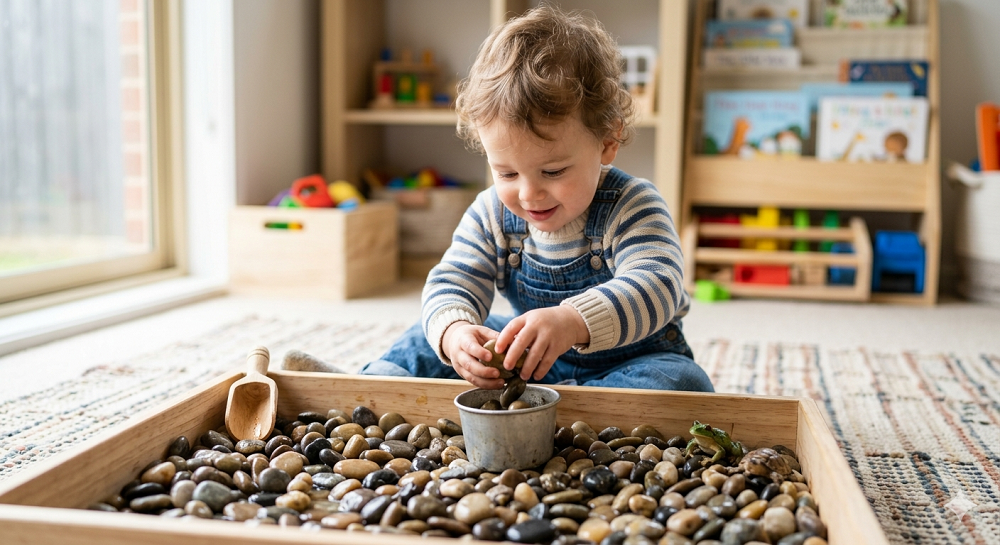
This is a “bonus” filler because it’s a bit different. Polished river stones (the kind you find in the floral section or at a landscape supply store) are heavy, cold, and incredibly smooth. They provide a “grounding” sensory experience that is very different from anything else on this list. They have a “thump” and a “weight” that kids find fascinating.
I’ve found that these are best for older toddlers and preschoolers who are interested in “treasure hunts.” We would hide “gold” (yellow painted stones) among the natural grey and brown stones. The kids would use a metal sifter to find the gold. The clink of stone on metal is a very distinct, “heavy” sound that really grabs their attention.
You can also use these for “water play.” Unlike most of the other fillers, stones can get wet. I’d fill a bin with stones and just an inch or two of water. It becomes a “creek bed.” Sarah and Maya would spend ages washing the stones or building “dams.” It’s a rugged, natural way to play that feels a bit like being outdoors even when you’re stuck in the kitchen.
One side note: stones are heavy. Don’t fill a giant bin with them, or you’ll never be able to move it. Use a smaller container, and always supervise. A flying stone is much more dangerous than a flying pom pom. But for focused, grounded play, there is nothing better than the cool, smooth surface of a river rock.
The Real Talk: What’s Not Worth Your Time
I’m going to be brutally honest with you: avoid dyed salt. People swear by it on Pinterest because it’s cheap and colorful, but it is a nightmare. It’s abrasive on little hands, it gets into every tiny scratch or hangnail and stings like crazy, and it creates a “dust” that coats everything in your house. It’s also a disaster if it gets in a child’s eyes. I tried it once with Sarah, and within ten minutes, she was crying and I was scrubbing the table with a wet rag. Never again.
Also, don’t bother with unpopped popcorn. It’s loud, it’s a major choking hazard for the little ones, and it’s surprisingly sharp. If a kid steps on a popcorn kernel, it’s like stepping on a Lego. Stick to the feed corn or the chickpeas; your feet will thank you.
Lastly, don’t feel like you have to make these bins look like a professional art installation. I see these “Instagram-worthy” bins with perfectly layered colors and expensive wooden toys, and I just laugh. My kids were happiest when I gave them a bin of plain chickpeas and a couple of old measuring cups from the kitchen. The “extra” stuff is for us; the “play” is for them.
Parting Wisdom
Parenting is a series of experiments. Some days the experiment ends with a child who is peacefully engaged for an hour, and some days it ends with you vacuuming the ceiling. Both are okay. You aren’t failing if the bin ends up on the floor; you’re just gathering data for the next time.
The goal of sensory play isn’t just “quiet time” for you (though that’s a nice perk). It’s about letting your child explore the physical world in a safe, contained way. Whether it’s the squish of aquafaba or the clatter of chickpeas, you’re giving them the building blocks of curiosity.
Which of these fillers are you most excited to try—or which one do you think your “mess-maker” will love the most? Let me know in the comments below, and let’s swap some more “tried and true” parenting hacks!