
The day Maya decided her afternoon nap was a relic of her “baby days” was the day I realized my afternoon coffee was no longer a luxury—it was a survival requirement. I remember standing in the hallway, watching her bounce a rubber ball against the baseboards while Sarah and Leo finally slept, and feeling that rising tide of panic. My “me time” had evaporated.
If you are currently staring at a toddler who has traded their midday slumber for endless energy, take a deep breath. You aren’t failing, and your house doesn’t have to become a permanent circus. We transitioned from naps to “Quiet Time,” a sacred hour where bodies stay calm, even if eyes stay open. Here are the 11 activities that actually saved my sanity and kept my three from tearing the wallpaper down.
1. Low-Mess Sensory Bins for Focus
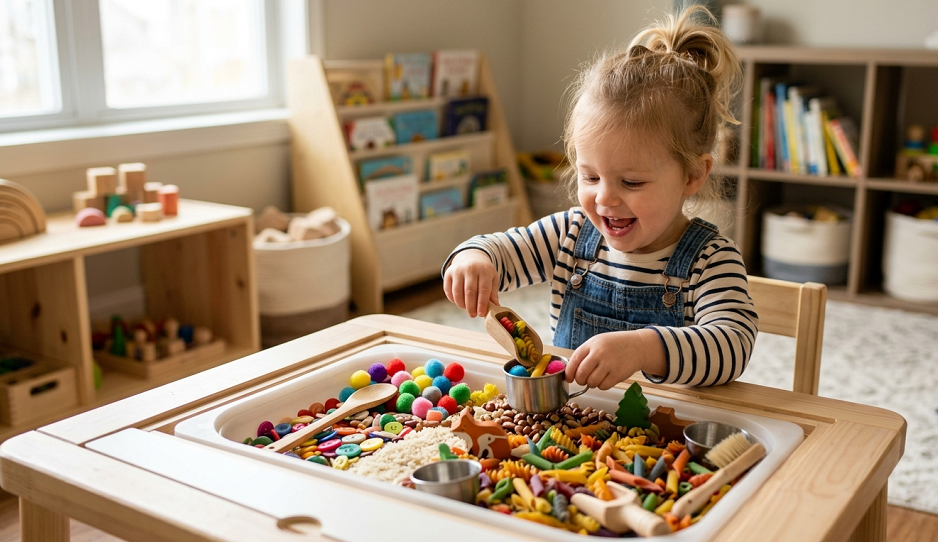
I used to think sensory bins were a scam invented by people who loved vacuuming. I’ve found that high-maintenance bins with glitter or tiny beads are a total waste of time, even if they look like the easier option for engagement. Instead, I discovered the hard way that simple, dry ingredients truly work if you’re patient enough to set the ground rules first.
For my son Leo, a bin of dried chickpeas and a few plastic construction trucks was the gold standard. He would sit for forty-five minutes just “transporting” the beans from one corner to the other. The weight of the beans and the sound they make against the plastic is oddly grounding for a kid who is buzzing with post-nap adrenaline.
The trick is the container. Don’t use a shallow tray; get a deep plastic storage tub. It keeps the “ingredients” inside the walls. I always laid down an old bedsheet underneath, telling him that if the beans left the sheet, the bin went back into the closet. Boundaries are the only thing that make sensory play possible in a quiet house.
If you’re worried about the mess, start with something even simpler like large pom-poms and a pair of kitchen tongs. It builds fine motor skills and keeps their hands busy while their brain processes the day. It’s quiet, it’s contained, and it gives you enough time to actually finish a chapter of a book or a hot cup of tea.
2. Audio Stories and Picture Book Pairing
When Sarah stopped napping, she still needed the “downshift” that sleep provided, but her brain wouldn’t turn off. I tried just giving her books, but she’d flip through them in three minutes and be back at my bedroom door. The game-changer was pairing a physical picture book with an audio recording of that exact story.
There is something magical about a toddler sitting on their bed, following along with the pages as a narrator speaks. It builds literacy, but more importantly, it creates a “sound bubble” that keeps them in one spot. We used an old CD player back then, but today you have endless options for kid-friendly speakers.
I strongly recommend avoiding screens for this. A tablet might seem like the easy route, but it overstimulates the very part of the brain we are trying to soothe. A simple audio player allows them to use their imagination to fill in the gaps. They aren’t just watching a story; they are living it in their mind’s eye.
Make a “Quiet Time Playlist” that lasts exactly sixty minutes. Tell your little one that they can come out when the music or the stories stop. It gives them a concrete sense of time, which toddlers desperately need since they can’t yet read a clock. It turns a “timeout” feeling into a special listening session.
3. The “Sticker Station” Strategy
Stickers are the unsung heroes of the parenting world. I used to buy those expensive “reusable” sticker books, but they usually lost their stickiness after two days. I’ve found that a plain roll of painter’s tape and a cheap pack of 1,000 stickers from the craft store is infinitely more effective.
I would take a large piece of cardboard or even just the back of a cereal box and draw “zones” on it with a marker. One zone for red stickers, one for blue, or one for “animals.” It gives the toddler a mission. A toddler with a mission is a toddler who isn’t asking you for a snack every thirty seconds.
For Maya, the tactile sensation of peeling the sticker off the sheet was half the fun. It’s excellent for developing those tiny finger muscles. If they struggle to get the stickers off, here’s a pro-tip: peel off the “background” sticky part of the sheet so only the individual stickers remain. It makes it much easier for frustrated little hands.
Eventually, this evolved into “Sticker Art Gallery” where she would decorate the inside of a large moving box. She could sit inside her “house” and decorate the walls to her heart’s content. It’s a low-cost, high-engagement activity that requires zero hovering from you, which is the ultimate goal of quiet time.
4. Magnetic Tile Building Challenges
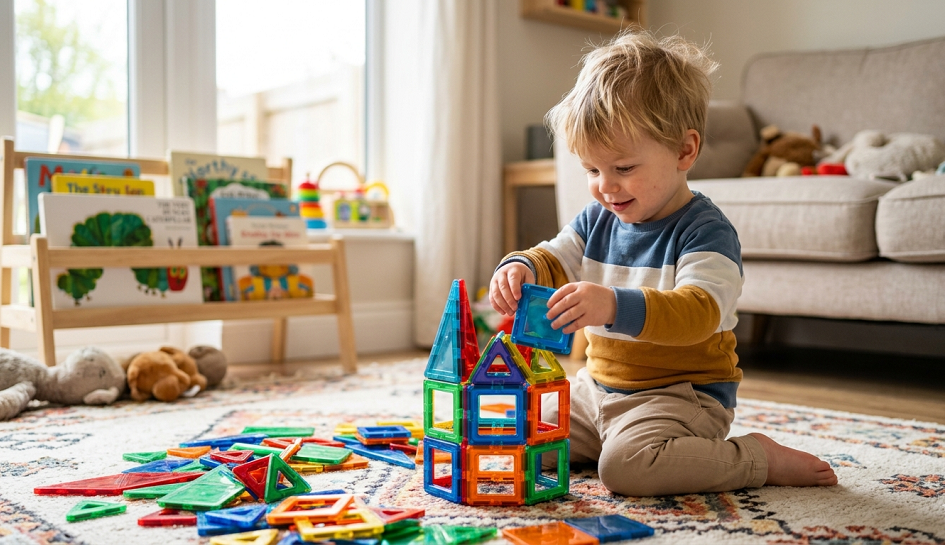
If I could only keep one toy from my kids’ childhood, it would be magnetic tiles. They are the only toy that all three of my children—Sarah, Maya, and Leo—played with consistently for years. They are quiet, they don’t hurt as much as Legos when you step on them, and they encourage independent problem-solving.
During quiet time, I would give them a “prompt” to prevent the “I don’t know what to build” whine. I’d say, “Can you build a garage for your three fastest cars?” or “Can you build a castle for the plastic dinosaurs?” Giving them a starting point focuses their energy immediately so they don’t wander.
I’ve found that keeping these tiles only for quiet time makes them feel like a special treat. If they are in the toy box all day, they lose their luster. But if they only come out when the “Quiet Time” sign goes up on the door, the kids are actually excited for the transition.
These tiles also teach basic physics and geometry without the kid even knowing they’re learning. They figure out that a tall tower needs a wide base, and they learn how to handle frustration when a structure collapses. It’s a quiet, meditative process that keeps them seated and focused.
5. Water Painting on Construction Paper
Water play is usually a high-stress activity for parents, but “painting with water” is the exception. All you need is a small cup of water, a few different sized paintbrushes, and several sheets of dark-colored construction paper. When the water hits the paper, it turns dark, making it look like real paint.
The beauty of this is that as the paper dries, the “art” disappears, leaving a blank canvas to start all over again. It’s the ultimate “reset” activity. My kids loved seeing their handprints appear and then slowly vanish. It’s rhythmic, calming, and completely stain-free.
I used to set Sarah up at the kitchen table while I did the dishes nearby, but eventually, I moved her to a small desk in her room. This taught her that she could be creative without me being her audience. Quiet time is as much about teaching them to enjoy their own company as it is about the actual activity.
If they get bored with just water, you can add a tiny drop of food coloring, but honestly, the “magic” of the disappearing water is usually enough. It’s a silent activity that requires a steady hand, which naturally slows down a hyperactive toddler.
6. Sorting and Cataloging “Treasures”
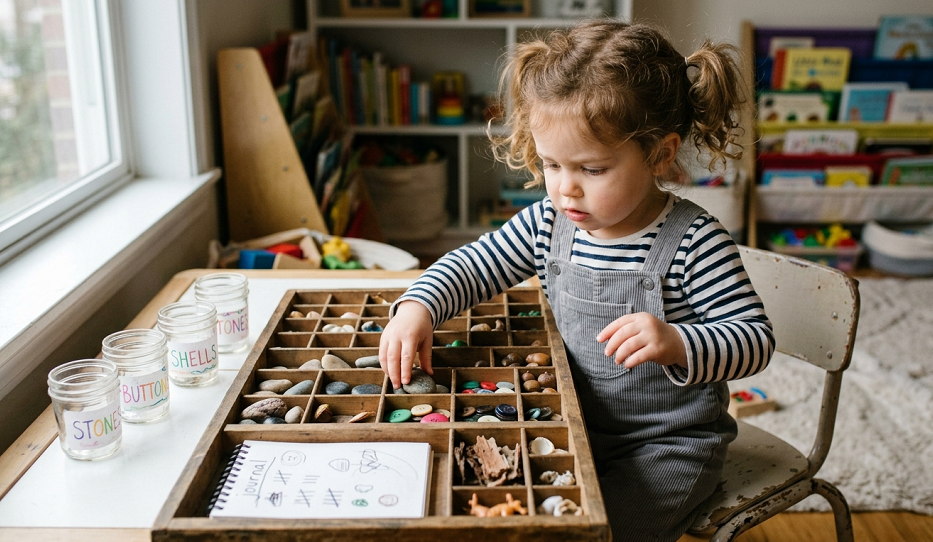
Toddlers are natural collectors. Whether it’s smooth stones from the driveway, buttons, or plastic bottle caps, they love to categorize things. I discovered that a muffin tin is the perfect “sorting station” for a child who has stopped napping.
I would give Leo a big jar of mismatched buttons (the ones you get in the “spare” kits with clothes) and ask him to sort them by color, size, or number of holes. It’s a quiet, repetitive task that is incredibly soothing for a young brain. It’s like a form of toddler meditation.
Don’t worry if they don’t follow your rules perfectly. If they want to sort by “the ones I like” and “the ones I don’t like,” let them. The goal isn’t mathematical accuracy; the goal is sustained, quiet focus. It keeps their hands busy and their mouths shut while you get a moment of peace.
Quick Side Note: Always ensure the objects are large enough to not be a choking hazard if your toddler is still in the “everything goes in the mouth” phase. Safety first, even in quiet time.
7. Window Art with Washable Markers
If you have a glass sliding door or a low window, you have a giant canvas. There are specific “window markers” that are completely washable and designed for glass. Maya spent hours drawing “gardens” on the glass door while I sat on the sofa nearby.
There’s something about drawing on a vertical surface that is more engaging for kids than sitting at a desk. It uses different muscle groups and gives them a sense of “rule-breaking” because we usually tell them not to draw on the house. Being allowed to draw on the window feels like a huge win for them.
When quiet time is over, the “clean up” can actually be part of the fun. Give them a spray bottle with a little water and a microfiber cloth. Most toddlers love spraying water, and they’ll happily wipe the window clean, which is a secret way to get them to help with chores.
I’ve found that this is a great way to transition back into the “active” part of the day. They spend 30 minutes drawing quietly, and then 10 minutes helping you “clean the gallery.” It’s a productive cycle that feels rewarding for everyone involved.
8. The “Magic” Discovery Box
This was my secret weapon for the days when nothing else worked. I had a shoebox hidden on top of the refrigerator. Inside were things that weren’t “toys” in the traditional sense—an old calculator, a magnifying glass, a compass, and some velvet fabric scraps.
Every few days, I would swap out one or two items. The novelty of the “Discovery Box” was enough to buy me at least twenty minutes of silence. Toddlers are fascinated by adult objects. Pressing the buttons on a dead calculator or looking at their own thumb through a magnifying glass is high-level entertainment.
I’ve found that the more “real” the items feel, the longer they play. A plastic “toy” phone doesn’t hold a candle to an old, disconnected flip phone from 2005. They want to mimic us. They want to feel like they are doing “important work” during their quiet time.
The rule was simple: the Discovery Box stayed in the bed or on the rug. If they started throwing the items, the box went back to the “magic” spot on the fridge. It’s about teaching them that quiet time is a privilege that comes with the responsibility of being gentle.
9. Pipe Cleaner and Colander Sculpture
This is one of those activities that sounds too simple to work, but it’s a powerhouse for concentration. Give your toddler a metal kitchen colander and a pack of colorful pipe cleaners. Show them how to poke the pipe cleaners through the holes to create “hair” or “spiders.”
Leo would get lost in this for ages. It requires a lot of hand-eye coordination to get those fuzzy wires through the tiny holes. It’s silent, it’s cheap, and it’s surprisingly creative. He would eventually weave them into complex colorful webs that he was so proud of.
I’ve found that this is particularly good for the “fidgety” kid. If your child is the type who can’t sit still, this gives them a way to move their hands with precision. It channels that physical energy into a small, controlled space.
When they’re done, the pipe cleaners are easy to pull out and store for next time. It’s zero-waste and takes up almost no space in your cabinet. It’s the kind of “MacGyver” parenting tip that keeps us all afloat.
10. Shadow Puppet Theater
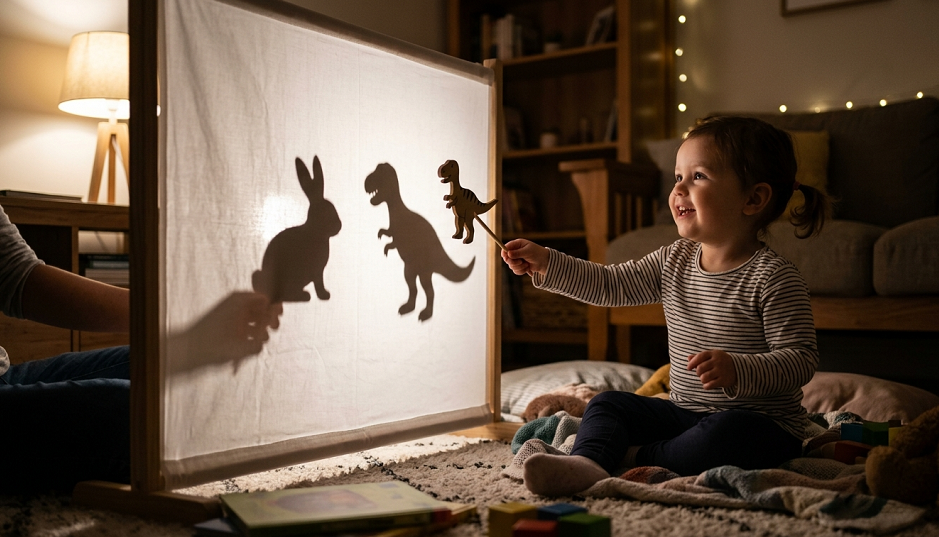
If your toddler’s room can get dark during the day, a flashlight can be a portal to another world. I used to give Sarah a small, kid-safe LED flashlight and let her make “shadow shapes” on the ceiling. It’s an activity that essentially forces them to lie down.
You can’t make good shadow puppets if you’re running around the room. You have to be still to get the angles right. Sometimes I would tape a few shapes (like a star or a moon) onto the end of the flashlight so she could project “constellations” onto her walls.
This is the closest thing to a nap without actually sleeping. The darkness and the soft light are very hypnotic. It lowers the heart rate and calms the nervous system. Even if they don’t fall asleep, they are getting the physical rest their growing bodies need.
I’ve found that this works best if you set the stage. Call it “The Light Show” rather than “Quiet Time.” Making it sound like a special event makes them much more likely to cooperate with the “no getting out of bed” rule.
11. Puzzle Time (with a Twist)
Puzzles are a quiet time staple, but a toddler who is bored will just throw the pieces. I’ve found that “Hide and Seek” puzzles are the way to go. I would hide the pieces of a wooden chunky puzzle around their room (in obvious spots) before quiet time started.
The “task” was to find all the pieces and complete the puzzle while staying “as quiet as a mouse.” It turns a sedentary activity into a slow, methodical scavenger hunt. It burns off a little bit of that physical energy but keeps the volume level at a minimum.
For Leo, I’d use a 12-piece floor puzzle. For Sarah, who was more meticulous, I’d give her two different puzzles mixed together so she had to sort them first. It’s all about matching the challenge to the child’s specific temperament.
If they finish early, have a “backup” puzzle ready. But I’ve found that the “search” part of the game usually takes up the bulk of the time. It’s a brilliant way to keep them moving without them actually “running.”
The Real Talk: What Isn’t Worth Your Effort
I’m going to be blunt: do not bother with “elaborate” crafts that require you to be there to help. If the activity starts with “First, help your child cut out…” it is not a quiet time activity. It’s a chore for you. Quiet time is for your recovery as much as theirs. If you have to sit there and manage it, nobody is resting.
Also, stay away from toys that make noise. I know that sounds obvious, but even those “educational” toys that beep and boop will eventually grate on your nerves when you’re trying to have a moment of silence. If it has a battery, it’s probably not a quiet time toy.
Lastly, don’t expect perfection on day one. I spent the first week of Maya’s “Quiet Time” just walking her back to her room every five minutes. It was exhausting. I almost gave up and just let her watch TV, but I’m so glad I stuck it out. I discovered the hard way that if you cave and turn on the cartoons, they will never learn to entertain themselves. Be firm. The quiet is worth the struggle.
Parting Wisdom
Transitioning away from naps feels like the end of an era, and in a way, it is. But it’s also the beginning of a beautiful new phase where your child learns that they are capable of being alone with their thoughts. You aren’t “abandoning” them in their room; you are gifting them the skill of self-regulation.
Start small—maybe just fifteen minutes of quiet time—and build up to an hour. Celebrate the small wins, and don’t beat yourself up if some days end in a tantrum. We’ve all been there. My three are all in college now, and they still value their “quiet time.” You’re building habits that last a lifetime.
What was the one toy or activity that finally gave you 20 minutes of peace today? Drop your suggestions or questions in the comment box below—I’d love to hear how your transition is going!