
I remember the afternoon I sat on my kitchen floor, surrounded by a mountain of laundry and three very bored, very energetic toddlers. Sarah was trying to climb the pantry shelves, Maya was using a wooden spoon to drum on the dishwasher, and little Leo was moments away from seeing if the cat’s tail was detachable. I felt like I was failing. I thought I needed those expensive, wooden sensory boards and fancy Montessori kits to help them develop their coordination.
The truth is, those pricey toys often ended up gathering dust under the couch. I eventually realized that my junk drawer was a goldmine for building hand strength and focus. You don’t need a massive budget to help your kids master their pincer grasp or bilateral coordination. You just need a bit of patience and a willingness to let your kitchen get a little messy. Here are 15 activities that actually work, tried and tested in the trenches of my own home.
1. The Classic Kitchen Colander and Pipe Cleaner Challenge
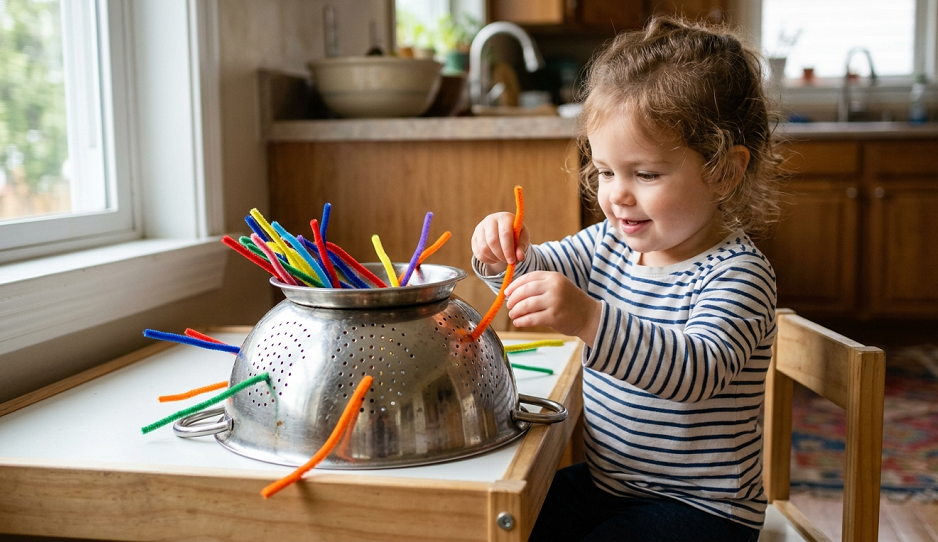
This was my absolute “go-to” when I needed fifteen minutes of peace to drink a lukewarm cup of coffee. I’ve seen some parents suggest using dry spaghetti for this, but I think that’s a mistake. Spaghetti snaps, creates a crumbly mess, and leads to frustration tears. Pipe cleaners are the superior choice because they are tactile, reusable, and offer just enough resistance to keep those little fingers working hard.
To set this up, simply flip a metal or plastic colander upside down on the floor or a high-chair tray. Hand your child a bundle of colorful pipe cleaners and show them how to poke the ends through the small holes. It sounds simple to us, but for a toddler, aligning that fuzzy wire with a tiny hole requires incredible hand-eye coordination.
As they get more confident, I like to encourage them to weave the pipe cleaners through multiple holes to create “bridges” or “rainbows.” This introduces the concept of over-and-under, which is a precursor to sewing and shoe-tying. It’s a quiet, focused activity that builds the intrinsic muscles of the hand without a single screen in sight.
One quick side note: if your colander has sharp metal edges around the holes, skip it. I learned that the hard way when Maya got a tiny scratch. Stick to smooth plastic or high-quality stainless steel that won’t snag.
2. Pincer Grasp Practice with Muffin Tins and Pom-Poms
Developing the pincer grasp—the ability to pick things up with the thumb and index finger—is the foundation for writing. I’ve found that using a standard 12-cup muffin tin is the most effective way to organize this practice. It provides clear boundaries and a sense of “completion” once every hole is filled.
I prefer using soft craft pom-poms because they come in various sizes. Start with the large ones and move to the tiny ones as your child’s precision improves. If you don’t have pom-poms, cotton balls work in a pinch, though they can be a bit “sticky” on dry skin. I’ve seen people try to use cereal for this, but honestly, my kids just ended up eating the supplies, which defeated the purpose of the activity.
To level this up for older toddlers, give them a pair of kitchen tongs or even a large set of tweezers. Using a tool adds a layer of complexity because they have to maintain pressure to hold the item while moving it. I watched Leo spend forty minutes straight moving “blue berries” (blue pom-poms) from one tin to another using my salad tongs.
The beauty of the muffin tin is the sorting potential. You can ask them to put only red ones in one row and yellow in another. This works on cognitive categorization alongside physical dexterity. It’s a double-win for a busy parent.
3. Water Transfer with Sponges and Bowls
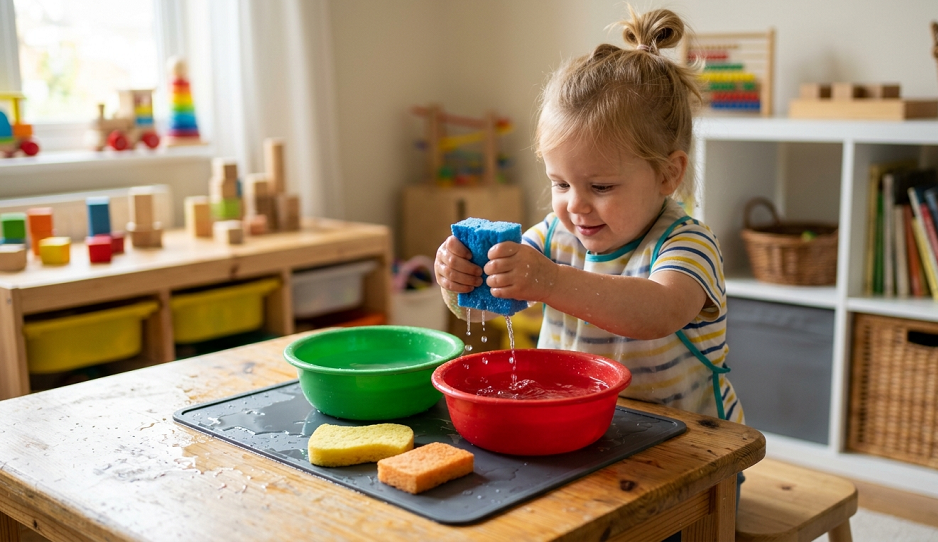
Most “expert” blogs will tell you to use eyedroppers for water play. I think eyedroppers are a total waste of time for younger kids who haven’t mastered the squeeze-and-release mechanic yet. It’s too fiddly and leads to more water on the floor than in the cup. Instead, start with a simple kitchen sponge.
Fill one bowl with water (add a drop of food coloring if you want to be “extra”) and leave another bowl empty. Show your child how to soak the sponge in the full bowl, lift it over the empty one, and squeeze with both hands. This is fantastic for bilateral coordination and building the larger muscles in the forearms and wrists.
My Sarah used to treat this like a high-stakes mission. She would get so focused on making sure “not a single drop” was wasted. Eventually, as they get stronger, you can cut the sponge into smaller squares. This forces them to use their fingertips rather than their whole palm to get the water out.
Yes, there will be splashes. I always put a thick beach towel down under the bowls. It’s much easier to toss a towel in the dryer than it is to stress about the hardwood floors. Letting them make a controlled mess is part of the “gentle” approach—it teaches them that mistakes are part of the process.
4. Penny Drop and Coin Bank Coordination
I am a big believer in the “Penny Drop” for teaching precision. You don’t need a real piggy bank for this. In fact, a plastic yogurt container or an old coffee tin with a slit cut in the lid works better because the “clink” sound is more satisfying. The auditory feedback tells the child they were successful.
Picking up a flat coin from a hard surface is a genuine physical challenge for a three-year-old. They have to use their nails or slide the coin to the edge of the table. Once they have it, rotating it to fit into a narrow vertical or horizontal slot requires excellent spatial awareness and finger manipulation.
I used to sit with Maya and talk about the “heads” and “tails” while she worked. It turned a motor-skill drill into a bonding moment. We would count the coins as they dropped, which snuck in some early math skills. It’s amazing how such a simple, free activity can hold their attention for so long.
A word of caution: obviously, coins are a choking hazard. I never let my kids do this unsupervised until they were much older. If your child still puts everything in their mouth, swap the pennies for large plastic buttons or those flat glass floral marbles—though even those require a watchful eye.
5. Threading with Pasta and Shoelaces
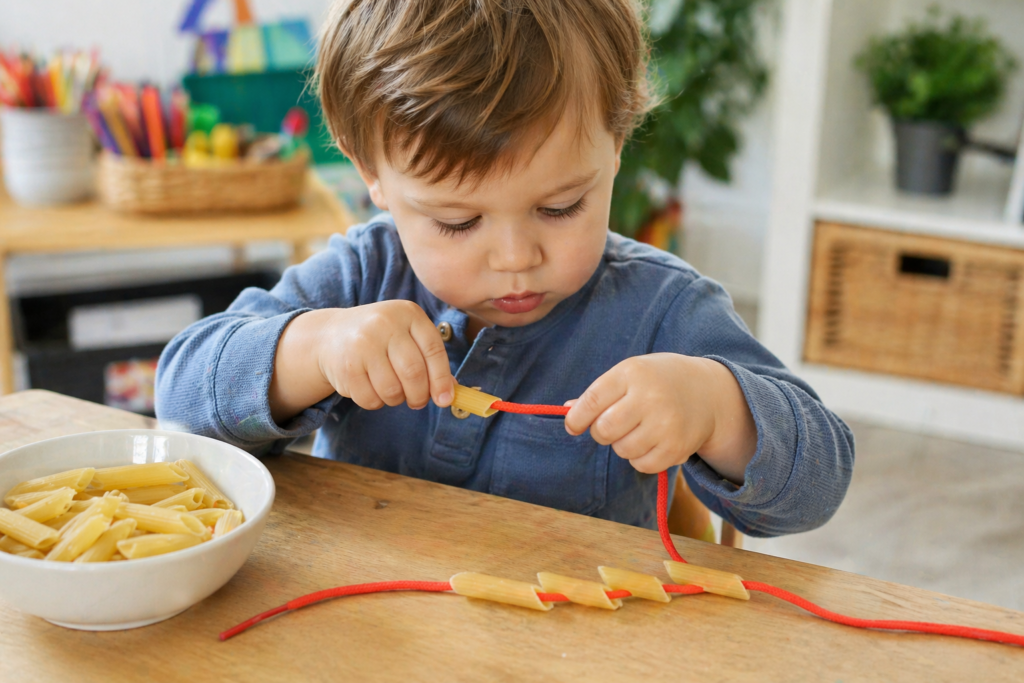
Forget buying expensive bead-stringing kits. Go to your pantry and grab a box of Penne or Rigatoni. These are perfect because the “beads” are large, sturdy, and have a wide hole. Use a clean shoelace (the stiff plastic tip, the aglet, makes it much easier to thread) or a piece of yarn with a bit of tape wrapped around the end.
I’ve found that using yarn without the tape tip is an exercise in futility. The yarn frays, the child gets frustrated, and the “peaceful” activity turns into a meltdown. Taking thirty seconds to wrap a bit of Scotch tape around the end of the string will save your afternoon.
Once the pasta is on the string, you can let them paint the “beads” or just wear the necklace as is. Leo used to wear his “noodle trophy” around the house all day. It’s a great way for them to practice using their dominant hand to guide the string while the non-dominant hand holds the pasta steady.
If you’re feeling ambitious, you can dye the pasta beforehand using vinegar and food coloring, but honestly, plain pasta works just as well. The goal is the movement, not the aesthetic. Don’t let Pinterest-perfect photos make you feel like your kid’s plain tan pasta necklace isn’t a masterpiece of motor development.
6. Cardboard Box “Post Office” and Slot Play
Don’t throw away your shipping boxes! They are the ultimate parenting tool. I used to take a medium-sized box and cut various shapes and slots into the lid. One skinny slot for “mail” (old playing cards or junk mail envelopes) and one round hole for “parcels” (tennis balls or rolled-up socks).
Sliding a playing card into a thin slit requires a level of “steady-hand” control that many kids lack initially. They have to align the card perfectly. I’ve found that using old decks of cards is brilliant because the cards are slightly slippery, making them even more of a challenge to grip firmly.
My kids loved playing “Postman.” I’d give them a bag full of “letters,” and they would deliver them to the box. It turns the physical exercise into a role-playing game. When the box was full, they’d open the lid, dump it out, and start over. It’s the toddler version of “Sisyphus,” and they absolutely love it.
One quick side note: if you have multiple children, give them each their own box. Sarah and Maya used to fight over who got to “post” the letter next, which resulted in a torn box and two crying girls. Two boxes, two sets of cards, and one happy mother.
7. Sticker Peeling and Art Creation
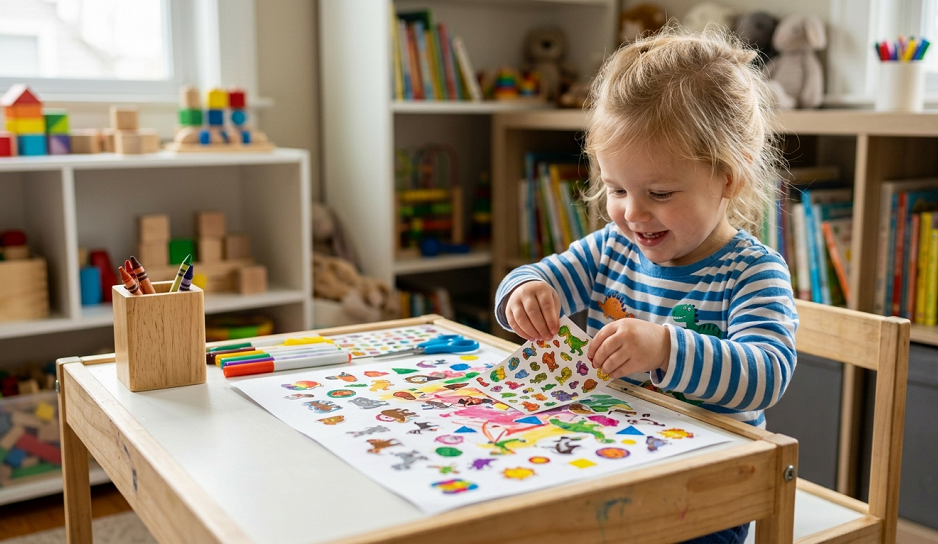
Stickers are one of the most underrated tools for fine motor development. The act of pinching the edge of a sticker and peeling it off the backing is incredibly difficult for small hands. I used to struggle with this because my kids would get frustrated when they couldn’t get the sticker up.
Here is my secret “pro-tip”: peel off the “negative” part of the sticker sheet—the sticky background that surrounds the actual stickers. This leaves the stickers isolated on the shiny backing, making it much easier for little fingers to get under the edges. It removes the barrier to entry and lets them focus on the placement.
I would draw a large circle or a path on a piece of paper and tell the kids to “follow the line” with the stickers. This adds a layer of visual-motor integration. They aren’t just sticking them anywhere; they are aiming for a specific target.
I found that cheap, basic paper stickers are better than the puffy ones or the 3D ones for this specific skill. The thinness of the paper sticker requires more precision. Plus, if they end up stuck to the carpet, the cheap ones are usually easier to scrape off!
8. Squirt Bottle “Car Wash” or Garden Watering
If you want to strengthen the muscles in the palm and fingers, nothing beats a trigger-pull spray bottle. I used to fill a few old (thoroughly cleaned!) cleaning bottles with plain water and take the kids outside. We would have a “toy car wash” where they’d spray down their plastic trucks and wipe them with a cloth.
The pulling motion of the trigger is quite heavy for a toddler, so they often have to use two hands at first. That’s okay! Eventually, they’ll develop the strength to do it with one. It’s the same muscle group used for cutting with scissors later on.
In the summer, I’d tell them they were “cooling down the driveway” or watering the flowers. It kept them occupied for ages. I’ve found that the “mist” setting is more fun for them, but the “stream” setting requires more intentional aiming.
Avoid the tiny travel-sized spray bottles. They are actually harder to use because the trigger is too small for a child’s hand to get a good grip. Stick to the standard-sized bottles, but only fill them halfway so they aren’t too heavy for the child to lift.
9. Tape Peeling and “Rescuing” Toys
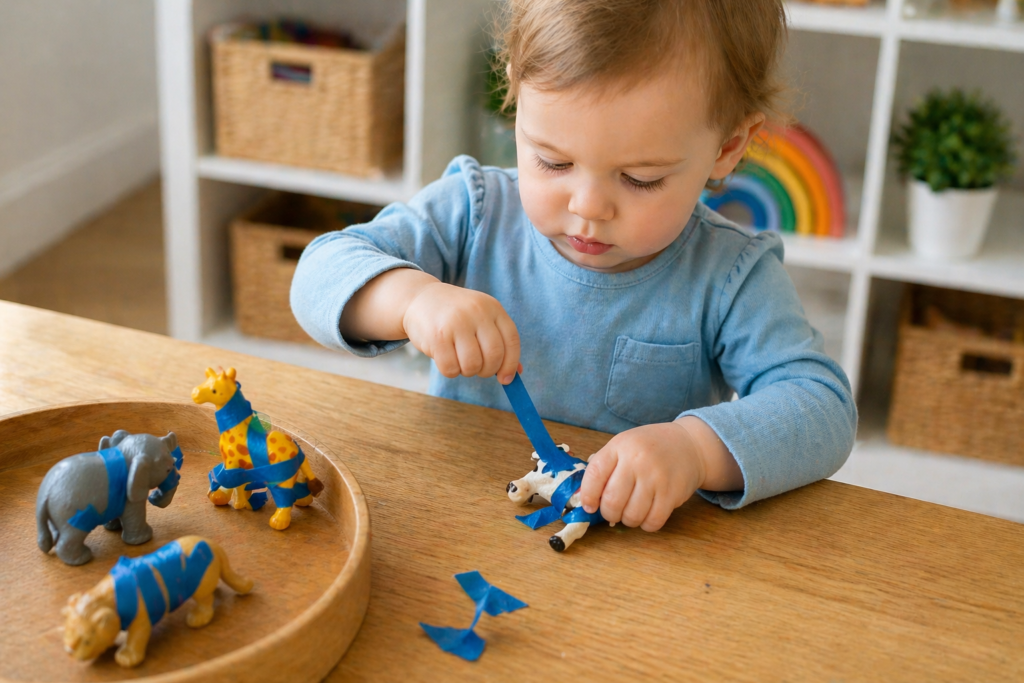
This is a fantastic activity for when you are stuck indoors on a rainy day. I would take a few of the kids’ plastic animals or toy cars and “trap” them on a baking sheet or a table using strips of masking tape or painter’s tape. The mission? The kids had to “rescue” their friends by peeling the tape off.
Painter’s tape is the best for this because it doesn’t leave a sticky residue on the toys or the furniture. I tried duct tape once when I was out of the blue stuff, and it was a disaster. It was too strong for the kids to peel, and it ruined the paint on a toy truck. Stick to the low-tack stuff.
The kids have to use their fingernails to find the edge of the tape and then pull it back. This builds finger strength and persistence. It’s a very satisfying task because there is a clear “before” and “after.”
I’d often make the “traps” more complex for Sarah as she got older, crisscrossing the tape so she had to figure out which piece to peel first. It’s a logic puzzle and a motor skill activity rolled into one. Leo just liked the ripping sound the tape made.
10. Sorting Beans with Kitchen Tongs
Dried beans are a staple in any sensory bin, but using them for sorting is where the real motor work happens. I like to mix together kidney beans, black beans, and chickpeas in a large bowl. Then, I provide several smaller ramekins or cups for the kids to sort them into.
I’ve seen people suggest using spoons for this, but I think tongs are far superior. Spoons are about balance, but tongs are about controlled pressure. If you squeeze too hard, the bean shoots across the room (which is funny, but counterproductive). If you don’t squeeze enough, you drop it.
Teaching a child to find that “middle ground” of pressure is a huge milestone. It’s the same skill they’ll need when they start holding a pencil—gripping it firmly enough to write, but not so hard that their hand cramps or the lead breaks.
Just be prepared for the cleanup. No matter how “gentle” your parenting is, a bowl of beans will eventually end up on the floor. I made a rule that the “game” wasn’t over until every bean was back in its jar. It taught them responsibility while giving them one last chance to practice their pincer grasp picking the beans up off the tile.
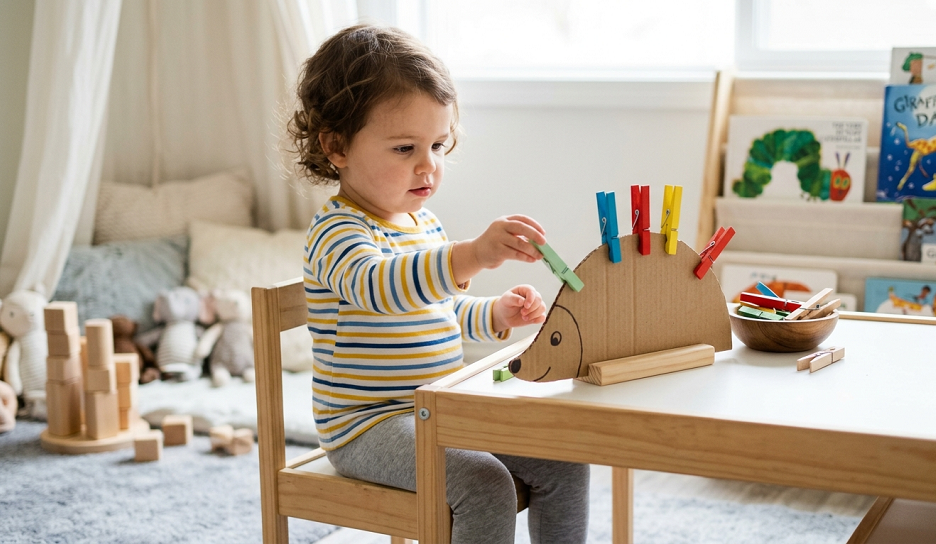
11. Clothespin “Hedgehogs” and Strength Building
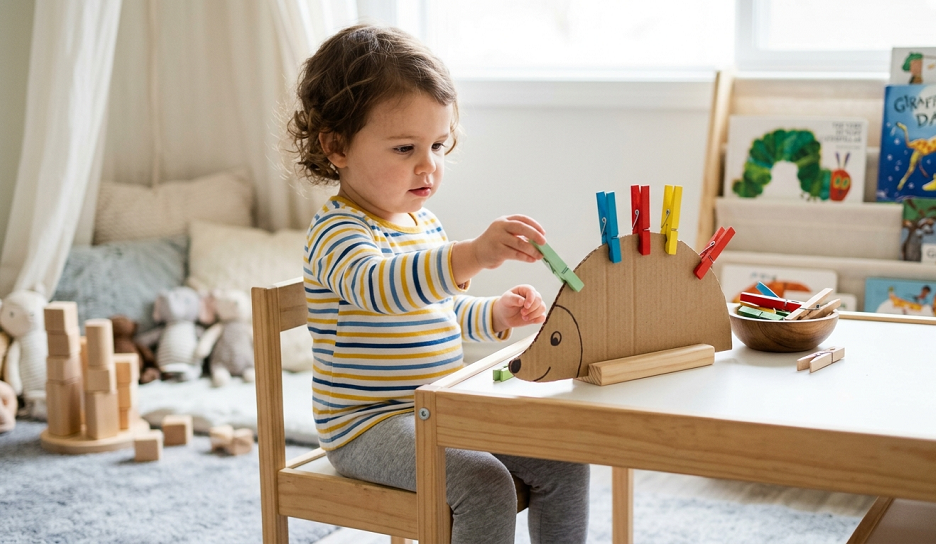
Clothespins are the ultimate finger-gym equipment. To an adult, opening a clothespin is effortless. To a child, it’s a serious workout for the thumb, index, and middle fingers. I used to have the kids clip clothespins around the edge of a sturdy cardboard box or a plastic bowl to make “spines” for a hedgehog.
I’ve found that the wooden spring-loaded clothespins are much better than the plastic ones. The plastic ones tend to slide and can sometimes pinch skin more painfully if they snap shut. The wooden ones have a better grip and a more consistent tension.
To make it more interesting, I’d write letters or numbers on the clothespins and ask the kids to clip them in order. “Can you find the ‘A’ and clip it on?” This turns a physical task into a literacy moment. Sarah loved “hanging up” her doll’s clothes on a low-strung piece of twine in the playroom.
If the spring is too stiff for your child, look for the “soft-grip” versions or slightly older, “worn-in” pins. You don’t want the task to be so hard that they give up, but it should require a visible effort. Watching their little faces scrunch up in concentration is one of the highlights of the toddler years.
12. Rubber Band Stretching on Cans or Bottles
This activity is great for older toddlers and preschoolers. Give them a handful of rubber bands and a sturdy water bottle or an unopened soup can. Show them how to stretch the rubber band with both hands and slide it over the top of the container.
This builds “hand arch” strength, which is vital for later skills like buttoning coats and using a computer mouse. I’ve noticed that kids often struggle with the “release” part—they can get the band on, but they have trouble letting go without it snapping.
I recommend using the thicker, colored rubber bands rather than the thin tan ones. The thick ones are easier to grip and less likely to snap and sting their fingers. Maya used to love seeing how many she could layer on one bottle until it looked like it was wearing a colorful sweater.
One quick side note: always supervise this one closely. Rubber bands can become projectiles in the blink of an eye. My Leo once discovered he could “ping” them across the living room, and that was the end of the rubber band activity for that week.
13. Screwing and Unscrewing Lids
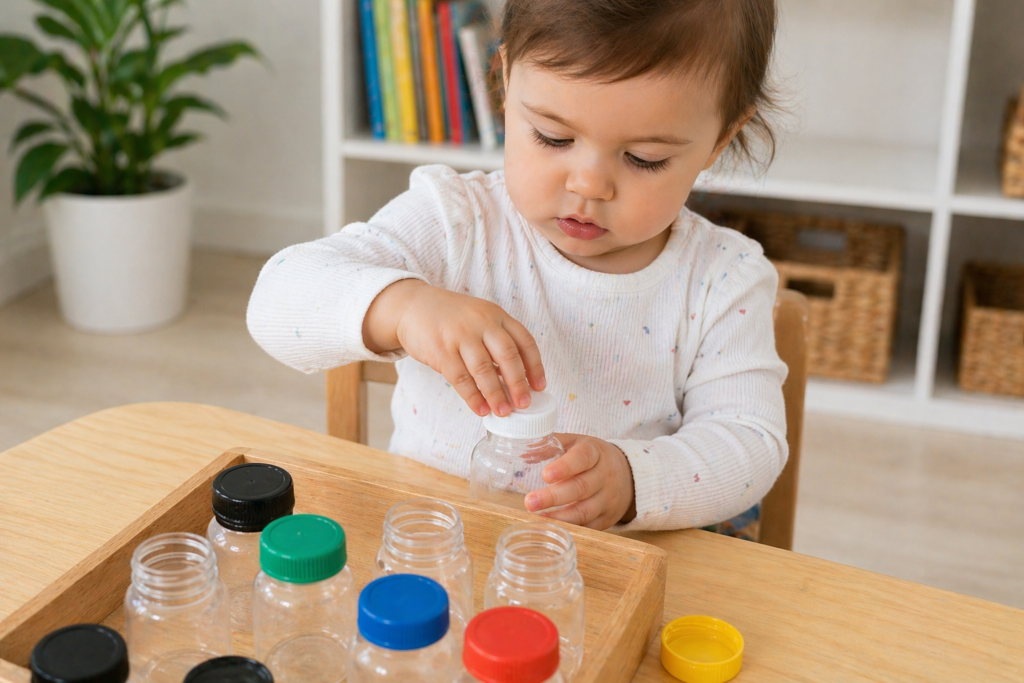
Next time you’re about to recycle your plastic bottles and jars, wash them out and keep them. A “lid matching” station is a fantastic way to practice wrist rotation (supination and pronation). This is a movement we use every day, from turning doorknobs to opening jars of peanut butter.
I would put out five or six different sized jars—spaghetti sauce, jam, water bottles—and put the lids in a separate pile. The kids had to find the right lid and screw it on tight. This requires them to use one hand to hold the jar steady and the other to perform the complex twisting motion.
It’s a very satisfying “Aha!” moment when they realize the small lid won’t fit the big jar. I found that metal lids on glass jars (under supervision) were actually easier for them to start with because the threads are “sharper” and catch more easily. The plastic-on-plastic threads of water bottles can be slippery and frustrating.
This was a great “quiet time” activity in our house. It’s self-correcting—the lid either fits or it doesn’t—so the child can work through it without me constantly hovering and “correcting” them.
14. Salt or Sand Tracing in a Tray
Writing isn’t just about holding a pencil; it’s about the “muscle memory” of letter shapes. I used to take a shallow baking tray and cover the bottom with a thin layer of salt, sugar, or sand. Then, I’d show the kids how to use their “pointer finger” to draw lines, circles, or their initials.
The sensory feedback of the salt under their finger is much more stimulating than a crayon on paper. If they make a mistake, they just give the tray a gentle shake and the “canvas” is wiped clean. This reduces the “fear of failure” that some kids feel when they can’t get a letter “right” on paper.
I’ve seen some people suggest using shaving cream for this. Personally, I found shaving cream to be a total nightmare. It gets under the fingernails, it smells like a locker room, and it inevitably ends up in someone’s eyes. Salt or sand is much easier to vacuum up and doesn’t leave a sticky film on everything.
As they get older, you can give them a paintbrush or a chopstick to “write” with. This transitions the skill from a finger-trace to a tool-grip. It’s a natural progression that feels like play rather than a “lesson.”
15. Pipe Cleaner “Beading” with Cheery-Os
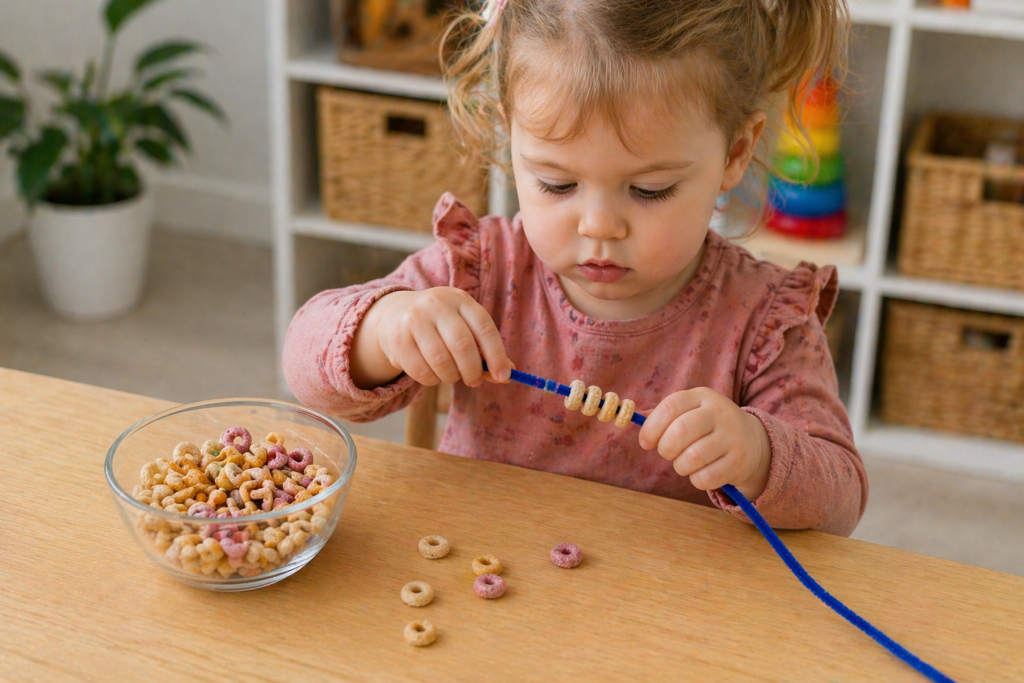
If you’re worried about your child swallowing small beads, use O-shaped cereal instead! Sliding the cereal onto a pipe cleaner is a wonderful fine motor task. The pipe cleaner is sturdier than string, so it stays upright, making it much easier for a child to aim the “bead.”
This was a favorite for Leo because he could snack while he worked. I’d tell him he could eat every third “bead” he put on. It kept him motivated and happy. Once the pipe cleaner is full, you can bend the ends together to make a bird feeder to hang on a tree outside.
The texture of the pipe cleaner provides a bit of “friction,” which actually helps the cereal stay in place. On a smooth string, the cereal often slides off the other end before the child can finish. The pipe cleaner is much more “forgiving” for beginners.
Just make sure your hands are clean before you start, especially if they plan on eating the “jewelry” afterward! It’s a simple, edible, and effective way to spend twenty minutes on a Tuesday morning.
The “Real Talk”: What’s Not Worth Your Energy
I’ve tried a lot of things over the years, and I want to be honest with you: some “fine motor” activities are more trouble than they are worth.
For example, I found that liquid glue projects with toddlers are usually a recipe for a meltdown (mine, not theirs). They don’t have the hand strength to squeeze the bottle consistently, so they either get nothing or a giant puddle that ruins the paper. Use glue sticks. They are much less stressful and still require a “cap on/cap off” motor skill.
Another one to avoid? Cheap, tiny safety scissors. If the scissors are poor quality, they won’t actually cut the paper; they’ll just fold it. This is incredibly frustrating for a child who is trying their best. Invest in one pair of high-quality, blunt-tipped kid scissors that actually have a bit of an edge. I’d rather supervise a child with a “real” tool than watch them cry over a plastic one that doesn’t work.
And finally, don’t worry about the “mess.” If you are constantly hovering with a wet wipe, your child will sense your tension and stop exploring. Put down a tarp, use a “messy mat,” or just accept that your kitchen floor will need a scrub later. The development happening in their brains and hands is worth a little bit of cleanup.
Parting Wisdom
Raising Sarah, Maya, and Leo taught me that parenting isn’t about being perfect; it’s about being present. These activities aren’t just about “milestones”—they are about the look of pride on your child’s face when they finally get that penny into the slot or that noodle on the string.
You are doing a great job, even on the days when it feels like all you’ve done is pick up beans. Those beans are building a future.
What is the one household item your child is currently obsessed with? Have you found a creative way to turn it into a “learning toy”? Share your ideas or ask a question in the comments below—I’d love to hear from you!