
The grocery store floor is cold, hard, and unforgiving, which is exactly where Maya decided to park herself during a legendary meltdown over a box of neon-colored cereal. I stood there, three kids deep into a Tuesday afternoon, feeling the collective burn of twenty judgmental eyes. It wasn’t just the screaming; it was that feeling of total helplessness. I realized then that while I could hold a boundary—no, we aren’t buying the sugar-coated cardboard—I hadn’t given her the tools to handle the tidal wave of frustration crashing over her little body.
We often tell kids to “calm down” without actually showing them the physics of how to do it. Expecting a five-year-old to self-regulate using only their thoughts is like asking a cat to do your taxes. It isn’t going to happen. They need something tactile, something physical, and something that anchors them to the present moment.
That’s why I’m a massive believer in the “Calm Down Wall.” It’s not a time-out corner, which usually just feels like a lonely prison. It’s a dedicated, interactive space where big emotions can be processed through the hands. Here are seven DIY sensory wall ideas that actually work, plus some hard-earned wisdom on what to skip.
1. The Magnetic “Weather of My Heart” Station
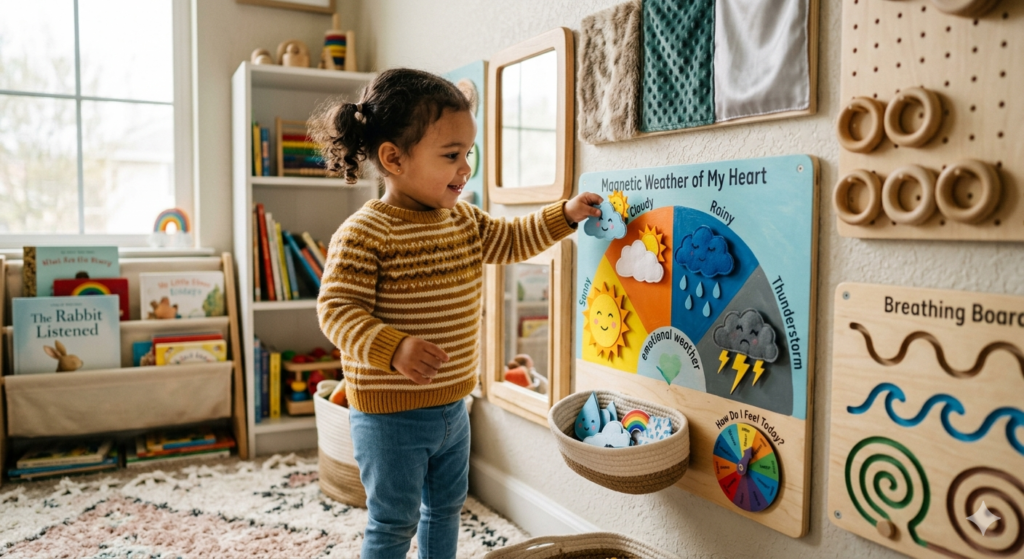
I’ve found that many parents spend way too much money on elaborate “emotion wheels” that kids just ignore when they are actually upset. If a child is in the middle of a red-hot rage, they don’t want to look at a cartoon face of a happy sun. They need to move something. A magnetic weather station allows them to physically grab a “thunderbolt” and slap it onto the board when they feel like they might explode.
To build this, you’ll need a simple galvanized steel sheet from the hardware store. Frame it with some sanded wood scraps so there are no sharp edges. Then, create large, chunky magnets out of felt or heavy-duty cardstock. I like using weather symbols because they are intuitive. A dark cloud isn’t “bad,” it’s just a state of being that will eventually pass.
When Leo was struggling with the transition from school to home, this was our first stop. I didn’t ask him “How was your day?” which is a question that usually gets a shrug. Instead, I’d watch him walk over to the wall and move the “Heavy Rain” magnet over the center. It gave us a common language that didn’t require him to find words he didn’t have yet.
The trick here is to keep the magnets within easy reach of their height. If they have to reach or stand on a stool, the frustration of the physical task will just add fuel to the emotional fire. Make it low, make it sturdy, and make sure those magnets have a satisfying “thunk” when they hit the metal. That tactile feedback is half the battle in grounding a child who is spiraling.
2. Low-Sensation Reversible Sequin Panels
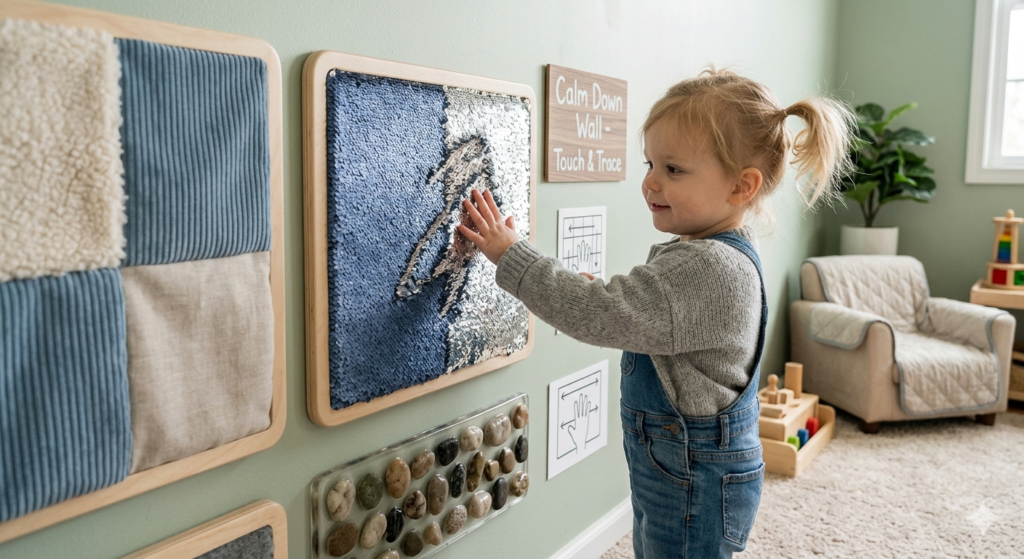
You’ve probably seen those pillows that change color when you swipe your hand across the sequins. While those are fine for a sofa, mounting a large-scale version on the wall is a game-changer for sensory seeking. I have discovered the hard way that small pillows end up being thrown during a tantrum. A wall-mounted panel, however, stays put and provides a massive “canvas” for repetitive, soothing motion.
I prefer using a 12×12 inch sequin fabric square. You can buy these in bulk and staple them tightly to a plywood backing. Frame it with a simple molding to hide the staples. The goal is to give the child a surface where they can “erase” their feelings. There is something profoundly meditative about the rhythmic “zip-zip” sound of sequins flipping over.
During the years when Sarah was navigating the pressures of middle school, I noticed she would stand by the sequin wall in our hallway and just swipe up and down for ten minutes. She wasn’t “playing”; she was regulating. The visual shift from, say, blue to silver provides immediate feedback to the brain that the person has control over their environment.
One mistake I see people make is choosing colors that are too neon or vibrating. Stay away from hot pinks or lime greens. I’ve found that deep navy, forest green, or matte silver are the most effective for lowering the heart rate. You want the wall to absorb the energy, not radiate more of it.
3. The Industrial “Busy Board” for High-Energy Frustration
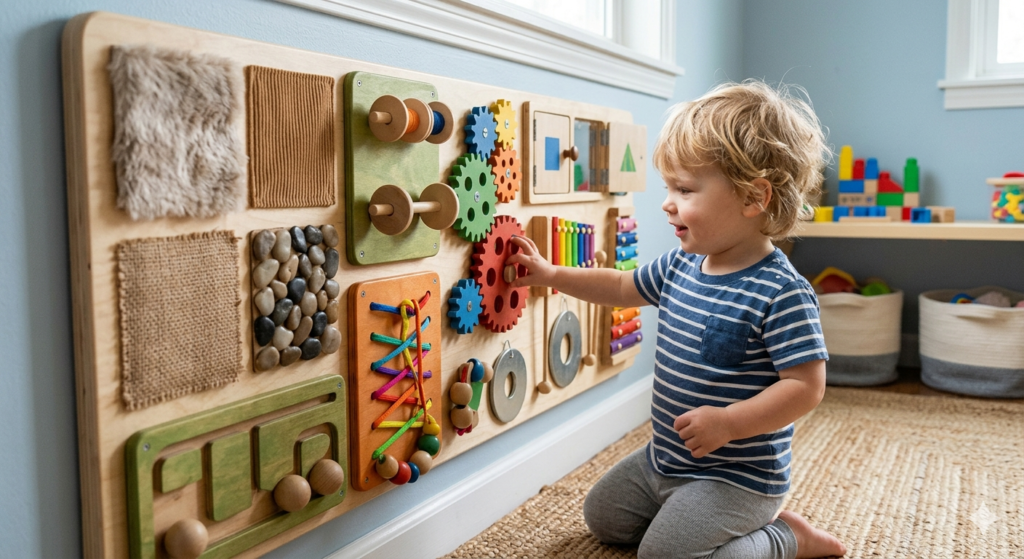
Sometimes “calm” doesn’t look like sitting still. Sometimes a child has so much adrenaline that they need to click, turn, and crank things to let the steam out. For my kids, especially Leo, “quiet time” was an insult when he was mad. He needed to do something with his hands. An industrial-style busy board is the perfect outlet for that “tight” feeling in the chest.
Go to the hardware store and buy things that make noise and have resistance. I’m talking about slide bolts, gate latches, heavy-duty light switches (the ones with the loud click), and even a short length of PVC pipe that they can drop a wooden ball through. Mount these securely to a heavy piece of MDF that is bolted into the wall studs.
I’ve found that using “real” hardware is infinitely better than the plastic toy versions. Kids can tell the difference. The weight of a metal latch feels significant in their hand. It provides a sense of “work” that plastic simply cannot replicate. When a child is feeling out of control, interacting with objects that have physical weight and resistance helps them feel “heavy” and settled in their own skin again.
A quick side note: Avoid anything that has a bell or a high-pitched squeak. You are trying to help them regulate, not drive yourself into a migraine. The sounds should be low-frequency—clicks, thuds, and sliding noises. These are grounding. High-pitched noises are stimulating, which is the exact opposite of what a “calm down” wall should achieve.
4. Texture-Graded Vertical Tactile Strips
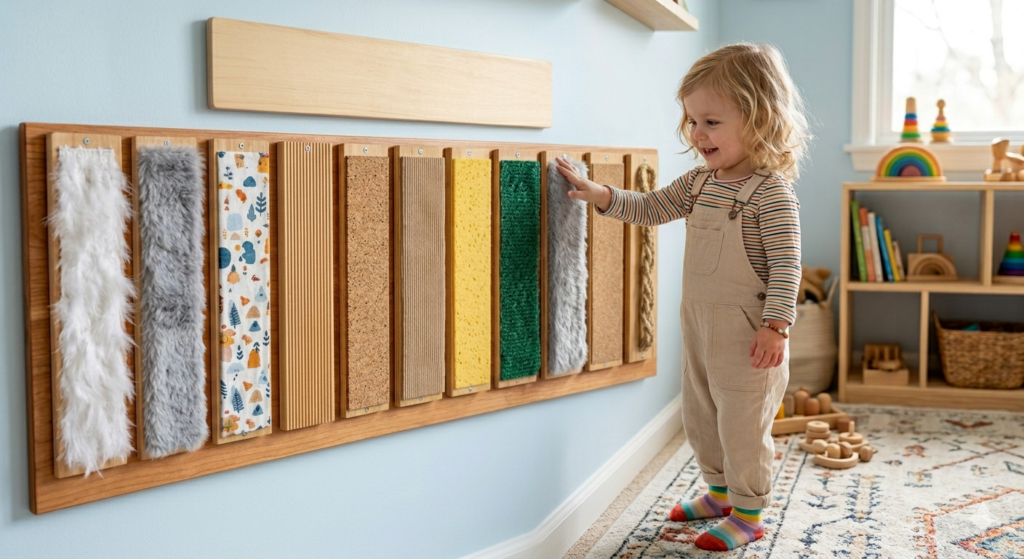
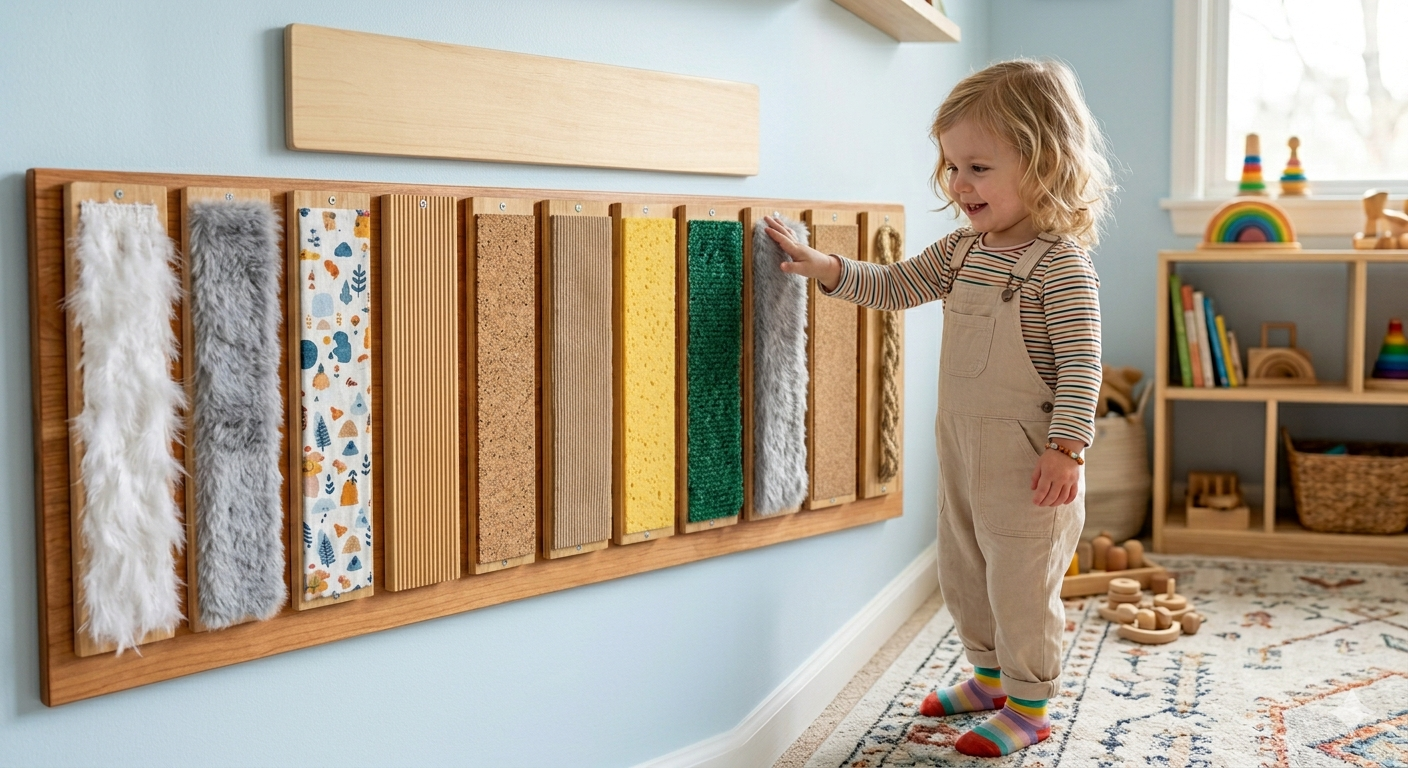
This is the easiest wall to build, but perhaps the most effective for “thawing out” a child who has shut down emotionally. When Maya would go into a “freeze” state—where she’d just stare at the floor and refuse to speak—texture was the only way to bring her back. We created a series of vertical strips, each about three inches wide, featuring different materials.
Start with something very soft, like faux fur or velvet, at one end. Move to something slightly firmer like a corrugated cardboard, then to something bumpy like the “hook” side of Velcro, and finish with something smooth like polished river stones glued to the board. I tell my kids to “walk their fingers” across the textures until they find the one that feels like their heart right now.
I’ve found that this simple act of choice—deciding which texture feels “right”—forces the brain to shift from the emotional limbic system back to the logical prefrontal cortex. You are asking them to make an executive decision: “Do I feel scratchy like the Velcro or soft like the fur?” It’s a subtle way to encourage self-awareness without a heavy-handed “How do you feel?” interrogation.
Make sure you use a high-strength adhesive for this. If a child manages to peel off a piece of the wall, it becomes a new source of stress (and a potential choking hazard for younger siblings). I’m a big fan of construction-grade epoxy for the stones and heavy-duty staples for the fabrics. This wall needs to be able to withstand some tugging.
5. The “Gravity” Water Pipe and Marble Run
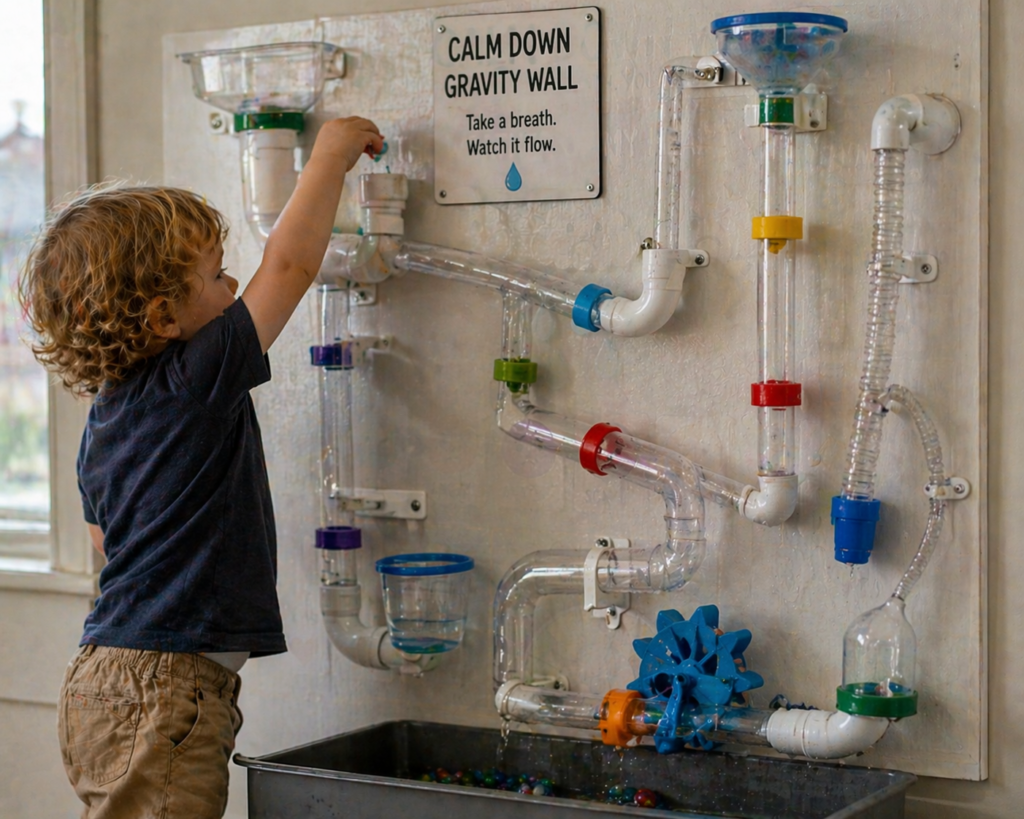
Visual tracking is a powerful tool for slowing down a racing mind. If you’ve ever stared at a lava lamp or a fish tank, you know how it feels to have your focus narrowed down to a single, slow movement. A DIY marble or water run on a wall creates that same “hypnotic” effect. It forces the eyes to follow a path, which naturally slows the breathing.
You can use clear vinyl tubing from the plumbing aisle and zip-tie it to a pegboard in a series of gentle slopes. At the top, place a small funnel. Give your child a small pitcher of water (or a handful of marbles if they are old enough) and let them watch the descent. I prefer water because the pouring motion itself is very rhythmic and soothing.
I will tell you right now: do not use sand. I know the “Zen garden” look is popular on Pinterest, but sand is a nightmare. It gets in the carpet, it gets in the eyes, and it inevitably becomes a mess that you have to clean up while you’re already stressed. Water is much easier to manage with a small catch-basin at the bottom of the wall.
When we used this with Sarah, we’d tell her to try and pour the water so slowly that it didn’t make a splashing sound at the bottom. This turned a “calm down” moment into a “mindfulness challenge.” It’s an opinionated take, but I think challenges are often more effective than “suggestions.” Giving a child a job to do—like pouring water silently—is often the fastest way to stop a crying jag.
6. The Back-Lit “Shadow Play” Nook
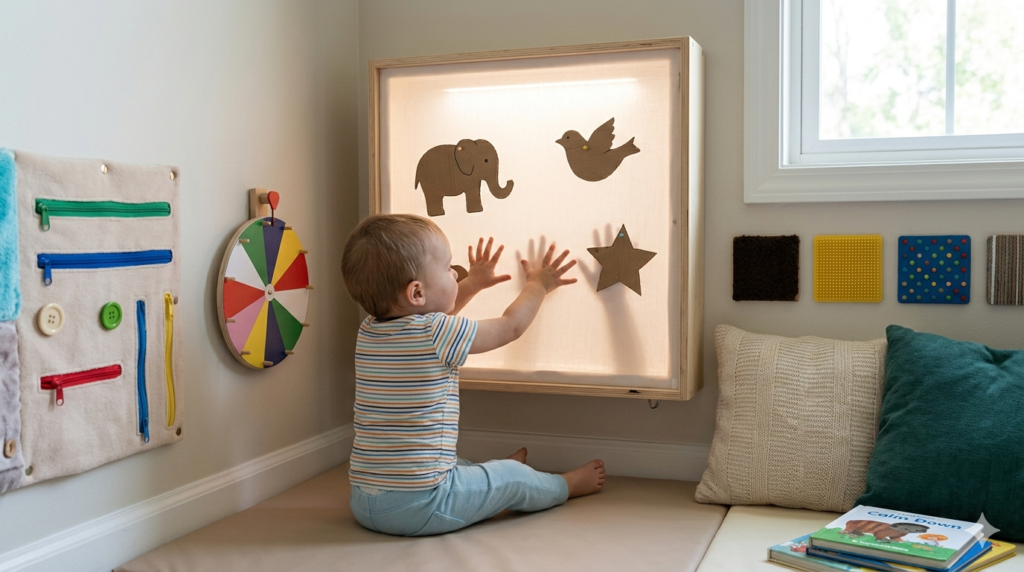
Sometimes the problem isn’t that a child needs to move; it’s that they are over-stimulated and need the world to go dark. A shadow wall is a brilliant way to provide a low-light, high-focus activity. By mounting a piece of frosted acrylic over a low-heat LED strip, you create a glowing surface that isn’t as harsh as overhead lights.
On this glowing wall, you can provide silhouettes of trees, animals, or even just abstract shapes. The child can move these shapes around to tell a story. I’ve found that when kids can’t talk about their own feelings, they can often talk about what “the bear” is doing on the shadow wall. It provides a safe distance between them and their big emotions.
To keep this budget-friendly, you don’t need fancy acrylic. A simple white bedsheet stretched over a wooden frame with a lamp behind it works just as well. The key is the “soft” light. In our house, we called this the “Cave.” If the living room felt too loud or the sibling squabbles got too intense, a kid could retreat to the shadow wall and just exist in that soft, amber glow.
I’ve discovered that this is particularly effective for kids who struggle with sensory processing. When the world feels too “loud” visually, the high contrast of shadows against a soft light acts as a visual reset button. It’s like clearing the cache on a computer that’s running too many programs at once.
7. The “Weighty” Resistance Band Wall
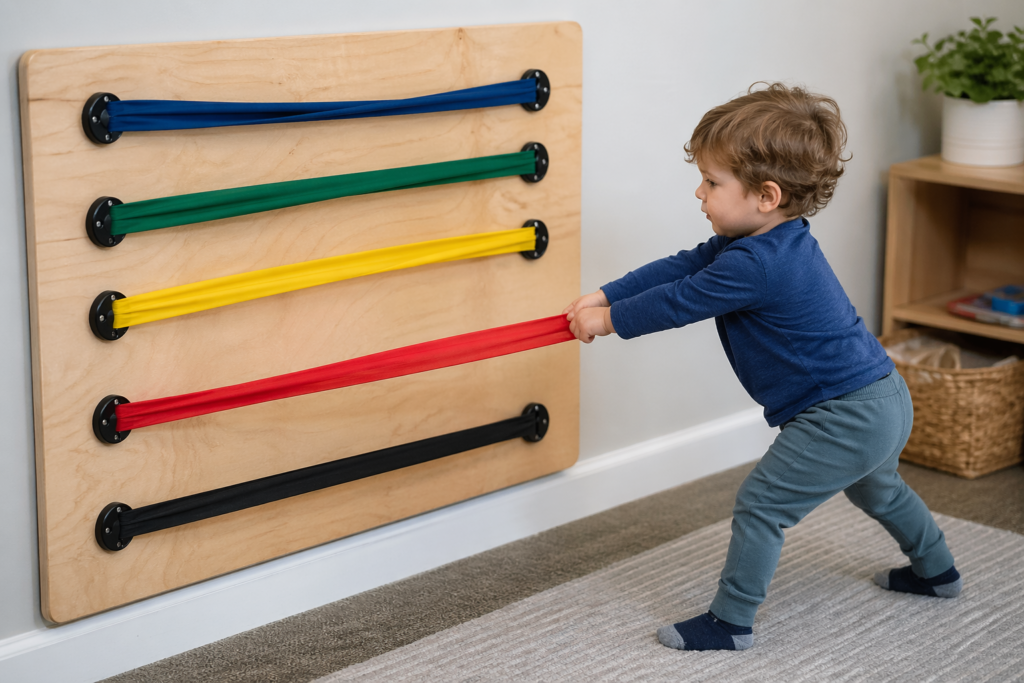
This one is for the kids who tend to get physically aggressive when they are upset—the ones who want to push, pull, or throw. Instead of telling them “stop pushing,” we give them something that is meant to be pushed. I used heavy-duty resistance bands (the kind used for physical therapy) and bolted them securely to a wall frame at shoulder height.
The child can stand in front of the wall, grab the handles, and pull with all their might. This provides “proprioceptive input,” which is essentially information to the brain about where the body is in space. For a child who is “losing it,” their body can feel floaty or out of control. Deep pressure and resistance help them feel “locked back in.”
I found this was a lifesaver for Leo. When he was angry, he didn’t want to talk, and he certainly didn’t want to look at a “calm down” bottle with glitter. He wanted to use his muscles. Giving him a safe place to exert that force meant my furniture stayed intact and he felt the physical release he was looking for.
Bonus tip: Make sure the bands are high-quality and check them regularly for nicks or tears. You don’t want a band snapping while a child is using it. Also, ensure the mounting is rock-solid. A resistance band pulled by a frustrated eight-year-old can exert a surprising amount of force on a wall.
Real Talk: What Isn’t Worth Your Time
I’m going to be very honest with you: don’t bother with anything that involves loose glitter, tiny beads, or complicated electronics. I’ve seen those “interactive touch-sensitive light panels” that cost $300. They are a total waste of money. When a kid is having a meltdown, they are likely to hit, kick, or throw things. You don’t want to be worried about a $300 piece of tech getting smashed.
Also, avoid “Calm Down Jars” that are permanently attached to the wall. I’ve found that kids get bored of them in three days. If it doesn’t require their active participation—if they are just staring at it—it’s not going to hold their attention long enough to actually regulate their nervous system. They need to be the actors in the process, not just the audience.
Finally, don’t make the wall too “busy.” If you put all seven of these ideas on one wall, you’ll create a sensory nightmare. Pick two or three that match your child’s specific “flavor” of upset. Do they shut down (need texture/soft light)? Or do they explode (need resistance/hardware)? Build for the child you have, not the “aesthetic” wall you saw on social media.
Parting Wisdom
Building a “Calm Down Wall” is a beautiful gesture, but it’s not a magic wand. The wall is just a tool; you are still the craftsman. These spaces work best when you use them with your child during the “quiet” times, so they know exactly how to use them when the storm hits.
When Maya was little, we spent many calm Sunday mornings just playing with the sequin wall together. Because it was a place of connection when she was happy, it felt like a safe harbor when she was sad. You aren’t failing because your child has big emotions. You are succeeding because you are building them a way to navigate those emotions safely.
Which of these sensory elements do you think would resonate most with your “spirited” little one? I’d love to hear your DIY wins (and the spectacular fails!) in the comments below. Let’s learn from each other.