
My youngest, Leo, once spent forty-five minutes trying to “wash” a smooth river stone with nothing but a puddle and a handful of dead grass. At the time, I was checking my watch every three minutes, thinking about the mountain of laundry sitting in the hallway and the fact that Sarah had a soccer game in an hour. I felt like a failure because we weren’t “doing” anything. I thought outdoor learning had to look like a structured botanical tour or a complex scavenger hunt found in the back of a glossy magazine.
The truth is, nature doesn’t need a curriculum. When Sarah, Maya, and Leo were small, I spent far too much energy trying to curate their experiences. I eventually learned that the more I stepped back and let the dirt do the teaching, the more they actually learned. If you feel like you’re failing because your toddler just wants to sit in the driveway and poke a crack in the pavement with a stick, take a deep breath. You aren’t failing; you’re witnessing a masterclass in physics and biology.
Here are 13 outdoor learning activities that actually work—and won’t leave you feeling like you need a degree in early childhood education to pull them off.
1. Sensory Nature Bins with Natural Textures
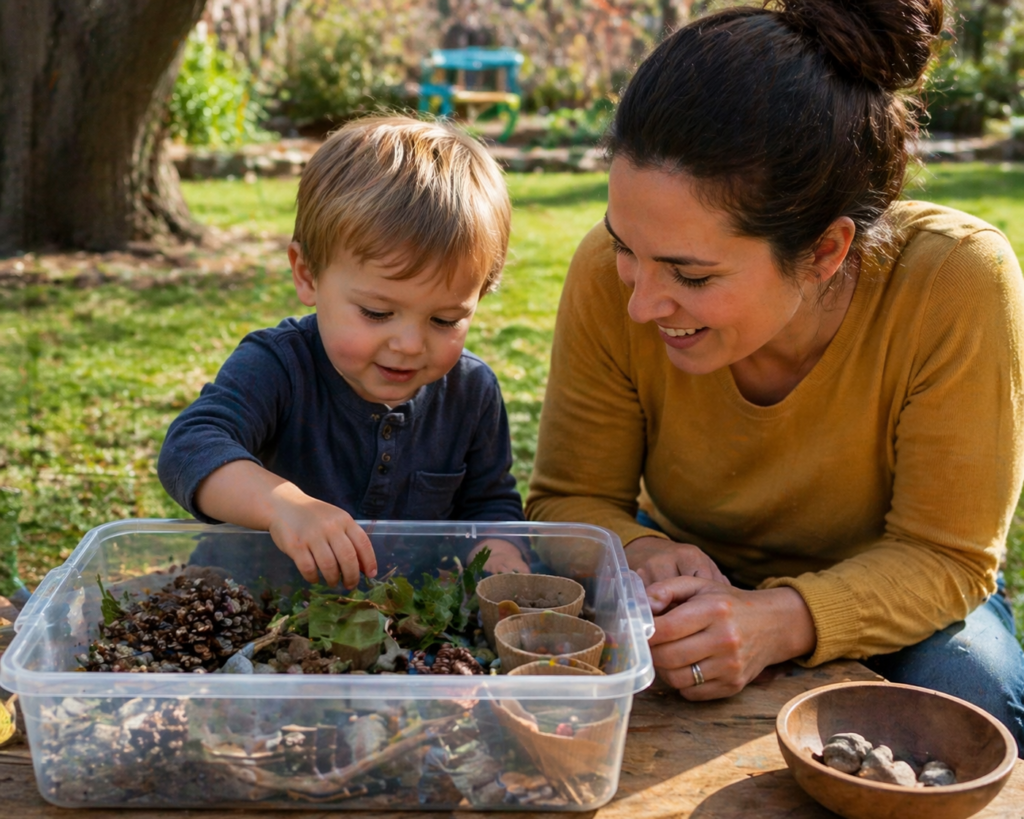
I’ve seen those expensive, pre-packaged sensory kits sold online for forty dollars, and I’m telling you right now: save your money. They are a total waste of resources. A plastic tub filled with dyed rice is a nightmare to clean up and teaches a toddler very little about the actual world. Instead, I discovered that the most effective sensory bin is the one you “harvest” together from your own backyard or a local park.
Take a sturdy plastic bin outside and let your toddler lead the way. We’re looking for high-contrast textures. Think crunchy dried leaves, smooth river stones, tickly pine needles, and bumpy acorns. The learning happens during the collection phase just as much as the play phase. As they drop an item in, use descriptive language. Don’t just say “that’s a leaf.” Say, “That leaf is brittle and brown. Hear how it snaps?”
Once the bin is full, give them a few “tools.” A set of tongs, a sturdy spoon, and a couple of old measuring cups are all you need. I watched Maya spend an entire afternoon sorting “smooth things” from “poky things” when she was three. This is early categorization—the literal foundation of mathematical thinking.
The best part about this activity is that it’s biodegradable. When the afternoon is over, you don’t have to worry about microplastics or dyed rice ruining your lawn. You just tip the bin over and return the items to the earth. It teaches a subtle, beautiful lesson about stewardship: we play with nature’s gifts, and then we give them back.
2. Mud Kitchen Math and Science
If you are afraid of your child getting dirty, I’m going to challenge you to get over it. Mud is the greatest toy ever invented. I used to try to keep my kids’ “good clothes” clean, but I eventually realized that childhood is a messy business. I designated a specific “mud zone” near our outdoor spigot, and it became the most popular classroom in our house.
A mud kitchen doesn’t need to be a fancy wooden structure you buy from a boutique. An old crate and a few cast-off pots and pans from your kitchen will do perfectly. The goal here is “concoction making.” Filling a pot with water and adding dirt to see how the consistency changes is a fundamental chemistry lesson. Is it soup? Is it paste? Is it “lava”?
To bring in the math, I give my kids specific “orders.” I might ask for a “Stone Stew” with exactly four large rocks and two handfuls of grass. Watching a toddler concentrate as they count out those items is pure magic. They are learning one-to-one correspondence—the idea that the number “four” represents four physical objects. It’s much more effective than flashcards.
I found that adding a few drops of dish soap to the mix makes the “science” even more exciting. The bubbles add a new texture and allow for conversations about air and surface tension. Just make sure you have a bucket of clean water nearby for a quick rinse-off before they head back inside. The mess is temporary, but the neural pathways they’re building are permanent.
3. Shadow Tracing on the Sidewalk
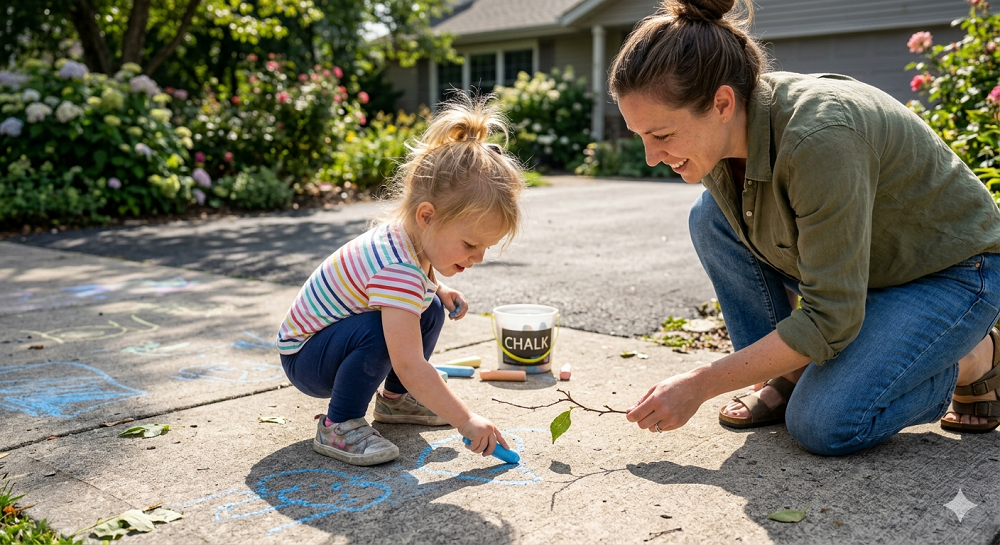
I am convinced that chalk is the most undervalued tool in a parent’s arsenal. While most people use it to draw stick figures, I’ve found it’s incredible for teaching toddlers about the movement of the sun and the concept of time. This is a “slow-burn” activity that you can revisit throughout the day, which is perfect for keeping a high-energy toddler engaged.
Find a sunny spot on your driveway or sidewalk. Place a simple object—like a plastic dinosaur, a toy truck, or even a large leaf—on the ground. Have your toddler help you trace the shadow it casts. Then, leave it there. Come back two hours later and trace the shadow again.
Your child will be baffled. “The dinosaur didn’t move, Mommy! Why did his shadow run away?” This is the perfect opening to talk about how the Earth is always spinning, even when we can’t feel it. Even if they don’t fully grasp the celestial mechanics, they are learning to observe changes in their environment over time.
Leo used to love tracing my shadow, too. I’d stand in the same spot at 9:00 AM, noon, and 4:00 PM. We’d see how “Tall Mommy” became “Short Mommy” and then “Stretched-Out Mommy.” It’s a hilarious and physically active way to introduce basic geometry and the concept of light sources.
4. Backyard Color Matching Hunt
Colors in books are always so… primary. But colors in nature are nuanced and complex. I found that my kids learned their colors much faster when we went on “Color Hunts” rather than just pointing at pictures of red apples. This activity requires zero prep and can be done in even the smallest outdoor space.
I take a cheap egg carton and paint the bottom of each well a different color. If you don’t want to paint, you can just use colored markers or even scraps of construction paper. Give the carton to your toddler and challenge them to find something in nature that matches each color. A yellow dandelion, a gray pebble, a green blade of grass, a brown twig.
This forces them to look closely. Instead of seeing a “green lawn,” they start to see the lime green of a new bud and the forest green of an old leaf. It builds their visual discrimination skills, which are crucial for later learning to tell the difference between letters like ‘b’ and ‘d’.
If they get stuck on a difficult color like purple or blue, don’t rush to find it for them. Let them sit with the frustration for a minute. I once watched Sarah search for ten minutes before she realized the tiny “blue” flowers in the weeds counted. That moment of discovery is worth a thousand “good jobs” from a parent.
5. Tree Bark Rubbings and Texture Comparisons
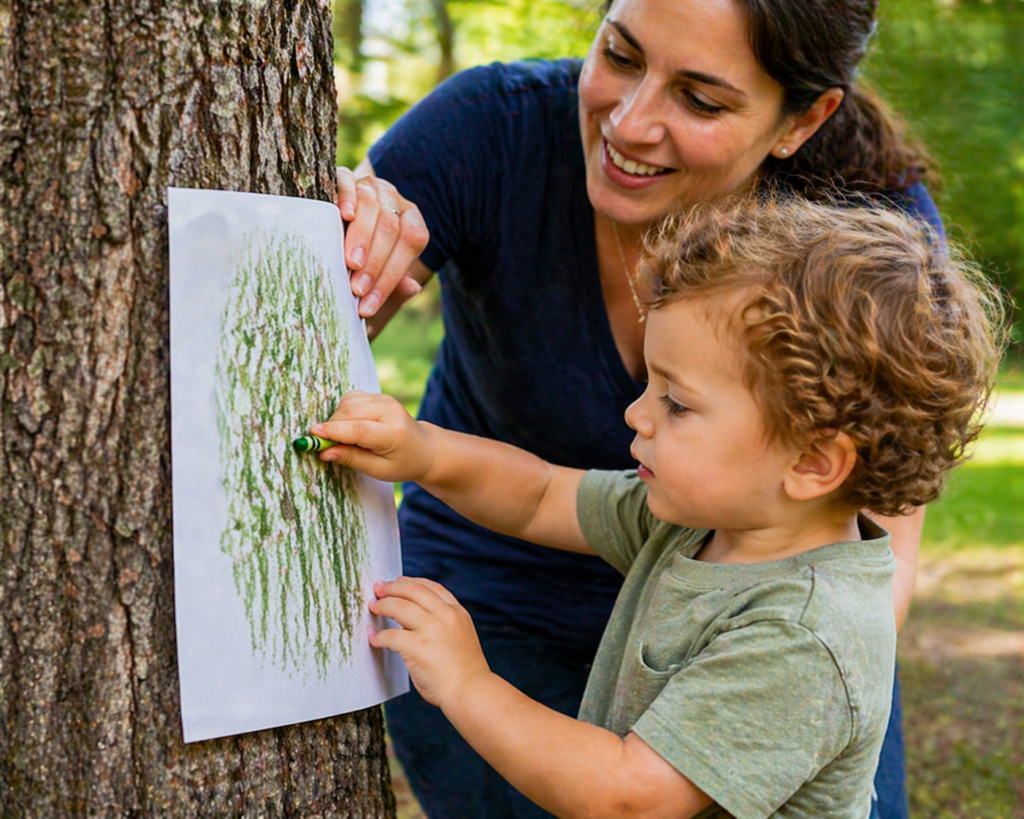
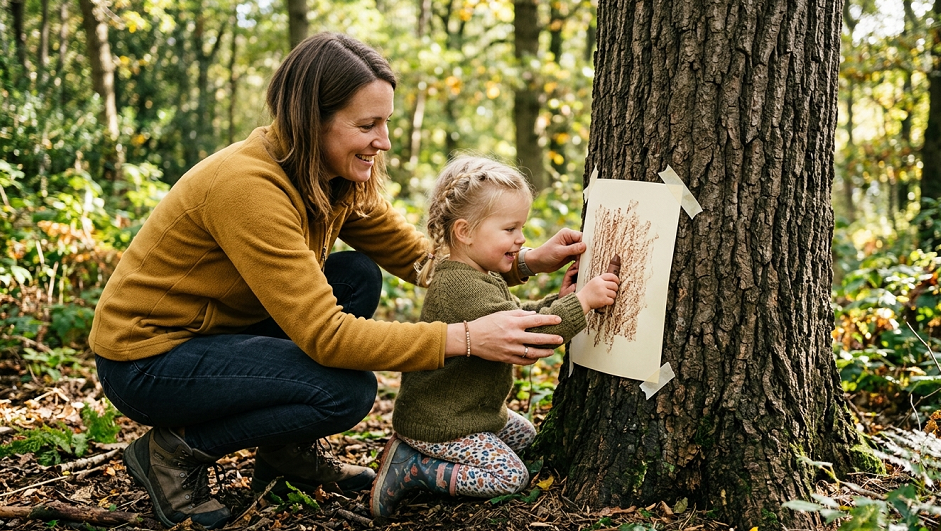
Paper and crayons belong outside just as much as they belong at the kitchen table. When Leo was in his “I must touch everything” phase, I started bringing out large sheets of paper and fat, broken crayons (the ones with the wrappers peeled off work best). Tree bark rubbing is a classic for a reason—it’s satisfying and produces an immediate result.
Taping the paper to the tree is a pro-tip I learned the hard way. Trying to hold a piece of paper still while a wiggly toddler “colors” it is a recipe for a meltdown. Tape it at their eye level, show them how to use the side of the crayon, and watch the patterns emerge.
Every tree has a different “fingerprint.” We would move from an old, rough oak to a smoother maple. We’d talk about how the oak felt like a “crumpy cracker” and the maple felt like “daddy’s chin.” Linking physical sensations to descriptive adjectives is how you build a robust vocabulary.
This isn’t just art; it’s early biology. You can explain that bark is like the tree’s skin or its winter coat. It protects the tree from bugs and the cold. By the time my kids were in elementary school, they could identify most of the trees in our neighborhood just by the texture of the bark, all because we spent those afternoons “coloring the trees.”
6. DIY Bird Feeders and Observation Stations
Teaching empathy is a huge part of gentle parenting, and caring for local wildlife is a great place to start. I’ve tried those complicated birdhouse kits you have to nail together, and frankly, they are more work for the parent than the child. I’ve found that the “Pinecone Special” is much more toddler-friendly and provides better immediate feedback.
Tie a string to a large pinecone, let your toddler slather it in peanut butter (or sunbutter if there are allergies), and then roll it in birdseed. Hanging these around the yard turns your outdoor space into a living laboratory. We would sit on the porch with a “field guide”—which was really just a piece of paper where I’d draw a tally mark every time a bird landed.
This teaches toddlers the value of “the quiet wait.” In our world of instant gratification, sitting still for five minutes to wait for a cardinal is a monumental task for a two-year-old. But when that flash of red finally appears, the excitement is unparalleled.
We’d talk about what the birds were doing. Are they eating? Are they talking to each other? What does their song sound like? I’ve discovered that imitating bird calls is a fantastic way to develop phonological awareness. If a toddler can mimic the “tweet-tweet-chirp” of a robin, they are practicing the distinct sounds that will eventually help them blend words when they start to read.
7. Water Painting on Hot Pavement
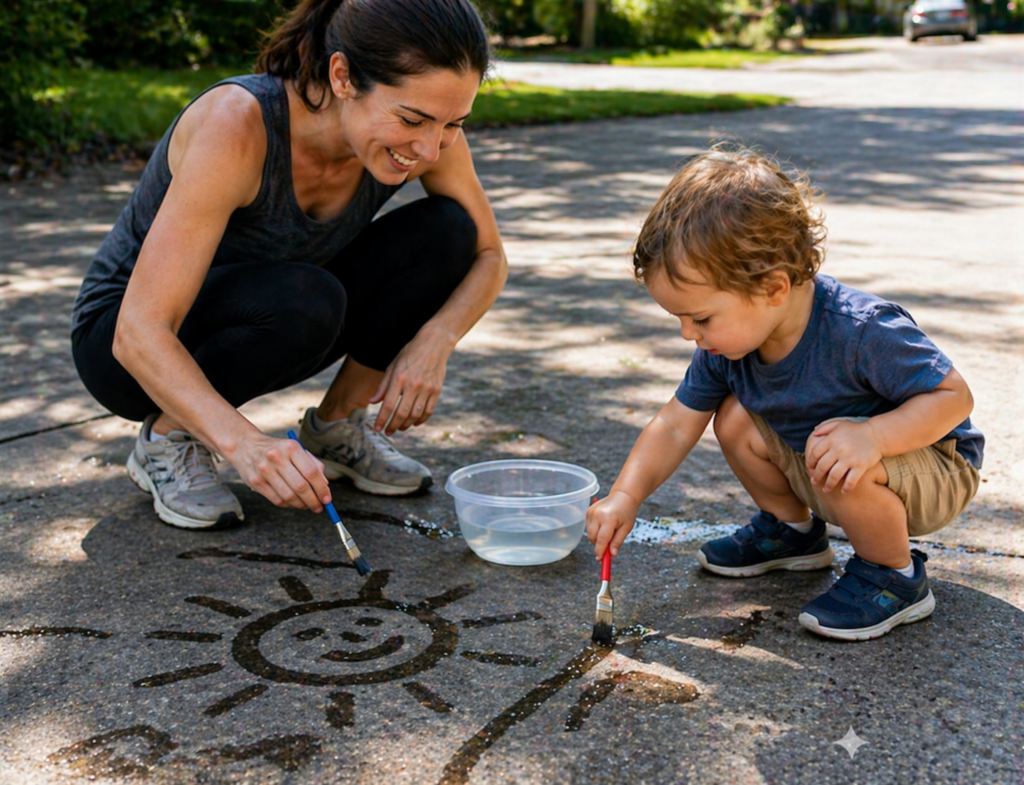
If you want a zero-mess activity that feels like magic, water painting is the winner. All you need is a bucket of water and a couple of large house-painting brushes. On a warm day, let your toddler “paint” the driveway, the fence, or the side of the house with water.
The lines appear dark and bold, and then—poof!—they disappear as the water evaporates. This is a fantastic way to practice gross motor skills. Moving that big brush in long strokes across the ground uses the large muscles in the shoulder and arm, which actually need to be strengthened before a child can successfully master the fine motor skills required for writing.
I used to have Maya practice drawing “big circles” or “giant zig-zags.” As she got older, we’d move to “water letters.” But for a toddler, just the act of making a mark and seeing it vanish is enough. It’s an early lesson in physics and the states of matter.
A quick side note: if you have a wooden fence, this is also a great way to “clean” it. My kids used to think they were helping me with chores when I’d give them a bucket of water and tell them the fence needed a new coat of “invisible paint.” It kept them busy for an hour while I actually pulled a few weeds nearby.
8. The “Ice Treasure” Excavation
This is my secret weapon for hot summer afternoons when everyone is cranky and “bored.” The night before, I take a large plastic container (like a Tupperware or a clean yogurt tub), fill it with water, and drop in a few “treasures.” These can be plastic dinosaurs, colorful beads, or even pretty leaves and flowers from the garden. Freeze it solid.
The next day, take the giant block of ice outside and give your toddler some tools for “excavation.” A small spray bottle of warm water, a salt shaker, and a dull plastic spoon are perfect. They have to work to get the toys out.
This is a lesson in persistence and problem-solving. They’ll quickly realize that the spray bottle works faster than the spoon. They’ll see how the salt makes the ice “crackle” and melt. It’s hands-on thermodynamics, even if they can’t pronounce the word.
I love this because it’s a self-limiting activity. Once the ice is melted, the “treasures” are ready for play, and the child is usually much calmer. There’s something about the sensory experience of cold ice on a hot day that resets a toddler’s nervous system. I’ve used this trick more times than I can count to avoid a pre-nap meltdown.
9. Bug Hotel Construction and Insect Observation
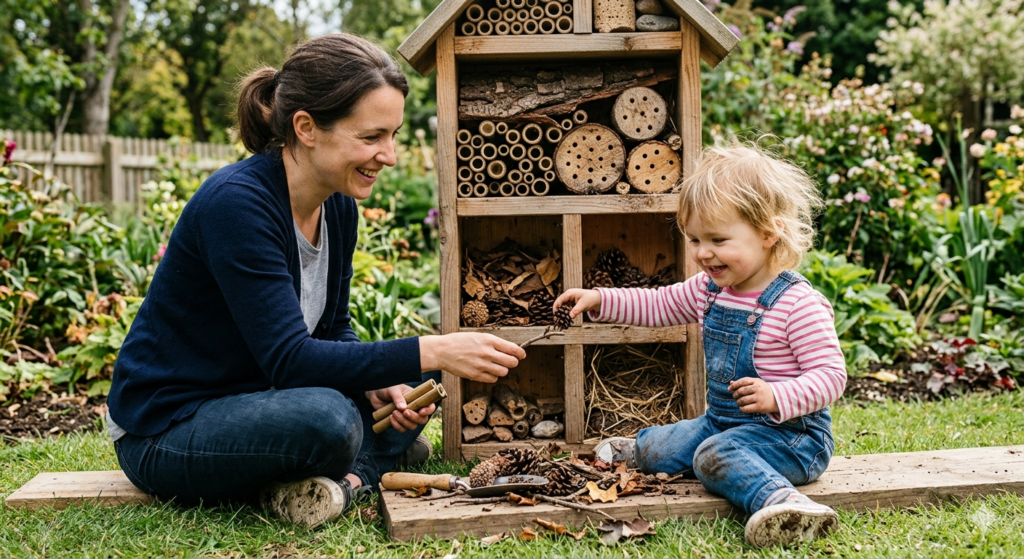
Most toddlers are fascinated by “creepy crawlies,” and I think it’s important to foster that curiosity rather than teaching them to be afraid. We built “Bug Hotels” in the corner of our garden using nothing but scraps. An old wooden box or even just a pile of hollow reeds, sticks, and bricks works beautifully.
The goal is to create lots of little nooks and crannies for insects to hide in. Once it’s built, you have a permanent “observation station.” We would go out every morning to see who had moved in. Was there a pillbug? A ladybug? A spider?
I bought a cheap magnifying glass for the kids, and it changed their world. Seeing the legs of an ant or the spots on a beetle up close creates a sense of wonder that you just can’t get from a screen. We talked about how every bug has a job to do—bees help the flowers, and ladybugs eat the “bad bugs” that hurt the veggies.
This is the beginning of ecology. It’s about understanding that we are part of a much larger system. Leo used to carry around a “bug jar” (with plenty of air holes!) so he could observe a guest for ten minutes before releasing them back into the “hotel.” It taught him to be gentle with creatures much smaller than himself.
10. Nature-Inspired Alphabet Hunt
Once your toddler starts recognizing a few letters, take the learning outside. I found that my kids were much more engaged with the alphabet when it wasn’t confined to a worksheet. We would go on a “Letter Hunt,” but instead of looking for printed letters, we looked for shapes in nature that looked like letters.
A “Y” shape in a tree branch. An “O” in a round stone. A “V” in a leaf vein. This is a high-level thinking skill called “abstraction.” It’s the ability to see a shape and relate it to a symbolic concept. It’s much harder than it looks!
If your child is younger, you can do a “Sound Hunt” instead. “Can you find something that starts with the ‘B’ sound? B-B-Butterfly! B-B-Bark!” This builds the foundation for phonics in a way that feels like a game.
I’ve discovered that the more we move while we learn, the better the information sticks. Jumping over a “J” shaped stick or running to an “R” shaped rock gets the blood flowing and the brain firing. We’d spend an hour doing this, and by the end, they were physically tired and mentally sharp.
11. Garden “Sow and Show” (Early Botany)
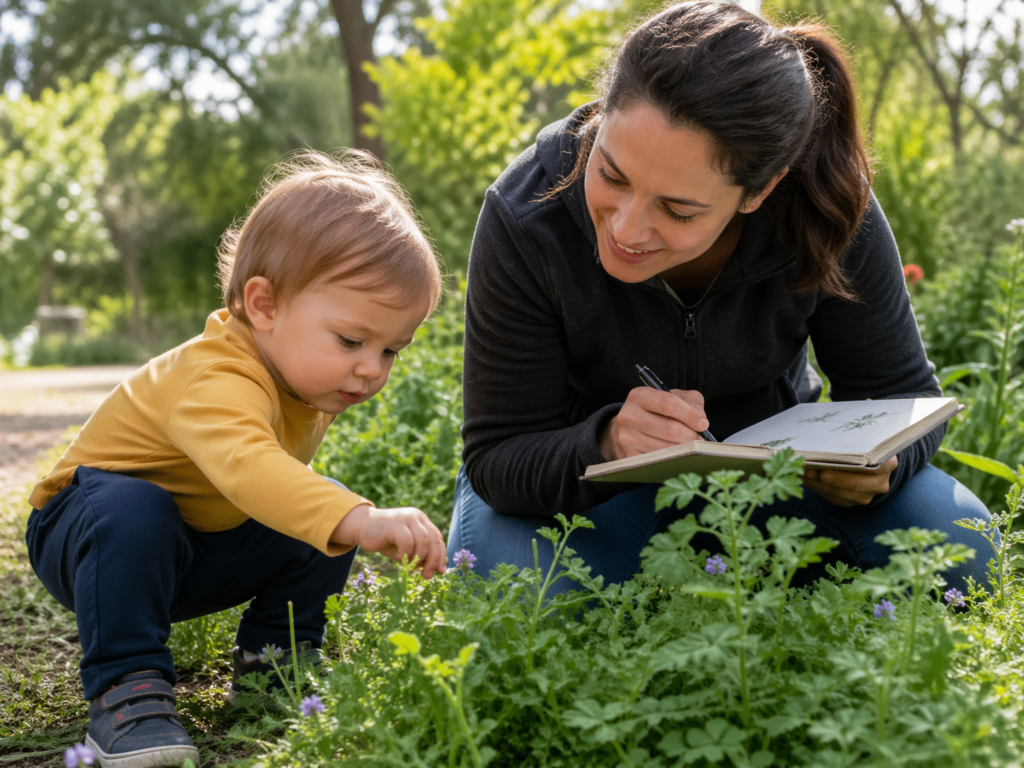
You don’t need a green thumb to teach your toddler about plants. In fact, I’m a fairly mediocre gardener, but my kids didn’t know that. We started with “The Big Three”: radishes, sunflowers, and beans. These are great because they grow fast, and the seeds are big enough for tiny fingers to handle.
Giving a toddler their own “plot” (even if it’s just a large pot) gives them a sense of ownership. They are responsible for the watering. They check every morning to see if the “baby plants” have poked their heads out. This teaches the concept of life cycles and the passage of time.
We would measure the sunflowers every week using a “string.” We’d cut a piece of string that was exactly as tall as the plant, and then compare it to the string from the week before. It’s a visual, tangible way to understand growth.
I’ve found that toddlers are much more likely to try a vegetable if they grew it themselves. Maya, who wouldn’t touch a salad to save her life, would happily munch on a radish she pulled out of the dirt. Gardening is the ultimate “slow food” movement, and it’s a wonderful way to connect with the rhythm of the seasons.
12. Puddle Jumping and “Sink or Float” Experiments
Rainy days are not “indoor days” in our house. They are “Science Days.” Put on the boots and the raincoats and head outside. Puddles are perfect laboratories for physics.
We would play “Sink or Float” with everything we found. Does a heavy rock sink? Yes. Does a light leaf float? Yes. But wait—does a “heavy” stick float? Yes! This leads to great conversations about why some things stay on top of the water even if they seem big.
We’d also build “dams” and “rivers.” Using sticks and mud to redirect the flow of water from a puddle is early engineering. It’s about understanding cause and effect. “If I move this rock, the water goes that way!”
I’ve seen parents try to do sink-or-float in a bathtub, but it’s just not the same. The scale of a large puddle and the unpredictability of rain make it much more exciting. Plus, the sheer joy of a “controlled splash” is great for a toddler’s soul. Just have the towels ready by the door!
13. Wind Chasers and Air Exploration
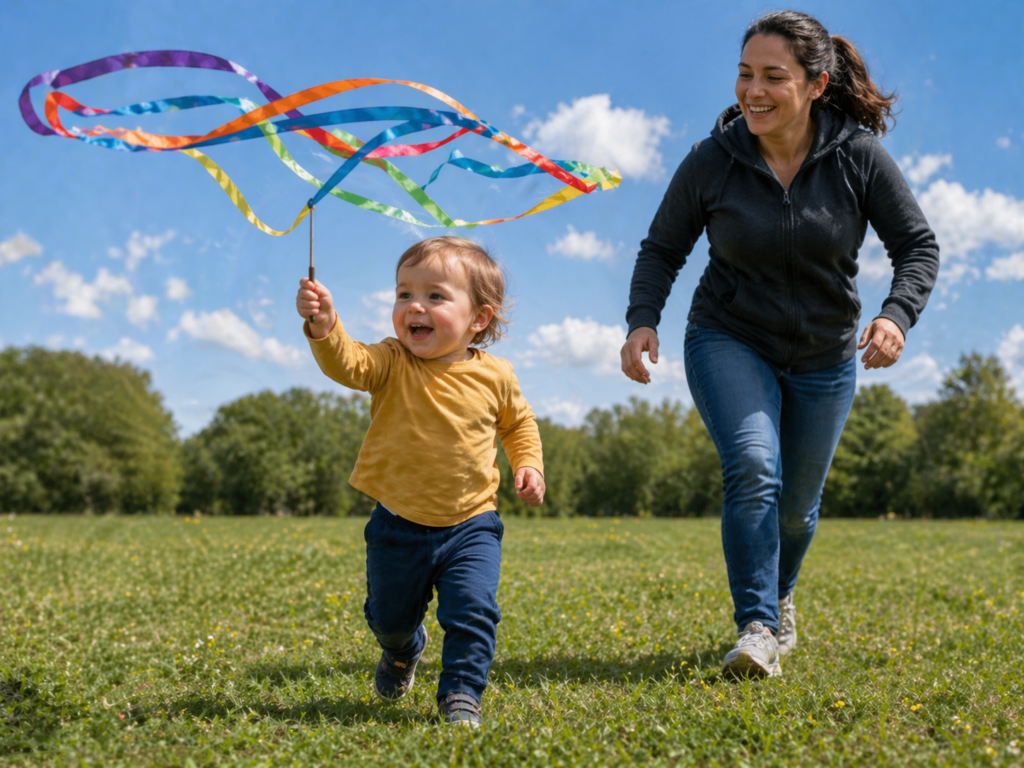
Air is invisible, which makes it a very difficult concept for a two-year-old to understand. I found that using “visual aids” helped bridge that gap. We’d make simple kites out of a paper bag and some string, or just tie long ribbons to a stick.
Running with a “wind ribbon” and seeing it trail behind them shows toddlers that the air is actually “something.” We’d look at the trees to see if the leaves were “dancing.” If the leaves are dancing, the wind is blowing.
We would also blow bubbles. Watching which way the bubbles drift tells us which way the wind is moving. This is a basic introduction to meteorology. We’d talk about “gentle air” (a breeze) versus “strong air” (a gust).
Leo used to love “racing” the wind. He’d throw a handful of dry grass into the air and try to catch it before it hit the ground. It’s a simple, beautiful way to connect with the invisible forces of nature. It reminds us that just because we can’t see something doesn’t mean it isn’t there—a pretty good life lesson for all of us.
The Real Talk: When Nature Isn’t “Pinterest-Perfect”
I’m going to be honest with you: sometimes nature play is a total disaster. There will be days when you spend twenty minutes getting everyone into their boots and coats, only for a toddler to step outside, get a tiny bit of mud on their thumb, and have a complete meltdown.
I’ve found that trying to “force” a nature activity is a total waste of time. If they aren’t feeling it, go back inside and try again tomorrow. Nature is supposed to be a place of peace, not a place of power struggles.
Also, don’t bother with those expensive “nature journals” for toddlers. They can’t write, and they usually just end up tearing the pages or eating the crayons. A “nature journal” for a three-year-old is just a collection of weird rocks in their pocket. Accept the rocks. Wash the rocks. The “journaling” can come later.
Lastly, be prepared for bugs. There will be ants. There might be a bee. Instead of screaming, I learned to say, “Oh, look, a friend is busy working! Let’s give him some space.” If you freak out, they will freak out. Your calm is their compass.
Parting Wisdom
My three are all grown now—Sarah is a lawyer, Maya is a teacher, and Leo is finishing up his degree in engineering. People often ask me what the “secret” was to their success. I truly believe it wasn’t the fancy tutors or the organized sports. It was the thousands of hours they spent in the backyard, poking at anthills and building mud pies.
Those early years of “unstructured” outdoor learning built a foundation of curiosity and resilience that served them well in the “real world.” They learned that if a dam breaks, you just build a better one. They learned that if you wait quietly, the birds will come.
Don’t overthink it. You don’t need a 2,000-acre forest; a small patch of weeds will do just fine. Just open the door and let them out. You might be surprised at how much you learn in the process, too.
What is your toddler’s favorite thing to do outside, even if it drives you a little bit crazy? Let’s swap stories in the comments below—I’d love to hear about your “nature wins” (and the mud-covered “fails”)!