

The summer my oldest, Sarah, turned twelve, I realized we were losing the battle to the “blue light glow.” Every time I turned around, my three kids were hunched over like little question marks, thumbs scrolling through nothingness. I felt like a failure. I was the “gentle parent,” yet I found myself wanting to hurl a tablet out a second-story window.
I didn’t do that—mostly because those things are expensive—but I did institute a “Summer of Dirt.” We went cold turkey on the screens for four hours every afternoon. It wasn’t pretty at first. Leo, my youngest, looked at me like I’d personally cancelled Christmas. But by week three, something shifted. They started talking to each other again.
Breaking the digital tether isn’t about being a drill sergeant; it’s about offering something more interesting than an algorithm. Here are 15 screen-free activities that actually worked for my family of five, along with the hard-earned wisdom I picked up along the way.
1. Backyard Bio-Blitz and Nature Journaling
I used to think nature journaling was for people with art degrees and endless patience. I was wrong. It’s actually for parents who want their kids to sit still for twenty minutes without a charger. A “Bio-Blitz” is just a fancy way of saying we are going to find every living thing in our yard and write it down.
When Maya was ten, she became obsessed with a specific type of garden spider. We didn’t need an app to identify it; we bought a physical field guide from a used bookstore. There is something tactile and grounding about flipping through paper pages rather than swiping a screen. It teaches kids that information doesn’t always have to be instant to be valuable.
I’ve found that giving a child a high-quality sketchbook—not just loose printer paper—makes a massive difference. If the paper feels special, they treat the activity with more respect. We spent hours sketching the veins in maple leaves and tracking the progress of our tomato plants.
The trick here is to stay out of their way. Don’t correct their drawings. If Leo drew a bird that looked more like a lumpy potato, I praised the “unique perspective.” This activity builds observational skills that help in school, but more importantly, it builds a connection to the physical world they are standing on.
2. The Great Neighborhood Scavenger Hunt
Most scavenger hunts are too easy and over in ten minutes. I discovered the hard way that if you want this to last, you have to make it a challenge. I’m talking “find a rock that looks like a famous politician” levels of difficulty.
When my kids were younger, I’d pair the older ones with the younger ones. Sarah and Leo would have to work together to find a house with a blue door, a leaf with a hole in it, and a neighbor willing to give them a spare rubber band. This forces cooperation. In a digital world, they are used to solo achievements; this brings them back to the team.
I’ve found that offering a physical prize—like picking the flavor of ice cream for dessert—is a much better motivator than “points.” Kids aren’t stupid. They know points are imaginary. They want something they can taste. We would set a timer for sixty minutes, and I would sit on the porch with a book, enjoying the rare silence of a screen-free house.
Don’t over-organize this. Give them the list and a bag, then let them navigate the neighborhood. This builds “free-range” confidence. Maya once came back with a discarded hubcap she thought was “art.” It sat in my garage for three years, but the pride on her face was worth the clutter.
3. High-Stakes Backyard Obstacle Courses
If you have a son like Leo, you know that physical energy has to go somewhere or it turns into household destruction. We started building “Ninja Warrior” courses using things we already had: old tires, 2×4 planks, and heavy-duty rope.
The key here is the “High Stakes” part. I’m not talking about danger, but about competition. We would record their times on a chalkboard. I’ve found that kids will spend three hours trying to shave two seconds off their “ladder climb” time if there is a leaderboard involved.
I’ve discovered that buying expensive, pre-made obstacle kits is a total waste of money. They break, or the kids get bored because they didn’t help build them. Let them use the patio furniture. Let them use the garden hose as a “laser beam” they have to crawl under.
This activity teaches resilience. When Sarah tripped on the “balance beam” (a piece of wood on two bricks), she had to decide whether to quit or try again. Without a screen to retreat to, she usually chose to try again. That’s where the real parenting happens—in the five minutes after a minor failure.
4. DIY Water Park and Engineering Challenge
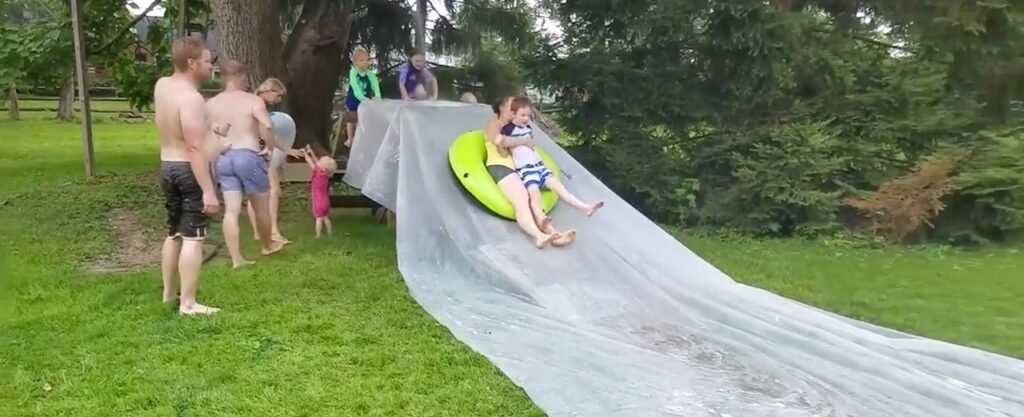
Every parent knows the “sprinkler under the trampoline” trick, but we took it further. I challenged the kids to build a continuous water delivery system using PVC pipes, buckets with holes, and old tarps. It’s part physics lesson, part soaking wet chaos.
I used to worry about the water bill until I realized how much I was spending on digital subscriptions. I’d rather pay for the water. The kids spent entire afternoons trying to get water from the top of the slide into a bucket ten feet away without it touching the ground.
I’ve found that “supervision” should be minimal here. I’d sit nearby with a glass of iced tea. If they got frustrated because their “aqueduct” collapsed, I’d ask a leading question like, “I wonder what would happen if you braced the base with those heavy rocks?” and then walk away.
This is “gentle parenting” in action—allowing them to struggle with a physical problem while remaining a supportive presence. By the time they were done, they were exhausted, prune-skinned, and completely disconnected from their online personas. It’s the best kind of tired.
5. Old-School Letter Writing and Pen Pals
In an age of instant DMs, the art of the long-form letter is dying. I decided to revive it by finding “Grandparent Pen Pals.” My kids would write to my parents or elderly aunts and uncles.
The rule was simple: you have to write at least two pages, and you have to ask three questions. Sarah used to complain that her hand cramped, but eventually, she started to love the process. She’d decorate the envelopes with stickers and drawings.
I’ve found that buying “fancy” stationery is the best way to get kids interested. If they have a nice pen and thick paper, the act of writing feels like a craft rather than a chore. It slows their brains down. They have to think about what they want to say before they ink it.
When the return letters arrived in the mail, the excitement was palpable. It wasn’t a notification ping on a phone; it was a physical object they could hold. This taught them the value of delayed gratification—something the internet is actively trying to destroy.
6. Culinary “Chopped” Junior Edition
My kitchen has seen some things. There was the “Oatmeal and Tuna” incident of 2016 that I’d rather forget, but the “Chopped” challenges were a summer staple. I’d give the kids three random ingredients—say, crackers, pickles, and leftover chicken—and thirty minutes to make a snack.
I’ve discovered that giving them full reign of the spice cabinet is the fastest way to make them feel like adults. Yes, they will probably use too much cumin. Yes, the kitchen will be a disaster. But they are learning a vital life skill: how to feed themselves without a microwave.
Maya actually became a quite talented cook through this. She learned how flavors interact and, more importantly, how to clean up after herself (which was a non-negotiable rule of the game). If you don’t clean the counter, you’re disqualified from the next round.
I’ve found that judging the food is the best part. I’d put on a fake British accent and give “constructive” feedback. It turned a mundane task like making lunch into a theatrical performance. It’s hard to miss your phone when you’re trying to defend your use of peanut butter on a turkey sandwich.
7. The 24-Hour “Living History” Challenge
This one is for the brave. We picked a time period—usually the 1800s—and tried to live like it for 24 hours. No electricity, no modern tech, and definitely no phones. We cooked over a fire pit and read by candlelight.
I’ve found that the first two hours are the hardest. The kids will moan about being bored. Let them moan. Boredom is the precursor to creativity. Around hour three, Leo started making a “bow and arrow” out of sticks and twine. Sarah started trying to “churn” butter in a mason jar.
This isn’t just a game; it’s a perspective shift. It makes them realize how much they rely on “magic boxes” for entertainment. We talked about what Sarah, Maya, and Leo’s lives would have been like back then.
A quick side note: Have a backup plan for dinner if the fire pit fails. I’m all for “living history,” but a starving toddler is a historical disaster no one needs to experience. We kept some “cold rations” (sandwiches) ready just in case.
8. Cardboard Box City Architecture
Never throw away a large appliance box in the summer. To a child, a refrigerator box is a mansion, a spaceship, or a fortress. We once collected enough boxes from neighbors to fill the entire basement.
The kids spent four days designing a “city.” They cut out windows, made “intercoms” out of paper towel tubes, and even created a currency system to trade for snacks. I’ve found that duct tape is the secret ingredient here. Give them three rolls and watch their engineering minds go to work.
I’ve discovered that “helping” usually ruins the fun. If I try to make the “roof” stable, I’m taking away their chance to figure out why it collapsed. My job is to provide the sharp box cutter (only for the older kids) and the tape.
By the end of the week, the “city” was a sprawling mess, but they had spent thirty hours working on a collaborative project. They were negotiating space, trading resources, and solving problems. You can’t get that from a video game.
9. Family Car Wash and Detail Shop
This might sound like “manual labor,” and it is. But if you frame it as a “Professional Detail Shop,” kids eat it up. I’d pay them a few dollars—less than a professional wash but enough to feel like a “real” job.
I’ve found that giving them the right tools—microfiber cloths, buckets of sudsy water, and a hose with a spray nozzle—is key. Leo loved the “power” of the hose. Maya liked the precision of cleaning the dashboard.
I’ve discovered that being a “picky customer” makes it more fun. I’d inspect the rims and say, “Excusme, there’s a smudge here. I’d like to speak to the manager.” They would giggle and scrub harder.
This teaches the value of hard work and the satisfaction of a job well done. Plus, I got a clean car. It’s a win-win. Just be prepared for a full-scale water fight to break out around the twenty-minute mark. That’s just part of the summer experience.
10. Intensive Gardening and “Seed-to-Table”
Gardening isn’t just for retirees. We gave each kid their own “plot” (or a large container). They were responsible for choosing the seeds, watering them, and weeding.
I’ve found that growing things you can actually eat—like strawberries or snap peas—is much more engaging than growing flowers. There is a primal joy in eating a tomato you grew yourself. Sarah was a notoriously picky eater until she grew her own kale. Suddenly, it was “gourmet.”
I’ve discovered that the “daily check-in” is the most important part. Every morning, before they did anything else, we’d go out and look for new sprouts. This creates a rhythm to the day that doesn’t involve a screen.
This activity teaches patience. Plants don’t grow faster because you “swipe up.” You have to wait. You have to nurture. In a world of “on-demand” everything, gardening is the ultimate antidote to the “I want it now” mentality.
11. Improve Theater and Homemade Movie Night
Instead of watching a movie, we made one. We didn’t use a phone to film it; we performed it live. We’d pick a theme—like “Space Pirates” or “Lost in the Jungle”—and spend the afternoon “scripting” (which mostly involved Leo shouting “Boom!”).
I’ve found that a “prop box” filled with old hats, scarves, and random kitchen utensils is a gold mine for creativity. Maya was always the director, Sarah was the lead actress, and Leo was usually the “special effects” guy who threw pillows at people.
We would invite the neighbors over for the “Premiere.” We’d serve popcorn and set up chairs in the living room. The kids felt like stars. The “performance” usually lasted ten minutes, but the preparation took all day.
I’ve found that “acting” helps kids process emotions and build confidence. It’s hard to be a “strong-willed toddler” when you’re focused on playing a “grumpy old king.” It gives them a healthy outlet for all that drama.
12. Local History “Detective” Missions
Every town has a weird history. We would go to the local library (the ultimate screen-free sanctuary) and look up old newspaper clippings or maps of our neighborhood from fifty years ago.
I’d give them a “mission”: find the oldest building on our street or figure out what used to be where the grocery store is now. We’d walk the streets like detectives, looking for clues in the architecture.
I’ve found that kids love a good mystery. When we discovered our house sat on what used to be a fruit orchard, they spent the whole afternoon looking for “ancient” apple trees. It connected them to their community in a way they’d never felt before.
This is a great way to sneak in some education without it feeling like “summer school.” It’s research, but with a purpose. It teaches them that the place they live has a story, and they are part of the next chapter.
13. The “Unplugged” Library Challenge
I’m a huge believer in the library. But we didn’t just go to get books. We did “The Library Challenge.” I’d give each kid a category—like “Bees,” “Ancient Egypt,” or “How to Build a Treehouse”—and they had to find three facts and one “cool” picture.
I’ve found that the “librarian” is your best ally. I’d encourage the kids to ask the librarian for help rather than looking things up on the computer. This builds social skills and teaches them how to navigate a physical filing system.
I’ve discovered that letting them pick out “guilty pleasure” books (like graphic novels or books about gross facts) is important. If you force them to read “the classics” all summer, they’ll associate reading with boredom. Let them read the “Diary of a Wimpy Kid” for the tenth time if it keeps them off the phone.
We would spend two hours in the air-conditioned quiet of the library. It was a reset button for their brains. They’d walk out with a stack of books and a sense of accomplishment.
14. DIY Board Game Design Studio
Instead of playing Monopoly for the thousandth time, we built our own board games. This is a massive project that can span several days. They had to invent the rules, design the board, and create the pieces.
I’ve found that “play-testing” is the most hilarious part. We’d try to play Sarah’s game, and within five minutes, we’d realize the rules made it impossible to win. We’d have a “developer meeting” to fix the “bugs.”
I’ve discovered that using “recycled” pieces from other games—like the thimble from Monopoly or a die from Yahtzee—makes the process faster and more fun. They aren’t starting from zero, but they are creating something entirely new.
This activity uses every part of their brain: math for the scoring, art for the board, and logic for the rules. It’s incredibly satisfying to see them play a game they built themselves. It’s “ownership” in its purest form.
15. The “Bonus” Sunset Picnic Tradition
This isn’t a high-energy activity, but it was our favorite. Once a week, we’d pack a simple dinner—just sandwiches and fruit—and drive to a local park or even just sit in the backyard to watch the sunset.
The rule: No phones, even for “taking a picture of the sunset.” We just had to look at it. We’d talk about the best part of the day and the worst part. We’d listen to the crickets and watch the fireflies come out.
I’ve found that these quiet moments are when the “real” conversations happen. Sarah told me about her fears for middle school during a sunset picnic. Leo admitted he was sorry for breaking a vase.
In the end, parenting isn’t about the “activities.” It’s about being present. The phone is just a barrier to that presence. When you put it away, you’re saying, “You are more interesting than the entire internet.” And that’s a message every kid needs to hear.
The Real Talk: Why Most Summer Plans Fail
I’m going to be honest with you: about 30% of what I just listed will result in a meltdown at some point. Someone will get a splinter. Someone will say “this is boring” for the forty-fifth time. Someone will accidentally spray the “Living History” fire with a garden hose.
I’ve discovered that the biggest mistake parents make is trying to be “The Cruise Director.” If you try to force the fun, the kids will resist. You have to be the “Consultant.” Offer the supplies, set the boundaries, and then back off.
Also, don’t try to do all 15 in one week. You’ll burn out by Tuesday. Pick one or two “big” things and fill the rest with “productive boredom.” Boredom is where the magic happens. It’s when Sarah starts writing poetry and Leo starts building a “robot” out of a cereal box.
Finally, don’t feel guilty if you have a “tech day” once in a while. We aren’t aiming for perfection; we’re aiming for balance. If it’s raining and everyone is cranky, put on a movie and don’t look back. Just make sure the next day involves some dirt.
Parting Wisdom
Raising Sarah, Maya, and Leo taught me that the days are long, but the summers are incredibly short. You only get about eighteen of them before they are heading off to college and texting you from their own “magic boxes.”
Don’t spend this summer fighting with your kids about their phones. Instead, give them a reason to put the phone down. Give them a memory that smells like cut grass and tastes like a slightly-burnt marshmallow.
You aren’t failing because your kids want to be on YouTube. You’re just a parent in 2026. It’s a tough gig. But you’ve got this. Just take it one “no-phone afternoon” at a time.
What’s the one activity your kids actually “forgot” their phones for? Or do you have a “Real Talk” horror story of a DIY project gone wrong? Drop your thoughts in the comments below—I’d love to hear from you!