
My living room once looked like a toy store had sneezed on it. There were light-up gadgets that beeped, plastic kitchens with 47 accessories, electronic learning tablets, motorized cars, and at least three versions of that one doll that sings the same four songs until you fantasize about a house fire. My kids — Sarah, Maya, and Leo — had more toys than they could ever play with.
And yet, at least twice a week, one of them would wander over to me and whine, “Mom, I’m bored.”
If you’ve been there, you know exactly how maddening that is. You’ve spent real money. You’ve given them options. You’ve watched a toy go from “I NEED this” to “I don’t even know where this is anymore” in under a week. And somewhere in the back of your mind, you start wondering if you’re doing something wrong.
You’re not doing anything wrong. You’ve just been sold a lie about what good play actually looks like.
The Problem with “More Toys”: Why Modern Toy Culture Is Failing Our Kids
Here’s something I’ve come to believe after raising three kids through the full spectrum of childhood: the toy industry is not in the business of supporting your child’s development. It’s in the business of making your child want the next thing before they’ve finished with the current thing.
Modern toys are engineered for immediate excitement. They light up, they talk back, they reward button-pushing with sounds and colors. The problem is that this kind of toy does the playing for your child. There’s no imagination required. No problem to solve. No story to create. The toy is the entertainer, and your kid is the passive audience.
I’ve found that toys which do too much are a total waste of money, even if they look like the more educational or engaging option. The research actually backs this up. Studies in developmental psychology have shown for years that open-ended play — where the child drives the narrative — builds stronger cognitive, emotional, and social skills than scripted, electronic play. But you don’t need a study to tell you that. You just need to watch a kid spend twenty minutes ignoring a $60 remote-control car to stack cardboard boxes instead.
The minimalist parenting movement has caught onto this. And they’ve been quietly heading back to the 1990s to find the answer.
What “Minimalist Parenting” Actually Means (And What It Doesn’t)
Before I go further, let me be clear about one thing: minimalist parenting is not about deprivation. It’s not about raising kids in a sparse white room with one wooden block and a sense of existential purpose. It’s not a parenting aesthetic for Instagram. It’s a philosophy.
At its core, minimalist parenting means being intentional. It means choosing fewer, better things that genuinely serve your child’s development — rather than reflexively buying the next trending toy every holiday season. It means trusting your child to be bored, and trusting boredom to do its job.
When Sarah was around eight, I made the decision to cut her toy collection roughly in half. She cried. I felt terrible. A week later, she had built an entire town out of a cardboard box, some markers, and a set of LEGO bricks we’d had in the house for years. That town lasted three weeks. She gave characters names, backstories, and ongoing plotlines. I’ve never seen her more absorbed in anything — not before the purge, not after.
That’s what minimalism in play looks like in practice. It looks like creativity filling the space that clutter used to occupy.
Why 90s Toys Were Actually Onto Something
The 90s weren’t perfect. But the toys were, in many ways, genuinely better for unstructured play. And minimalist parents have started noticing.
Think about what defined 90s toy culture: LEGO Classic sets with no instructions and no licensed theme. Wooden blocks. Lincoln Logs. Lite-Brite. Playmobil figures. Simple art supplies. Marbles. Jump ropes. Magnetic drawing boards. These toys had one crucial thing in common — they required your child to do the work of playing.
LEGO is probably the most obvious example. In the 90s, you got a bucket of bricks and your imagination. Today, LEGO sets are more expensive, more theme-specific, and often come with instructions so detailed they’ve essentially become a building manual rather than a creative prompt. I’m not saying those sets are bad. I’m saying they’re different, and that difference matters.
The 90s also coincided with a pre-screen era where kids were expected to entertain themselves. That expectation, which some parents now treat as cruel and unusual, was actually doing children a huge developmental favor. Boredom is not an emergency. It’s a launchpad.
The 5 Best 90s Toys Worth Bringing Back — And Why They Work
1. Classic LEGO Bricks (The Non-Themed, Open-Ended Kind)
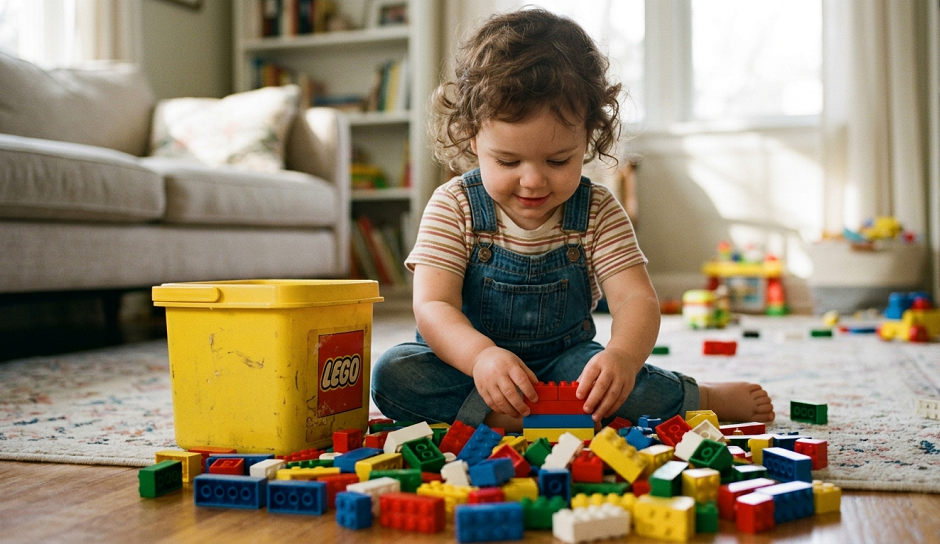
I’ll say it plainly: the best toy investment I ever made for all three of my kids was a large tub of mixed LEGO Classic bricks. No themes, no instructions, no licensed characters. Just bricks in various sizes and colors.
The beauty of classic LEGO play is that it is never “done.” There is no right answer, no completed state, no win condition. Your child can build the same thing ten different ways and call it a success every single time. It teaches spatial reasoning, patience, problem-solving, and creative confidence — and it does it without batteries, Wi-Fi, or a subscription fee.
I’ve watched Leo build the same base structure at least a hundred times. Each time, it became something new: a spaceship, a fort, a bakery, a “monster trap.” That flexibility — that willingness to tear down and rebuild — is a skill that will serve him his entire life. I genuinely believe that more than I believe in most parenting advice I’ve ever read.
If you’re going to buy one toy this year, buy a big tub of classic bricks. Don’t buy the Death Star. Buy the bricks. Your future self will thank you.
2. Playdough (Homemade or Store-Bought — It Doesn’t Matter)
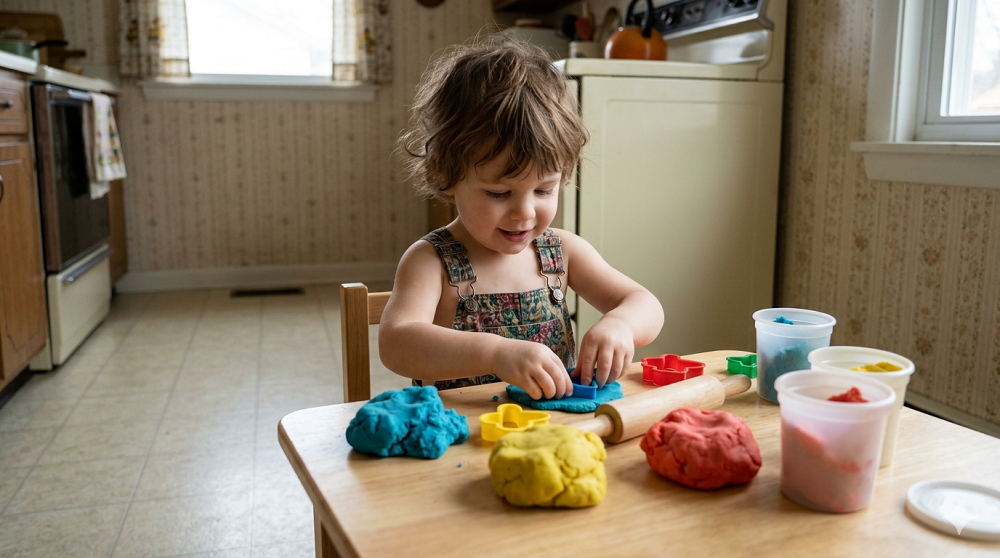
Playdough is one of the most underrated toys in existence, and I say that as someone who has spent years scraping it out of carpet. The sensory element alone makes it incredibly valuable for young children, but it goes far beyond that.
When Maya was in a particularly anxious phase around age six, playdough became her anchor. She’d sit at the kitchen table and knead it, roll it, cut it with plastic utensils for twenty, thirty minutes at a time. It was regulating in a way that I couldn’t always achieve with words. Her occupational therapist later confirmed what I was seeing: tactile, open-ended play like playdough is deeply calming to the nervous system and excellent for fine motor development.
Playdough also invites collaboration naturally. Two kids at a table with playdough will almost always start sharing, trading colors, building things together — without you having to prompt them. Compare that to two kids with separate screens, and the social difference is stark.
The 90s version of this was exactly the same as it is today: a can of Play-Doh, some simple plastic tools, and a table covered in a dollar-store tablecloth to make cleanup easier. The simplicity is the whole point.
3. Lincoln Logs and Classic Wooden Building Sets
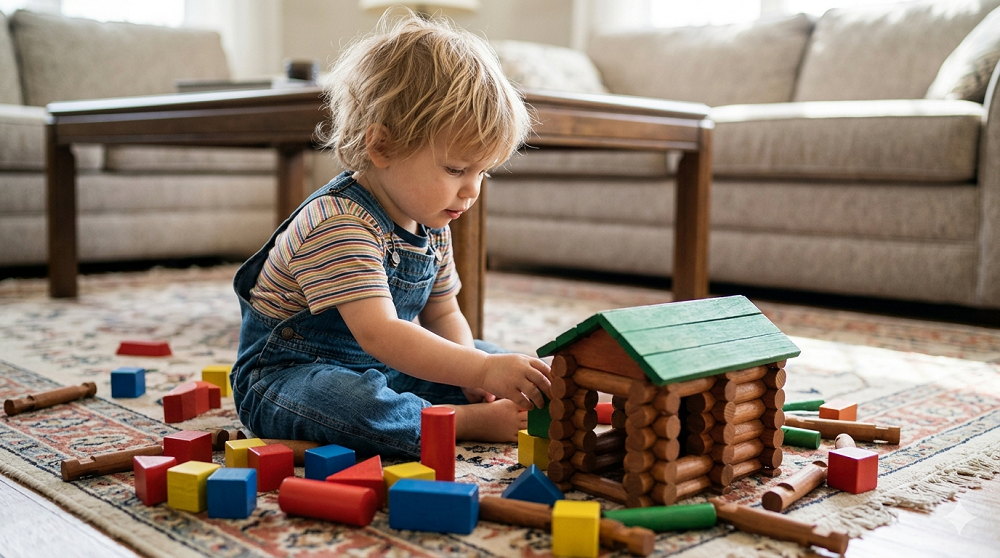
There’s something about wooden toys that screens and plastic simply can’t replicate. They have weight. They have texture. They make a satisfying sound when they come together. And wooden building sets, specifically the 90s-era Lincoln Logs style, teach construction logic in a way that’s almost quietly genius.
When children build with Lincoln Logs or similar wooden sets, they’re engaging in what developmental psychologists call “constructive play.” They’re not just stacking — they’re problem-solving in real time. Does this roof piece fit here? How do I make this wall stable? What happens if I try this differently? These are engineering questions dressed up as fun, and kids work through them completely on their own.
I’ve found that wooden building sets also tend to have a longer active life than plastic toys. They don’t break. They don’t need batteries. They look attractive even when they’re scattered on the floor, which means you’re slightly less likely to lose your mind stepping on them. Leo played with the same set of wooden blocks from age two all the way through first grade — which, in toy years, is basically a lifetime.
The minimalist advantage here is significant: one set of good-quality wooden blocks can replace easily ten plastic toys that each serve a narrower purpose. Fewer things. More play.
4. Art Supplies — The Boring Basic Kind
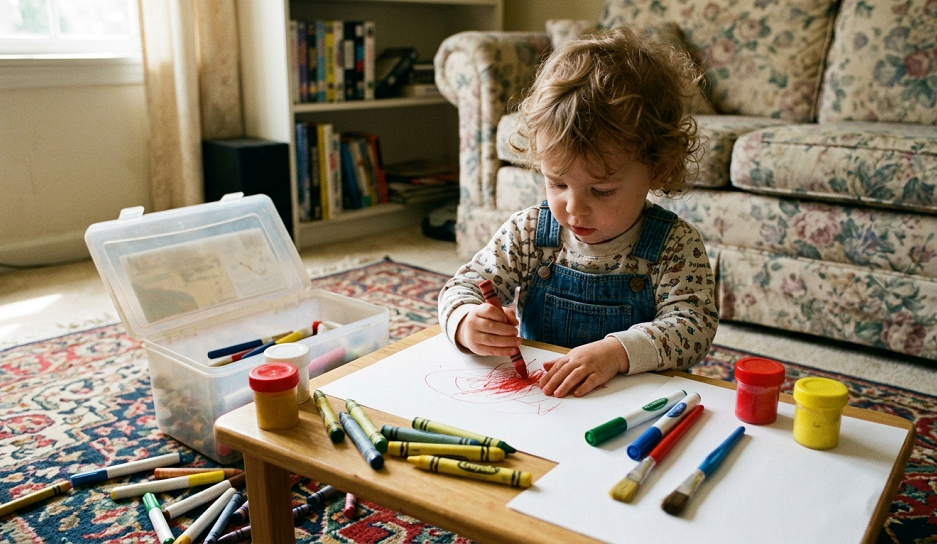
Here is where I will be fully opinionated and entirely unapologetic: the craft kits you buy at Target with 47 pre-cut foam shapes and a tube of glitter glue are a total waste of your money and your time. Every single one of those kits ends with a rushed project, a pile of leftover materials nobody knows what to do with, and a child who has learned to follow instructions rather than make creative decisions.
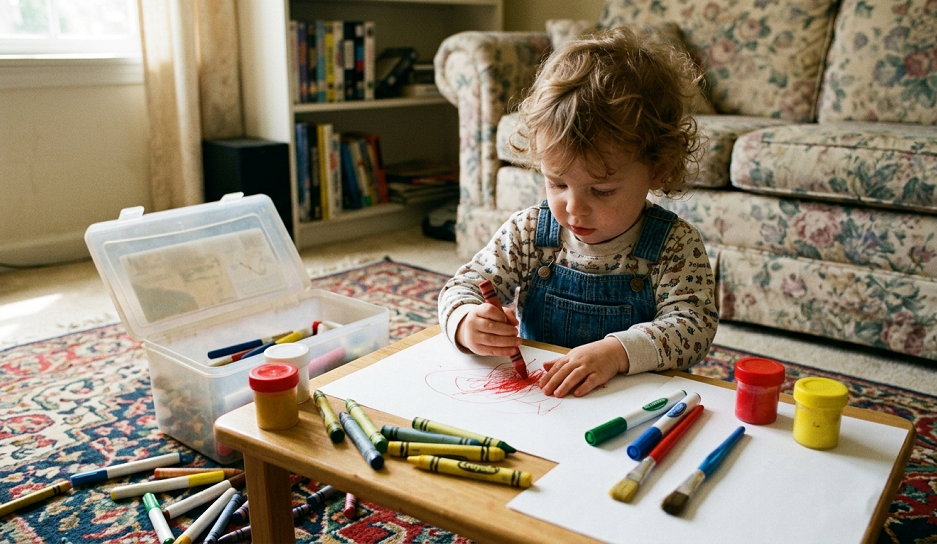
Give your child a blank sketchbook. Give them a basic set of crayons or colored pencils. Maybe some watercolors if you’re feeling brave. That’s it. That’s the whole kit.
When Sarah was eight, she went through a phase of drawing comic strips every single day. The characters had names and ongoing storylines that spanned weeks. Maya did the same at ten with elaborate maps of imaginary worlds. These weren’t directed projects. Nobody handed them a template. They had blank pages and they filled them — because children, when given space and materials and no instructions, will create things that will absolutely astonish you.
The 90s equivalent of this was the simple spiral notebook and the 64-count Crayola crayon box. The one with the sharpener in the back. No offense to any current craft kit manufacturers, but that sharpener in the back was peak childhood joy, and no foam sticker is going to compete with it.
5. Outdoor “Loose Parts” Play (The 90s Called It “Just Go Outside”)
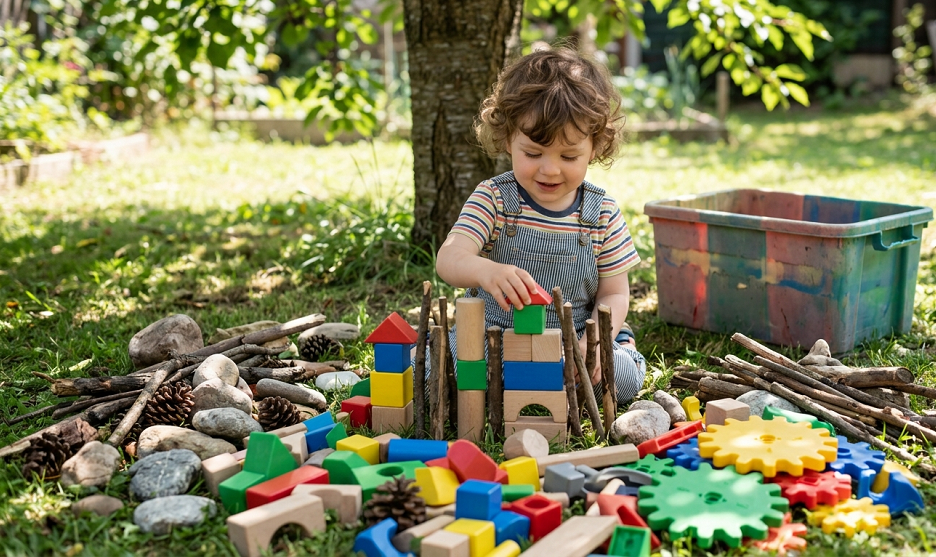
This one isn’t a product you buy — it’s a philosophy you restore.
In the 90s, kids went outside with no plan and no supervision and they figured it out. They found sticks. They dug in dirt. They built forts out of branches and leaves. They balanced on logs. They made up elaborate games with rocks and chalk. This kind of unstructured outdoor play with whatever materials the natural environment provided is what child development experts now call “loose parts play,” and it is having a serious renaissance among minimalist parents.
The research on outdoor, unstructured play is extraordinary. It supports physical development, obviously, but it also builds risk assessment skills, resilience, emotional regulation, and social negotiation in ways that indoor structured play simply cannot match. When kids decide together how a fort should be built, or whose rule counts in the game they just invented, they are doing incredibly complex social work.
I’m not saying let your five-year-old roam unsupervised for six hours. Times have changed, and your neighborhood context matters. But I am saying that a backyard, a pile of sticks, and a parent who resists the urge to organize the activity is one of the most valuable play environments you can offer.
Quick side note: Don’t underestimate the humble jump rope. It sounds almost embarrassingly simple. But jump rope develops coordination, cardiovascular fitness, rhythmic timing, and — when played in a group with rhymes and rules — genuine social skills. It’s also one of the few outdoor toys that works equally well alone or with friends, requires zero batteries, and costs about four dollars. I’d take a jump rope over a motorized scooter any day of the week.
Real Talk: What Can Go Wrong With the Minimalist Toy Approach
I believe deeply in this approach. I’ve seen it work with all three of my kids. But I would be doing you a disservice if I pretended it was seamless.
The hardest part of minimalist toy philosophy isn’t choosing the right toys. It’s the transition. If your child is used to highly stimulating, high-input toys, switching to open-ended, simpler options can feel like a punishment to them — at least initially. Leo went through a solid two weeks of resistance when I scaled back his collection. He didn’t know what to do with himself. He sulked. He complained. He told me other moms were better than me, which I filed under “things kids say.”
And then, gradually, he started playing differently. More independently. More imaginatively. The boredom became a springboard.
The other challenge is external pressure. Grandparents, well-meaning friends, birthday parties — the world is full of people who want to give your child the flashiest, most impressive gift they can find. You can’t control that, and I’d encourage you not to try too hard to control it. Pick your battles. Accept the gift graciously, add it to the rotation, and see what happens. Minimalism isn’t a religion. It’s a direction, not a destination.
I’ll also be honest: there are kids for whom structured, themed toys genuinely work better. Kids with certain learning differences, kids who are highly visual or kinesthetic, kids who light up at the intersection of story and toy in a way that plain bricks don’t offer — they’re real, and they exist. Watch your child. Trust what you observe. No parenting philosophy, including mine, should override what you see working right in front of you.
Parting Wisdom
The best thing I ever did for my kids’ play lives was also one of the scariest: I gave them less, and I trusted them to figure out more. It felt counterintuitive. It felt like I was somehow withholding something. But the evidence — in my own children, in the research, in the gentle revolution of minimalist parents quietly swapping out plastic light-up toys for tubs of LEGO bricks and blank sketchbooks — is overwhelming.
Your child doesn’t need more options. They need more space — space in the toy bin, space in the schedule, and space in the afternoon where nothing is planned and nothing is expected.
The 90s got a lot wrong. But on this one, they got it right.
You’re not failing your kids by simplifying. You’re trusting them. And that trust, more than any toy on any shelf, is what they’ll remember.
I’d love to hear from you: Have you tried scaling back your child’s toys, or brought back any retro favorites? What happened? Drop your experience in the comments below — your story might be exactly what another parent needs to read today. Questions are always welcome too. That’s what this little corner of the internet is for.