
There comes a point — usually during bath time when someone is screaming, someone else is hungry again, and you’re pretty sure you haven’t had a warm cup of coffee since 2019 — where you wonder if your kids will remember anything good about their childhood. Not the vacations. Not the birthday parties with the bouncy castle. Just you. Will they remember you?
That question kept me up more nights than I’d like to admit. Raising Sarah, Maya, and Leo didn’t come with a manual. What it came with was a lot of trial and error, a few spectacular parenting failures (Leo’s “independence phase” at age four was genuinely terrifying), and a slow, humbling realization: kids don’t need grand gestures. They need rhythms. They need to know that certain things will always happen, that you will always show up for those things, and that your family has its own particular, slightly quirky way of moving through the world.
That’s what traditions do. They aren’t just nice memories — they are the architecture of belonging.
Here are 11 simple family tradition ideas that actually work, along with some honest thoughts on what doesn’t.
1. The Sunday Morning Slow Breakfast — No Screens, No Rush
This one changed our family more than almost anything else I’ve tried, and I say that as someone who has attempted meal planning, chore charts, and a brief, disastrous experiment with a “feelings jar.”
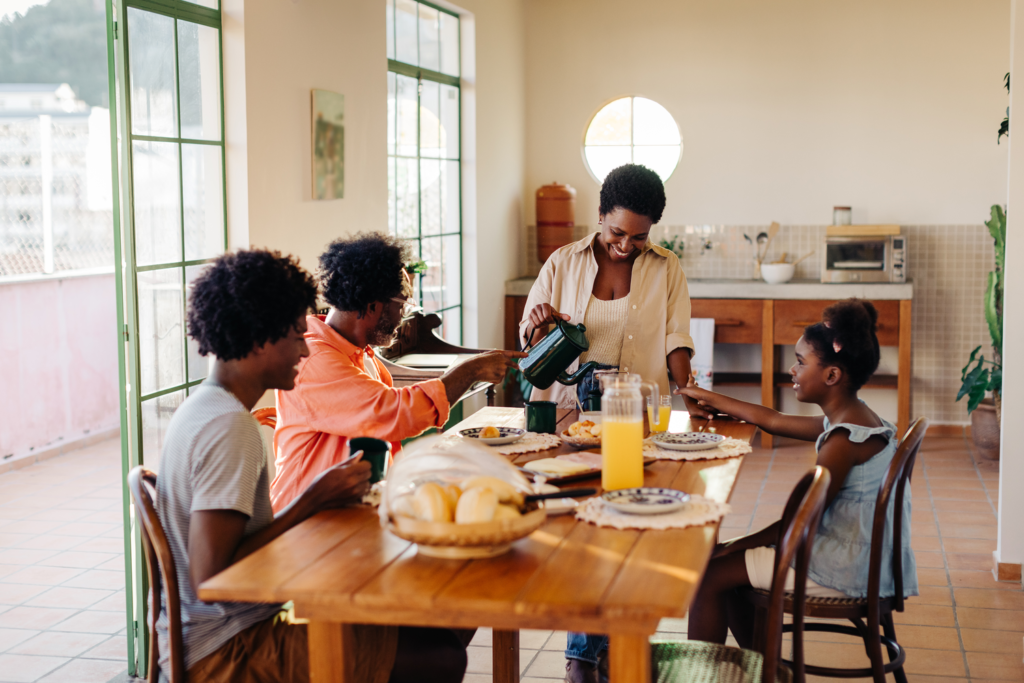
Sunday mornings in our house became sacred early on. Nobody had to be anywhere. I’d make something that took actual effort — real pancakes, scrambled eggs, fruit salad — and the rule was simple: phones stayed in bedrooms until the dishes were done. We sat together. We talked. We didn’t have an agenda.
What surprised me was how much my kids actually opened up in that low-pressure setting. Maya told me about a friendship falling apart at school while absently poking at her eggs. Leo confessed he’d been scared about a math test when we were all just sitting there laughing about something silly. Nobody was being parented at. We were just eating.
The key is consistency, not perfection. There were Sundays this didn’t happen — travel, illness, teenage rebellion. But most Sundays, it happened. And now that Sarah is 24 and living in another city, she texts me on Sunday mornings. Sometimes just: “Miss slow breakfast.” That’s enough for me.
How to start: Pick one morning — doesn’t have to be Sunday. Make something slightly more intentional than toast. Put your phone away first. The kids will notice that you went first.
2. A Family Motto or Saying That’s Uniquely Yours
I know, I know — it sounds cheesy. I thought so too. But hear me out, because this is the tradition that has held up the longest and costs absolutely nothing.
When my kids were young, we started saying “We figure it out” whenever something went wrong. Lost luggage at the airport? “We figure it out.” Rained out the camping trip? “We figure it out.” The phrase wasn’t about toxic positivity — it wasn’t “everything is fine!” It was a statement of identity. We are people who figure things out.
Over time, that motto became part of how my kids identified themselves. I heard Leo use it with his college roommate during a tough semester. I heard Maya say it to her younger cousin. It had legs I never expected.
A family motto works because it gives kids a framework when you’re not in the room. It’s your voice, echoing in their head during hard moments, without you having to be there. That’s powerful stuff.
How to start: Don’t manufacture a motto from scratch. Listen to your family for a few weeks. Is there a phrase you naturally repeat? A belief that keeps coming up? Name it. Write it on a sticky note on the fridge. See what happens.
3. The Birthday Interview — One Question Every Year
Every birthday, I sit down with whoever is turning a year older and ask them the same set of questions. What was your favorite memory this year? What’s something you’re proud of? What do you wish you could change? What are you looking forward to?
I write down their answers in a notebook I keep for each child.
I started this when Sarah turned five. She is now 24. I have nineteen years of her answers. When she turned eighteen, I read some of them back to her. She cried. I cried. Leo, who was nearby, pretended he wasn’t crying and went to get a glass of water that took suspiciously long to pour.
The beauty of this tradition is that it tells your child: your thoughts are worth recording. Your inner life matters enough to document. That message, repeated every single year, does something profound to a child’s sense of self.
How to start: A dollar-store notebook is fine. A voice memo on your phone is fine. The container doesn’t matter. What matters is that you ask, you listen, and you save the answers.
4. Weekly “Highs and Thorns” at Dinner

I’ve found that asking kids “how was your day?” is a total waste of time, even if it looks like the easier option. The answer is always “fine.” Always. It doesn’t matter if they just survived a school fire or won the spelling bee. “Fine.”
Instead, I discovered the hard way that “Highs and Thorns” truly works if you’re patient enough. The rule: everyone at dinner shares one high from their day and one thorn — something hard, annoying, or disappointing. And here’s the critical part: grown-ups go first, every time.
When I started sharing my thorns — a frustrating meeting, a hard conversation, a moment I handled badly — my kids relaxed. They realized that hard things happen to adults too. That struggling isn’t a sign of failure. And slowly, they started sharing real thorns, not performed ones.
This tradition requires patience because it takes a few weeks before kids trust it. In the early days, Leo’s thorn was always “I don’t have a thorn.” That’s fine. Keep going. One day he’ll surprise you.
How to start: Announce it at dinner tonight. Go first. Share something real from your own day — not a humble-brag thorn, an actual hard thing. Model the vulnerability you want to see.
5. A “Gratitude Jar” That You Open Once a Year
Through the year, any family member can write something they’re grateful for on a slip of paper and drop it in a jar. It can be big (“I’m grateful Maya was born”) or small (“grateful for the good parking spot today”). We open ours on New Year’s Eve and read them all aloud.
What I love about this tradition is that it builds a counter-narrative to the year’s hard moments. By December, you might be exhausted, you might have had a rough few months, but then you’re sitting there reading a note in Leo’s nine-year-old handwriting that says “grateful for Dad’s chili” and everything feels a little lighter.
It also teaches kids to notice good things as they happen — to have the impulse to write something down instead of letting it pass unacknowledged. That’s a life skill, not just a family tradition.
A quick side note: if you try this and the jar is nearly empty at year’s end, don’t shame anyone. Just make the jar more accessible next year. Put it on the kitchen counter, put some pens right next to it. Lower every possible barrier.
How to start: Any jar works. A pasta jar, a mason jar, a shoebox if the jar thing isn’t your aesthetic. Put it somewhere visible. Write the first note yourself.
6. Seasonal Family Rituals Tied to Nature
Not everyone has the same access to nature, and I want to be clear that you don’t need a backyard or a forest preserve to make this work. What matters is acknowledging the rhythm of seasons together.
In our family, the first fall Saturday was always the day we made soup. Not a specific soup — just a soup, whatever we were feeling. Everyone had a job in the kitchen. Even when my kids were tiny, they could wash vegetables or stir something. The smell of that soup became, for all three of my kids, the smell of fall itself.
Spring meant planting something — even just a pot of basil on a city windowsill. Summer had its own rituals. What you choose matters less than the consistency.
The reason nature-based rituals work so well is that they connect kids to something larger than themselves. Time moves. Seasons change. And every year, your family marks it together. There’s deep comfort in that pattern, especially during childhood years when so much feels uncertain and new.
How to start: Pick one season and one simple act. Something your family could realistically do every year regardless of budget. Make soup. Pick apples. Plant one seed. Do it the same time next year.
7. The Annual Letter to Your Future Self
Once a year — we did this on the first day of school — everyone in the family writes a letter to themselves to be opened in five years. We seal them, label them with the open date, and keep them in a family envelope in a drawer.
I first made my kids do this when Sarah was eight. She found it hilarious and wrote mostly about her favorite TV show and her hamster. When she opened it at thirteen, she was genuinely moved. The girl in that letter felt like a stranger and a best friend at the same time.
This tradition does something really specific: it gives children a relationship with their own growth. They aren’t just growing — they’re watching themselves grow. That kind of self-awareness, built early, is worth its weight in gold.
For parents, writing your own letter alongside your kids is important. Don’t just facilitate; participate. My kids used to peek over my shoulder to see if I was actually writing or just pretending. I was always actually writing.
How to start: First day of school, New Year’s Day, or birthdays all work. Provide paper, an envelope, and uninterrupted quiet. Seal it. Mark the open date. Put it somewhere you won’t lose it.
8. The Monthly “Yes Day” (With Real Rules)
One Saturday a month, one child gets to be the decision-maker for a chunk of the day — usually a four-to-six-hour window. They pick the breakfast, the activity, the lunch spot. Within reason and within budget. And the family says yes.
I want to be precise about what this is and isn’t. It is not a free-for-all. When Maya was seven, she wanted her Yes Day to involve eating only cereal and watching movies all day. We said yes, with the understanding that this counted as her day. She used it. She had a great time. It was also a bit boring by hour three and she admitted as much.
What Yes Day teaches is that every member of the family has preferences that deserve space. The youngest child’s preferences matter. The quiet child who always goes along with everyone else gets their moment. Over time, it also teaches kids to think about what they actually enjoy — not what they think they should enjoy.
The rule I’d add: parents don’t complain during Yes Day. You can set safety and budget limits upfront, but once those are set, you show up with genuine enthusiasm. Kids can smell performative participation from a mile away.
How to start: Announce it, let each kid have a turn over the next few months, and make the first one count. Your real buy-in on the first Yes Day sets the tone for all the ones that follow.
9. A Family Book (or Podcast) Club — Especially for Car Rides
I’ve raised three very different readers. Sarah devoured books. Leo avoided them until adulthood. Maya was somewhere in the middle. The format that worked for all three of them was audiobooks on long drives — and the rule that we talked about what we heard.
We didn’t call it a book club. We just listened and then talked. About characters’ choices. About whether a decision was fair. About what we would have done differently. Some of our best conversations about ethics, courage, and friendship happened somewhere on the interstate while a narrator described a fictional kid’s fictional problem.
The magic of this tradition is that it gives kids a safe fictional distance to discuss real things. Leo would never have talked to me about peer pressure directly, but he had very strong opinions about a character who caved to one. I knew exactly what he was really saying.
How to start: Pick an audiobook everyone might tolerate. Start it on the next road trip or school run. Don’t force discussion — just ask one question out loud and see what happens.
10. A “Family Walk” That Has Nothing to Do With Exercise

I’m not talking about a fitness walk. I’m talking about a slow, wandering walk where nobody has a destination and the only rule is that you stay together and you don’t look at your phone.
We started our family walk tradition by accident during a power outage when my kids were young. With nothing else to do, we just walked around the neighborhood. We noticed things — a house with a funny mailbox, a dog that always barked at us, the way the light looked on a particular corner at dusk. My kids named the dog (they called him Gerald) and asked about him every time we walked past, even years later.
That walk became a ritual. Sunday evenings when the weather allowed. It was the opposite of productivity, which is exactly why it worked. Nobody was trying to accomplish anything. We were just present together, noticing the same world at the same pace.
How to start: After dinner, this weekend, propose a fifteen-minute walk with no destination. If your kids complain (and they might), go anyway. Bring a snack if that helps. After three or four times, it becomes normal. After a few years, it becomes something they’ll miss.
11. The Annual Family Photo That Isn’t Polished
I have boxes of professional family photos. Coordinated outfits, good lighting, everyone smiling. They’re lovely. My kids can barely remember taking them.
What I also have, though, is a yearly tradition of taking one completely unscripted photo of our family doing exactly what we’re doing on a random Tuesday in whatever month I feel like. Cooking dinner. Watching something together. All piled on the couch. Nobody posed. Nobody warned.
Those photos are the ones my kids actually stop and look at. Because they capture truth, not performance. They show who we actually were, not who we were trying to look like.
This tradition is so simple it almost doesn’t count, except that it does. It tells your children: our ordinary life together is worth documenting. What we look like when nobody’s watching is also beautiful.
How to start: Right now, today — take one photo of your family doing whatever you’re doing. No staging. Save it. Do it again next year, same approximate time. Build the archive.
Real Talk: What Can Go Wrong (And What Isn’t Worth the Effort)
Let me be direct here, because I’ve wasted real time and real emotional energy on family traditions that sounded beautiful and fell apart spectacularly.
The “gratitude journal” where everyone writes every morning before school? A lovely idea. A total failure in our house. We had three kids on three different schedules who barely had time to eat breakfast. Forcing a gratitude practice at 7:15 AM turned gratitude into a chore, which is the exact opposite of the point. Sometimes the beautiful thing doesn’t fit your actual life, and that’s okay.
Elaborate holiday traditions that require weeks of setup also tend to collapse under their own weight. I’ve learned to choose depth over complexity. One simple thing done consistently beats five elaborate things done resentfully.
And please — don’t try to launch five new traditions at once. Pick one. Do it long enough that it sticks. Add another only when the first feels natural. Your family isn’t a project to be optimized. It’s a collection of actual human beings with actual limits, and traditions should feel like relief, not pressure.
If a tradition stops working — if your kids have aged out of it, if it’s creating friction instead of connection — you’re allowed to let it go. Traditions should serve the family, not the other way around.
The Wrap-Up: You’re Not Behind. You’re Right On Time.
Here’s what I want you to take away from all of this: you don’t have to have been doing these things since your kids were born to start now. You don’t need a perfectly scheduled household or a Pinterest-worthy aesthetic. You need about fifteen minutes, one genuine idea, and enough consistency to let a pattern form.
Sarah, Maya, and Leo are adults now. When I ask them what they remember about childhood, they don’t mention the expensive vacations or the big birthday blowouts. They mention the Sunday pancakes. They mention the walks. They mention the time we sat around reading gratitude notes and Leo’s was about chili.
The small things, done repeatedly with love, are the things that last.
My parting wisdom is this: start with the tradition that sounds most like you. Not the most impressive one, not the one that looks best on paper — the one that genuinely fits how your family already moves through the world. Connection doesn’t need a complete overhaul. It just needs a door you open on purpose, again and again.
Now I want to hear from you: What’s one tradition your family already has — even if you’ve never called it that? Or is there a tradition you’ve always wanted to start but haven’t been sure how? Drop it in the comments below. I read every single one, and some of your ideas end up in future posts. This community is genuinely one of the best things about this work, and your experience matters here.
Have questions or want to share your experience? Leave a comment below — or reach out directly through our contact page. We’re all figuring this out together.