
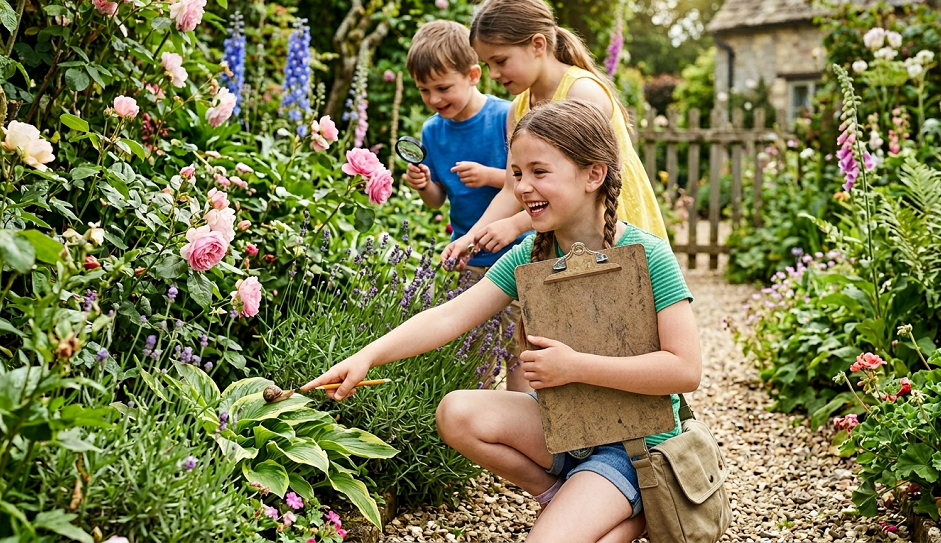
Every summer, it happens. The kids have been inside for approximately forty-five minutes and someone has already said the words “I’m bored.” You point at the yard — that beautiful, green, perfectly good yard — and they stare at it like you’ve just suggested they vacation on the moon.
That was my life with Sarah, Maya, and Leo for more summers than I care to count. Three kids, an outdoor space, and absolutely zero interest from them in using it. I tried the classic “just go play outside” line. I tried bribery. I once tried dramatically sighing while staring out the window, hoping they’d feel guilty enough to go explore on their own. None of it worked.
What finally worked — and I mean really worked, in the “they begged to do it again tomorrow” way — was giving them a mission. A purpose. A reason to care about what’s growing under their feet.
Garden scavenger hunts changed the game in our household. And I’m not talking about printing out some generic list from a search engine and calling it a day. I’ve found that a totally generic list is a total waste of time, even if it looks like the easier option. Instead, I’ve discovered the hard way that a scavenger hunt only works when it’s specific, a little silly, and genuinely connected to what’s actually in your outdoor space. It takes about ten extra minutes to customize, and the payoff is enormous.
Here are seven garden scavenger hunt ideas that have earned gold stars in our family — and a few hard-won lessons along the way.
1. The Texture Trail: A Sensory Garden Scavenger Hunt for Young Kids
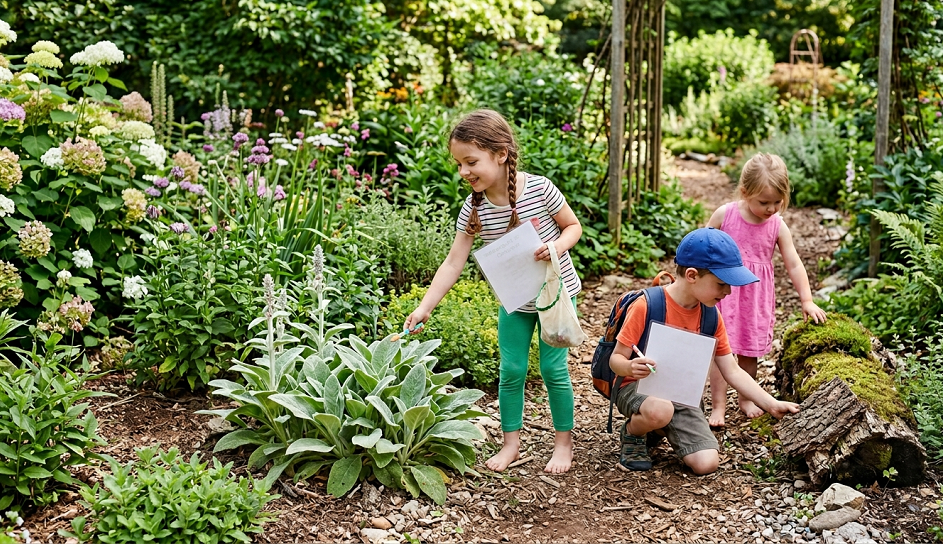
This one started as an accident. Leo was about four years old, and I was trying to explain why he shouldn’t just yank every plant out of the ground to “investigate it.” So I gave him a job instead: find me something rough, something smooth, something soft, and something poky. He was gone for thirty minutes. Thirty. Minutes. In four-year-old time, that’s basically a full workday.
The Texture Trail is perfect for younger kids, roughly ages three to seven, because it doesn’t require any reading or counting skills. You’re handing them a sensory experience that teaches them about the natural world without them even realizing they’re learning anything.
How to set it up: Write or draw a simple list of textures to find. Rough bark, smooth stone, fuzzy leaf, prickly stem, squishy soil, silky petal. If your kids can’t read yet, draw little pictures or cut out images from a magazine. You can even create a “texture board” — a piece of cardboard where they tape or press their finds. The board becomes a keepsake, which is a bonus.
Why it works: Young children are hardwired for sensory exploration. You’re not fighting their instincts — you’re channeling them. My pediatrician once told me that unstructured sensory play is one of the most developmentally rich activities a young child can do. A garden is basically a free sensory gym if you know how to frame it.
One thing I’d add: Don’t correct them too quickly if they pick something that doesn’t fit the category the way you’d expect. Leo once brought me a worm and declared it “smooth AND squishy,” which was scientifically accurate and deeply disgusting. I counted it. That kind of lateral thinking is worth encouraging.
2. The Bug Safari: A Backyard Insect Scavenger Hunt for Curious Kids
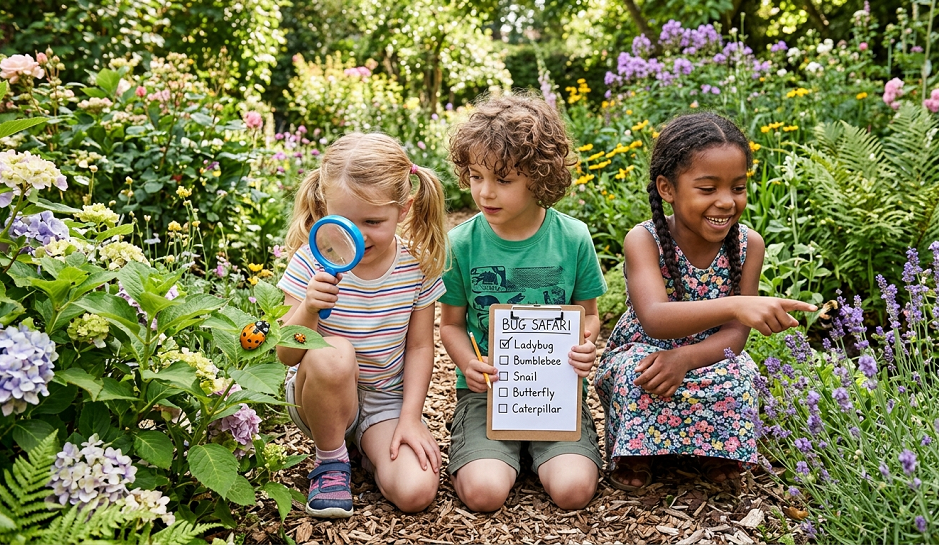
Sarah was my bug kid. The girl was not afraid of anything that crawled. Maya, on the other hand, screamed when a beetle landed on the porch. What I discovered is that a Bug Safari works for both types of kids — because you get to decide the rules. Sarah’s version involved catching and inspecting. Maya’s involved spotting from a safe distance and drawing what she saw in a little notebook.
The point isn’t to hold a cricket. The point is to observe, slow down, and notice that the garden is absolutely teeming with life.
How to set it up: Create a list of insects and small creatures that are realistically findable in your garden. Ants, bees (observe only — no touching), butterflies, ladybugs, earthworms, caterpillars, pill bugs, grasshoppers. Give each child a small notebook or a printed sheet with illustrations. When they spot something, they check it off or draw it. Bonus: look up each creature together afterward and pick one fun fact to remember.
Why this beats the alternatives: I’ve tried those plastic bug-catching kits, and I’ve found them to be mostly a way to spend money on something that breaks in a week. A notebook and a pencil are infinitely more durable and teach the same observation skills — better ones, actually, because drawing forces your child to look closely in a way that grabbing something into a plastic tube does not.
The age range sweet spot: Kids aged five to eleven tend to get the most out of a Bug Safari. Younger kids need more supervision near anything that might bite or sting. Older kids can be given field guides and turned loose with real research goals — what’s the most common insect in our garden this week? Do the numbers change after rain?
3. The Color Wheel Challenge: A Rainbow Garden Scavenger Hunt
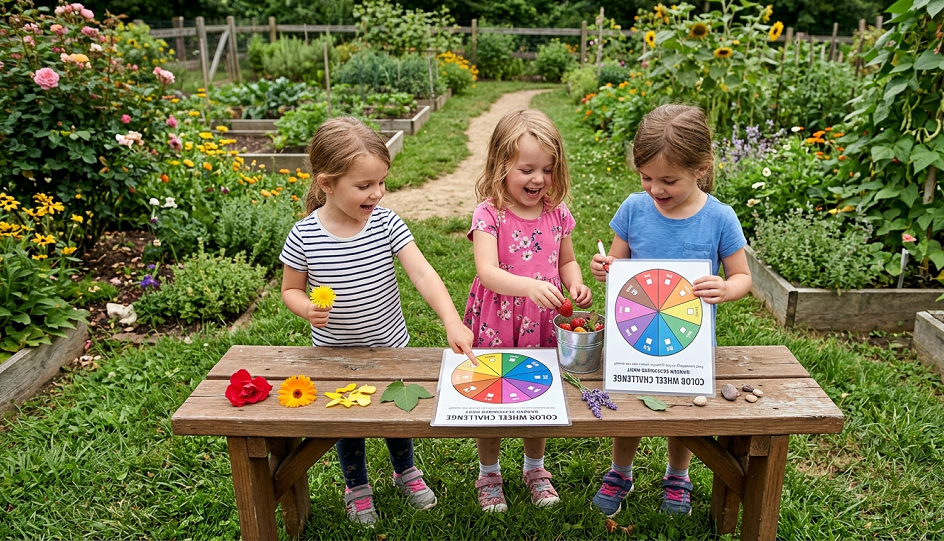
This is the one I recommend most often to parents whose kids have zero interest in plants. It requires absolutely no plant knowledge. You’re not asking them to name anything. You’re just asking them to find every color of the rainbow in the garden.
Red, orange, yellow, green, blue, indigo, violet. Seven colors, one outdoor space, and usually a surprising amount of competition between siblings about who can find the most obscure shade of indigo in a garden that doesn’t contain a single blue flower.
How to set it up: Print or draw a simple color wheel on a piece of paper. Kids find one natural thing for each color — a leaf, a petal, a stone, a piece of bark — and either draw it, photograph it on an old tablet (if you want one exception to the screen-free rule), or tape a small sample to the paper. Give a time limit. Twenty minutes works well. More than thirty and the energy starts to flag.
Here’s what makes it memorable: Add a “mystery color” challenge at the end — something unusual like silver, black, or brown. Kids get genuinely creative trying to find a black beetle, silver spider silk, or a deep brown seed pod. It teaches them that color in nature is far more varied and subtle than a crayon box suggests.
Why I love this for mixed-age groups: The Color Wheel Challenge scales beautifully. A four-year-old finds a red flower and is thrilled. A ten-year-old starts dissecting the concept of what “indigo” actually means in nature. Everyone succeeds, nobody feels left behind, and the conversation afterward — about how plants get their colors, why flowers are bright, what chlorophyll is — happens naturally, without a single PowerPoint slide.
4. The Garden Detective Hunt: A Nature Observation Scavenger Hunt for Older Kids
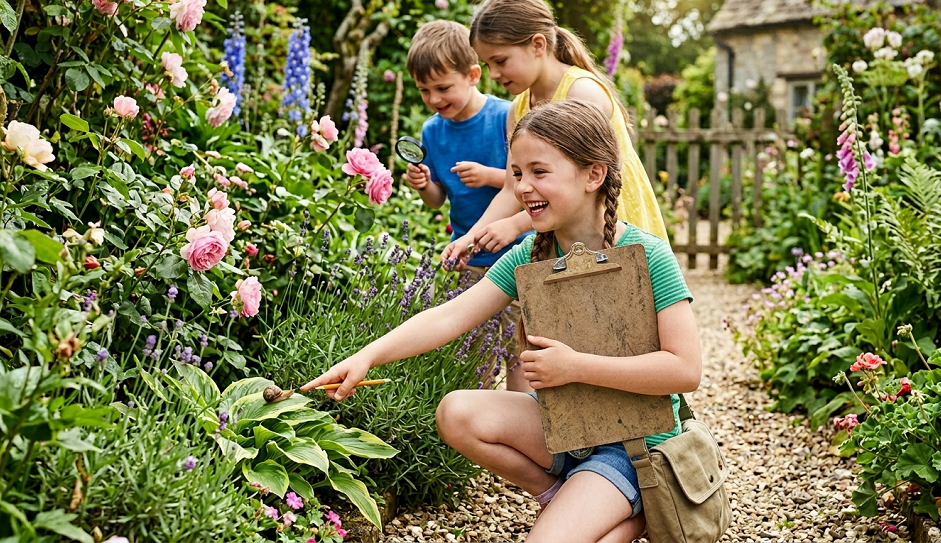
By the time Leo hit eight or nine, simple find-and-check lists weren’t doing it for him anymore. He needed something that felt like a real challenge. That’s when I started building what I call the Garden Detective Hunt — a scavenger hunt built around clues and evidence rather than direct sightings.
Instead of “find a bee,” the clue becomes: “Find proof that a bee was here today.” Instead of “find a flower,” it becomes: “Find a flower that is past its peak bloom and explain how you can tell.” The child has to think, reason, and make an argument. It’s basically the scientific method dressed up as a treasure hunt.
How to set it up: Write five to eight observation clues. Here are some examples that have worked well in my garden:
- Find evidence that something has been eating the leaves. What do you think made those marks?
- Find a plant that is getting more sun than it probably wants right now.
- Find two plants competing for the same space. Which one do you think is winning?
- Find a seed that is ready to travel. How does it plan to get somewhere new?
- Find the oldest-looking thing in this garden. How can you tell it’s old?
Why this one is a game-changer for reluctant older kids: I’ve found that kids aged eight and up often resist scavenger hunts because they feel babyish. This version feels like actual detective work. The key is asking “how do you know?” after every single answer. That one question does more for critical thinking than most classroom exercises I’ve seen.
5. The Nighttime Garden Scavenger Hunt (Yes, Really)
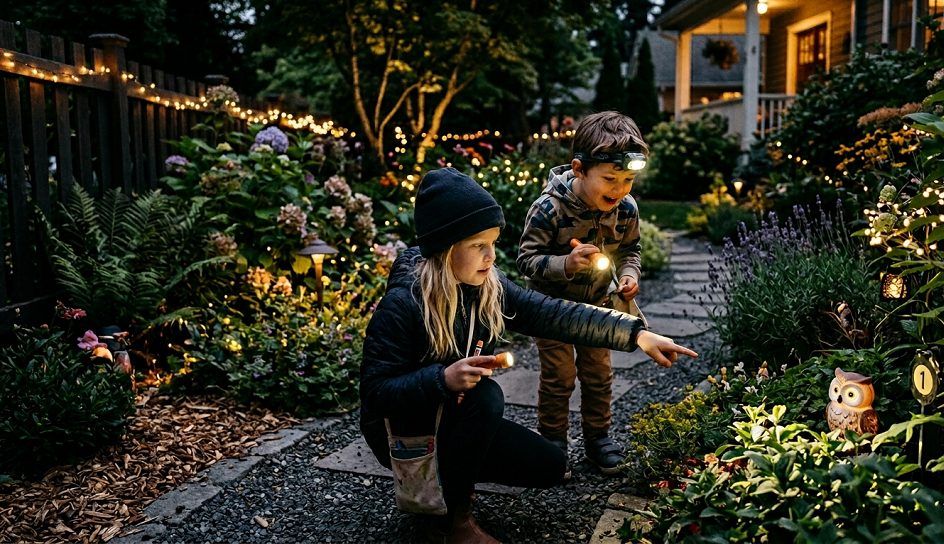
This one requires a flashlight, a supervising adult, and a willingness to accept that your kids will be slightly unhinged with excitement and probably won’t sleep for another hour afterward. It is absolutely worth it.
The nighttime garden is a completely different world. Moths instead of butterflies. Fireflies if you’re lucky enough to have them. Slugs and snails doing their slow business along the edges of the beds. The air smells different, the sounds are different, and children who are completely over the daytime version of outdoor exploration will suddenly be wide-eyed and genuinely awed.
How to set it up: Keep the list simple, because it’s dark and reading is harder. Five to seven items maximum. Some ideas: a moth near a light source, a spider in a web (easier to find at night), a snail on a leaf, a plant that smells different at night (jasmine, moonflower, and four o’clocks are famous for this), dew beginning to form on a grass blade, any creature that is clearly active and moving.
Timing matters: Just after dusk is the sweet spot — probably thirty to sixty minutes after sunset depending on your season. Bring bug spray, sensible shoes, and prepare for the fact that your child will absolutely shine a flashlight directly in your eyes at some point. It’s basically a rite of passage.
My honest parenting opinion: This is a special-occasion hunt, not a weekly routine. Its power comes precisely from being rare. I did it with my kids maybe three or four times a summer, and each time it felt like an event. Overdo it and the magic disappears. Protect the magic.
6. The Garden-to-Table Scavenger Hunt: Teaching Kids Where Food Comes From
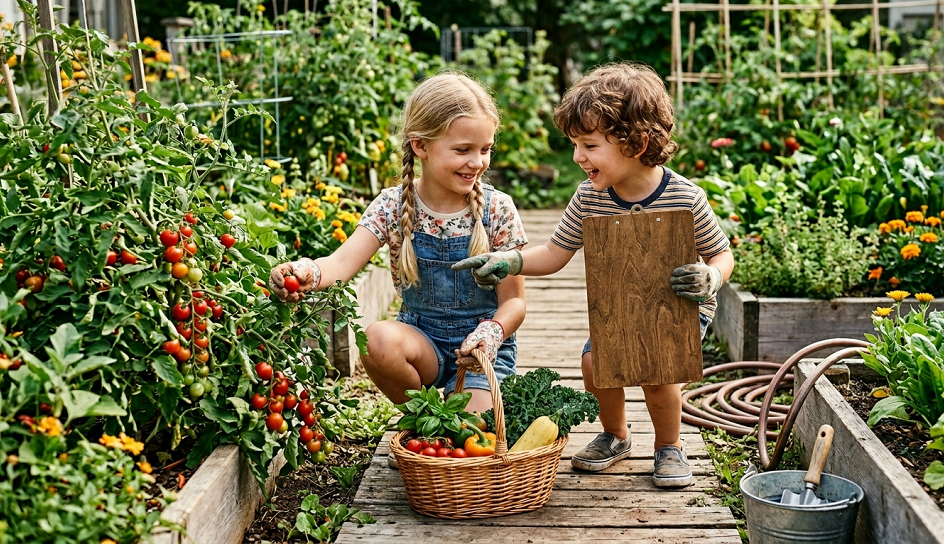
If you grow anything edible — even a single tomato plant, a pot of herbs, or a strawberry runner — this hunt is for you. It is also the hunt that has the most lasting impact, in my experience. Long after my kids stopped caring about finding the prettiest petal, they retained the knowledge of where food actually comes from. And that knowledge changed the way they ate.
The Garden-to-Table Hunt asks kids to find ingredients for a meal, snack, or drink. It’s purposeful. It ends with something they can eat. That combination of real-world relevance and immediate reward is extraordinarily motivating for children who struggle to see the point of “just being in nature.”
How to set it up: Before the hunt, decide on a simple recipe that uses garden ingredients. Salad. Herb butter. Strawberry shortcake. Mint lemonade. Write a list of what they need to find and harvest. Include quantities, which adds a math element. “Find twelve cherry tomatoes. Find five big basil leaves. Find one cucumber.” Walk them through safe harvesting before they start — what’s ready, how to pick without damaging the plant, what to leave alone.
The conversation that always follows: Every single time I did this hunt with my kids, they became more willing to eat the food they’d grown. Leo, who spent three years refusing to eat anything green, ate a salad he had harvested himself when he was seven years old. That moment is burned into my memory. He didn’t suddenly love salad. But he tried it. And that was everything.
7. The Seasons Scavenger Hunt: A Year-Round Outdoor Activity for Kids
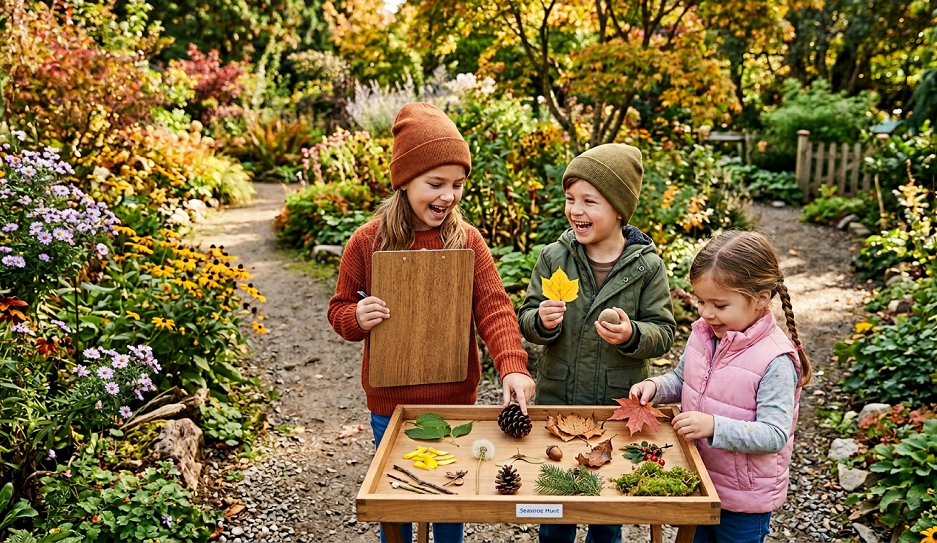
Most scavenger hunts are designed for peak summer — green, blooming, buzzing. The Seasons Hunt flips that assumption on its head and turns the entire calendar year into an opportunity. I’ve done versions of this in early spring when the garden was barely waking up, in late autumn when everything was dying back, and once, memorably, in a light snow, which the kids still talk about.
The premise is simple: the garden looks different every single month, and paying attention to those changes is itself a skill — an important one. Noticing. Tracking. Remembering.
How to set it up: Create a seasonal list that reflects what’s actually happening in your garden right now. In early spring, the list might include: a new bud on a branch, a patch of bare soil warming in the sun, a returning bird. In late summer: a seed pod about to burst, a leaf just beginning to yellow, a vine that has outgrown its support. In autumn: a fallen seed, evidence of an animal preparing for winter, a leaf that has changed color but not yet fallen.
The long game: What makes this hunt truly powerful — and I’ve seen this pay off with my own kids — is keeping a journal. Each month, after the hunt, kids draw or describe what they found. Over time, the journal becomes a record of the garden through the year, and flipping back through old entries teaches the concept of seasons and cycles in a way that feels visceral and personal rather than academic.
A quick side note worth mentioning: Don’t stress about having a “real” garden for this one. A single potted plant on a balcony, a tree in a parking strip, a patch of weeds in a crack in the sidewalk — all of it is nature. All of it changes with the seasons. You don’t need acreage to make this meaningful.
Real Talk: What Can Go Wrong (And What Isn’t Worth the Effort)
Let me save you some frustration.
Overly complicated lists are a trap. Every time I made a list longer than ten items, at least one child gave up halfway through and declared the whole thing “boring.” Keep it focused. Depth beats breadth every time.
Prizes can backfire. I’ve watched scavenger hunts turn into anxious competitions the moment a prize was introduced. In my house, the best reward was always doing it together — me out there with them, genuinely curious about what they’d find. Your presence is the prize. I know that sounds like a greeting card, but I’ve tested the alternative and the greeting card wins.
Don’t correct the wonder out of it. There will be a moment when your child brings you something misidentified, mislabeled, or completely off the list and declares it their best find. Let it be. The goal is not botanical accuracy. The goal is a child who looks at a garden with curiosity rather than indifference. You can introduce accurate names gently, over time, without deflating the moment.
Weather resistance matters. Print your lists in advance and keep them in a waterproof folder, or laminate them if you plan to reuse. There is nothing more anticlimactic than a soggy, illegible scavenger hunt list dissolving in a child’s hands after five minutes outside.
Parting Wisdom
Here’s what I want you to take away from all of this: the point was never really the scavenger hunt. The point was the pause. The moment your child squats down to look at an ant trail and actually sees it — not in a documentary, not in a game, but right there under their feet in the actual world — something shifts. It might not shift loudly or dramatically. But it shifts.
You are not failing when your kid would rather watch a screen. That pull is real and it is powerful and it was designed by people who are very good at what they do. You’re not competing with laziness. You’re competing with dopamine loops engineered by professionals.
But here’s what I’ve learned after raising three kids to adulthood: the garden wins, if you give it half a chance. Because the garden is real. It smells like something. It changes. It surprises. And no screen has ever handed a child a warm strawberry still holding the heat of the afternoon sun.
Start small. Pick one hunt from this list that matches where your kid is right now. Do it with them, not just for them. And then tell me how it goes.
I’d genuinely love to hear what worked, what flopped spectacularly, and any ideas you’ve tried that I haven’t listed here. Drop your thoughts in the comments below — this community learns best from each other, and your experience might be exactly what another parent needs to read today.