
The sun is still blazing at 8 p.m. The birds haven’t even gone quiet yet. And somewhere in your house, a child who is absolutely not tired is doing their seventh lap around the couch, making the kind of noise that belongs at a carnival, not at bedtime.
Been there. Lived it. Survived it — three times over.
When my kids were young, summer used to unravel every sleep habit we’d carefully built during the school year. Sarah, my eldest, turned into a night owl the moment June arrived. Maya started negotiating bedtimes like she was in a boardroom. And Leo? Leo simply refused to accept that the sun going down was a thing that happened to him. “But it’s still light outside, Mom” was his signature line from ages four to nine.
Here’s what I eventually learned: summer doesn’t have to destroy your child’s sleep. It just asks you to do things a little differently. And the earlier you set a summer bedtime rhythm — not a rigid schedule, but a rhythm — the smoother your evenings will go from June through August.
These are the seven tips that actually worked in my home. Not the tips I wish had worked. The ones that did.
1. Reset Expectations Before You Reset Bedtime
Summer Sleep Isn’t the Enemy — Rigidity Is
The biggest mistake I made with Sarah’s first summer was treating it like a discipline problem. She wasn’t going to sleep at her school-year time of 7:30 p.m., and I kept framing that as a failure — hers and mine. What I didn’t understand yet is that a child’s circadian rhythm is genuinely affected by light. Extended daylight tells their brain to stay alert. It’s biology, not defiance.
Once I stopped treating late summer sunsets as something to fight and started treating them as something to work with, everything shifted. That doesn’t mean I let my kids stay up until 10 p.m. every night — I absolutely did not. But it does mean I adjusted bedtime by 30 to 45 minutes during the summer months and stopped expecting a 7-year-old’s body to pretend it was dark when it wasn’t.
Give yourself — and your child — a little grace here. A summer bedtime that lands 30 minutes later than the school-year one is not a parenting failure. It’s a seasonal adjustment. The goal is consistency within that new summer window, not a mirror image of the school year.
If you go into summer with the expectation that everything will look exactly the same as April, you will be frustrated by the end of the first week. Reset your expectations first, and the rest of this becomes a lot more manageable.
2. Use Blackout Curtains — But Don’t Make Them Your Only Tool
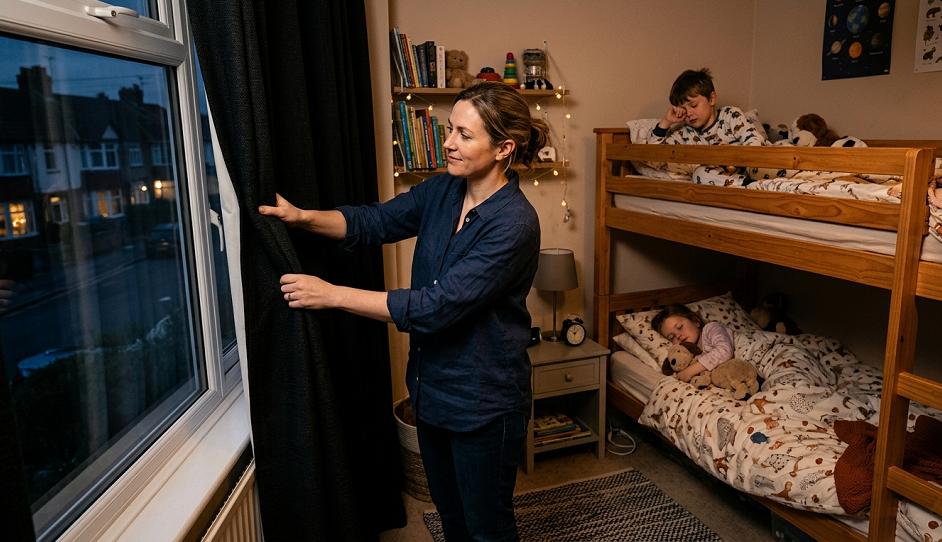
Managing the Light Environment for Better Kids’ Sleep in Summer
Blackout curtains are genuinely wonderful. I’m a fan. We had them in all three of my kids’ rooms by the time Leo was born, and they made a real difference in helping little ones fall asleep when the sky still looked like mid-afternoon. If you don’t have them yet and your child is struggling, I’d put them on your shopping list before anything else on this list.
That said, I’ve found that parents sometimes lean on blackout curtains as a complete solution — and then feel blindsided when the kids still won’t sleep. The curtains control one input: visual light. They don’t address the fact that your child just spent three hours at the pool, has a sugar high from the popsicle they had at 6 p.m., and can hear the neighbor kids still playing outside. Light is one piece of the puzzle.
Use the curtains. Pair them with a cool room temperature (around 68–72°F tends to work well for most kids), a white noise machine if outdoor sounds are an issue, and a wind-down routine that starts before you close those curtains. The curtain-closing itself can become a powerful sleep cue — make it a ritual. Say the same thing each time you do it: “Time to tell the sun goodnight.” Kids respond to predictable little ceremonies like that more than we realize.
One more thing on this: be careful with the timing of the curtain closure. Closing them at 5 p.m. just because bedtime is at 8 p.m. tends to confuse kids and creates resentment. Close them about 30–45 minutes before you want them asleep. That’s the sweet spot.
3. Anchor the Routine to Activities, Not the Clock
Building a Summer Bedtime Routine Kids Will Actually Follow
Here is the piece of advice I wish someone had handed me when Sarah was four years old: in the summer, what comes before bed matters more than what time the clock says.
During the school year, kids are naturally anchored to the clock — the school bus comes at a fixed time, lunch is at a fixed time, dismissal is at a fixed time. Their bodies learn to trust the schedule. Summer strips all of that away. The clock means very little to a child whose entire day is unstructured.
So instead of saying “bedtime is at 8:30 p.m.,” try building a sequence of activities that reliably signals: sleep is coming. In our house, it went something like this: outdoor time ends → dinner → quiet indoor play or reading → bath → pajamas → two books → lights out. Every single evening. The sequence was the anchor, not the time.
The beautiful thing about activity-anchored routines is that they’re flexible without being chaotic. Some nights dinner runs late. Some nights the bath is quick. The sequence still happens in the same order, which means your child’s nervous system still gets the same message: we are winding down, sleep is near. When you anchor to the clock and something disrupts the clock, the whole routine falls apart. When you anchor to activities, you have built-in flexibility.
This is especially helpful for families with multiple kids at different ages. Maya and Leo had different bedtimes, but they both followed their own version of the same sequence. That consistency made it easy for them to understand where they were in the evening without constant reminders from me.
4. Wind Down the Body AND the Brain
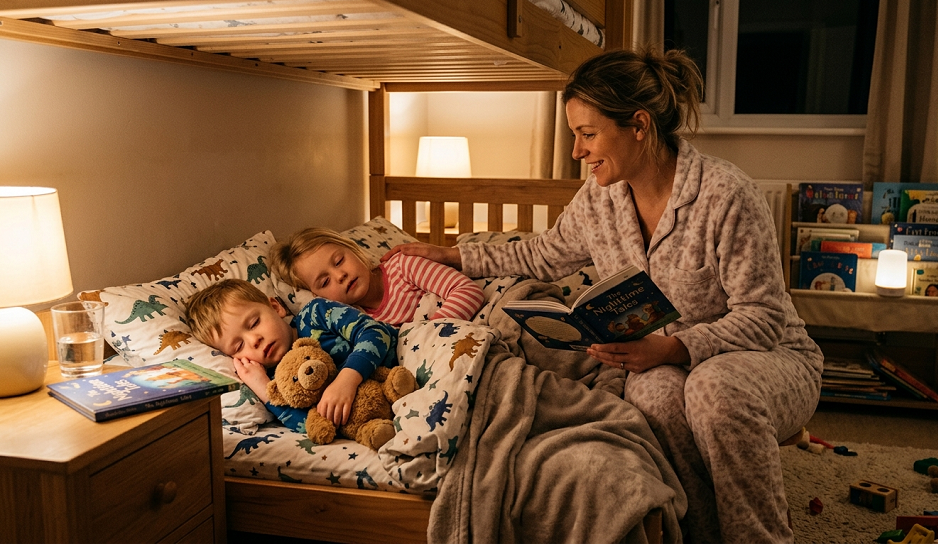
Calming Bedtime Activities That Actually Work for Summer-Wound Kids
Summer evenings are sensory overloads. Kids have been running, swimming, shouting, eating, laughing, and living their absolute best lives from sunrise to sunset. And then we expect them to… just stop. Lie down. Be still. Drift off peacefully.
That’s not how nervous systems work. The body needs a transition.
I’ve found that two separate wind-down stages work far better than one. The first is physical wind-down: no more running, roughhousing, or screens that involve fast movement and loud sounds. This ideally starts about an hour before bed. The second is mental wind-down: low stimulation, calm conversation, and predictable, repetitive activities. This starts about 30 minutes before lights out.
For physical wind-down, outdoor play should wrap up before that final hour. Swap it for something lower-key — building blocks, coloring, simple puzzles, or even helping set the table for tomorrow’s breakfast. These aren’t thrilling activities, and that’s the point. The brain starts to shift gears.
For mental wind-down, I am a firm believer in reading aloud. Even when my kids were “too old” to be read to, they still loved it in the summer. There’s something about a parent’s voice telling a story in the quiet of the evening that is deeply regulating for children. It doesn’t need to be long. Ten to fifteen minutes of a shared book is enough to shift the whole emotional register of the room.
Screens — and I say this with full knowledge that I sound like a broken record — are a total wreck for this stage of the evening. I’ve tried negotiating with this fact. I’ve tried “just 20 more minutes of a calm show.” It doesn’t work. The blue light suppresses melatonin production, the content keeps the brain alert, and the transition off the screen always creates conflict. Turn them off an hour before bed and hold that line. Your future self at 9:15 p.m., when the kids are actually asleep, will thank you.
5. Let Kids Have a Voice in the Routine
Age-Appropriate Choices That Build Summer Sleep Cooperation
This is the one that changed everything with Maya, who was — how do I put this lovingly — extremely opinionated from approximately age three onward. She didn’t want to be told what to do at bedtime. She wanted agency. And when I stopped fighting that and started channeling it, bedtime became a cooperative effort instead of a nightly standoff.
The key is offering choices within a structure. The structure is non-negotiable: you are going to bed. The choices are real but bounded: do you want the bath before or after pajamas? Do you want to read two books or three? Do you want the hall light on or the nightlight? Do you want me to stay for five minutes of quiet talking or do you want to fall asleep on your own?
These are not tricks. Kids aren’t stupid — if you fake choices, they know. But genuine, small choices within a firm boundary communicate something powerful: I trust you to be part of this process. That trust builds cooperation over time. And it gives a child something to feel proud of. “I chose my bedtime books tonight” is a completely different emotional experience from “Mom made me go to bed.”
With older kids — I’m talking eight and up — you can bring them into even more of the planning. At the start of each summer, I’d sit down with my kids and we’d talk through what the summer bedtime would look like. What time felt fair to them? What did they want the routine to include? We didn’t always agree, and I didn’t always give them everything they asked for, but the conversation itself created buy-in. They were invested in a routine they helped create. That investment is worth more than any enforcement strategy I’ve ever tried.
6. Handle the “But It’s Summer!” Protests Without Losing Your Mind
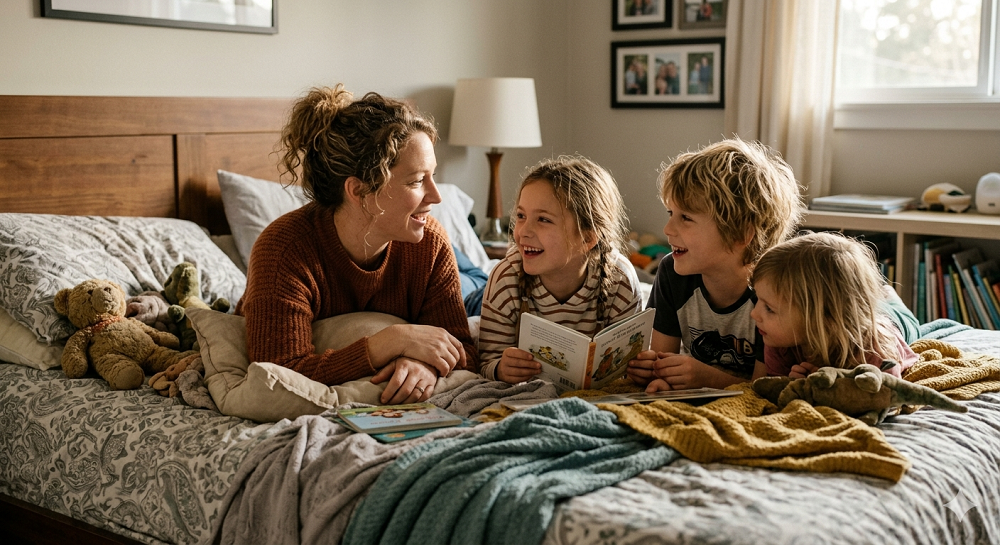
Responding to Bedtime Resistance with Calm and Confidence
Every parent reading this knows the summer protest catalog by heart. “It’s still light outside.” “There’s no school tomorrow.” “The neighbors are still playing.” “I’m not even tired.” “Can I just have five more minutes?” (Reader: it is never five minutes.)
Here is my honest opinion on how to handle this: do not argue, do not negotiate, and do not explain yourself more than once. I know that sounds harsh coming from a gentle parenting blog, but hear me out. Explaining your reasoning is not the same as entertaining a debate. You explain once, warmly and clearly. Then you hold the boundary.
Something like: “I know it feels early, and I know the sun is still up. Summer bedtime is a little later than school bedtime, AND it’s still bedtime. I love you. Let’s do our books.” Then you do the books. You don’t revisit the debate. If they bring it up again, you calmly acknowledge it and redirect: “I hear you. It’s still time.”
What I’ve found — and this took me an embarrassingly long time to learn with Leo — is that long explanations and negotiations actually increase bedtime resistance. They signal that the decision is still open for discussion. Kids are remarkably good at detecting ambivalence. When you are calm, warm, and completely certain that bedtime is happening, most of the protest drains away. The certainty in your voice is the thing that makes it feel safe to comply.
There will be hard nights. There will be tears. There will be a night when you’re exhausted and you just give in and let them stay up late, and then you pay for it the next day with a overtired, cranky child. That’s not failure — that’s being human. Dust yourself off and try again the next night.
7. Be Consistent for at Least Two Weeks Before You Judge the Results
Why Summer Sleep Training Takes More Patience Than You Think
Everyone wants results by night three. I’ve been there — I’ve done the whole routine perfectly for two days, the kids still push back on night three, and I convince myself nothing is working. This is one of the most common ways parents abandon good summer sleep habits before they’ve had a real chance to take hold.
Sleep rhythm changes take time. Pediatric sleep researchers generally agree that it takes somewhere between ten days and two full weeks for a new bedtime routine to feel natural to a child’s body. That’s two weeks of the same sequence, the same approximate time, the same responses to resistance. Two weeks of you holding the structure even when it’s inconvenient.
I know two weeks sounds long when you’re in the trenches. But think of it as an investment. Two weeks of consistency in June buys you two full months of smooth summer evenings. That math is very much in your favor.
Track it if it helps you stay motivated. A simple chart on the fridge — nothing elaborate, just a checkmark for each night you ran the routine — can make the investment feel visible and real. My kids actually liked having a chart too. It gave the routine a sense of momentum.
And when you hit week three and your child walks to their room without you having to remind them, closes their curtains, picks their books, and settles in without a single protest? That feeling is worth every difficult night it took to get there.
⚡ Quick Side Note: Morning Wake-Up Matters Just As Much
One thing most parents forget in the summer bedtime conversation: the morning is part of the equation. If your child goes to bed at a consistent time but is allowed to sleep until 9 or 10 a.m. every morning, you’re constantly resetting their internal clock and fighting biology every evening. A reasonable summer wake-up time — even if it’s an hour later than the school year — anchors the whole circadian rhythm. You can’t fix the back end (bedtime) if the front end (wake time) is all over the place. This doesn’t mean you need to yank them out of bed at 6 a.m. in July. But a consistent wake time, even on weekends, is the quiet secret behind every family whose summer sleep actually works.
Real Talk: What Doesn’t Work (Even If It Looks Like It Should)
The Summer Sleep Strategies That Are a Waste of Your Energy
Let me save you some time here.
Keeping kids up late to “tire them out” is a trap. I’ve heard this one my whole parenting life, and I’ve tested it enough to tell you with confidence: it backfires almost every time. Overtired children don’t sleep better — they get a second wind, their cortisol spikes, and they actually become harder to settle. The tired-enough theory sounds logical. It just isn’t how children’s nervous systems work.
Summer “bedtime vacations” — where you throw out the routine entirely for two or three weeks — are a total waste of time. I understand the appeal. Summer should be free! Relaxed! Unscheduled! And I agree with that in spirit. But completely abandoning any structure around sleep, then trying to reinstate it before school starts, puts you in a brutal position at the end of August. You’re not giving your child freedom — you’re setting them up for a very hard September re-entry, and yourself up for two weeks of terrible evenings trying to rebuild what you had.
Rewards charts for bedtime compliance work short-term and then collapse. I’ve seen this with my own kids and heard it from dozens of parents. The first week is great — everyone’s excited about the stickers. By week three, the novelty has worn off and you’re back where you started, except now you’ve also created an expectation of reward for what should be a normal part of the day. Use the chart to track consistency for yourself, not as a bribe for your child.
The approach that actually works is also the least glamorous one: a calm, consistent, age-appropriate routine repeated night after night with warmth and firm follow-through. There’s no hack. There’s just the doing of it.
Parting Wisdom
Summer is short. Painfully, beautifully short. And I know it can feel like bedtime battles are stealing the best part of it — those long, golden evenings that feel like they belong to everyone except the exhausted parent herding children toward pajamas.
But here’s what I want you to hold onto: a good summer sleep rhythm doesn’t just make your evenings easier. It makes your children’s days better. Kids who sleep well are more patient, more curious, more joyful, and easier to be around. That good sleep is a gift you’re giving them, even when it doesn’t feel like it in the moment.
You are not failing because your kids resist bedtime. You are not failing because last night went sideways. You are a parent who shows up every night and tries again. That is not failure. That is love in its most practical, unglamorous form.
One routine at a time. One summer at a time.
What’s the biggest bedtime challenge in your house this summer? Is it the light, the heat, the siblings keeping each other up, or something entirely unique to your family? Drop your experience in the comments below — I read every single one, and other parents learn just as much from your stories as they do from anything I write. Ask your questions too. There are no silly ones here.