
The sky opens up, the kids come crashing inside, and within eleven minutes flat someone is hanging off the couch and someone else is crying because they’re bored. You haven’t even had your second cup of coffee yet.
Every parent I know has lived this scene. I lived it more times than I can count across three kids — Sarah, Maya, and Leo — who were all blessed with the kind of energy that makes golden retrievers look sedentary. Rainy days were my nemesis for years, until I stopped trying to entertain them and started building things with them.
That was the shift. Not keeping them busy. Building.
Construction play — stacking, engineering, designing, hammering, connecting — is one of the most naturally satisfying things a child can do. It burns energy, yes. But it also teaches spatial reasoning, patience, and the very important life lesson that things sometimes fall apart and you just have to start over. That last one? My kids needed that more than any worksheet ever gave them.
Here are the ten indoor construction activities I swear by. Some of these came from Pinterest boards. Most of them came from pure desperation on a Tuesday with rain hammering the windows.
1. Cardboard Box Engineering Challenges
Why It Works for High-Energy Kids
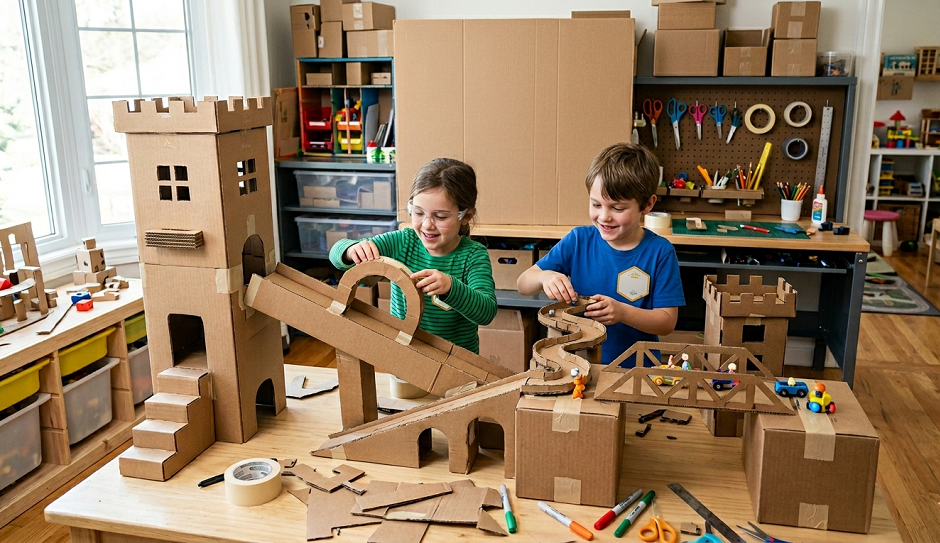
Cardboard is, without exaggeration, the greatest free building material on the planet. I’ve saved every Amazon box, cereal box, and diaper box that came through my house since Sarah was two years old. My husband thought I was hoarding. I was preparing.
The trick is to not just hand them a pile of boxes and say “go build something.” That lasts about four minutes. What actually works is giving them a specific challenge. Can you build a house tall enough for your stuffed animals? Can you make a bridge between two chairs that holds a book? Can you build a car you can actually sit in?
The challenge format changes everything. Suddenly Leo isn’t just stacking — he’s problem-solving. Maya once spent three solid hours building an entire miniature city for her dolls, complete with roads drawn in marker and a “parking garage” made from a shoebox stack. That was a record. I genuinely got to drink a full pot of coffee that morning.
You’ll need: scissors (or an X-Acto knife for you, not them), masking tape or packing tape, and markers for decorating. Hot glue guns are a total game-changer for older kids who can handle them with supervision, around age eight and up in my experience. The structures actually hold together instead of slumping sadly an hour later, which means kids stay invested longer.
Quick side note: Skip the fancy cardboard “building kits” that cost $40 and come pre-scored. They look appealing on the shelf, but the pre-cut pieces limit creative thinking in ways I find genuinely counterproductive. Free boxes beat them every single time.
2. LEGO or Duplo Structured Build Challenges
How to Make Block Play Last More Than Ten Minutes
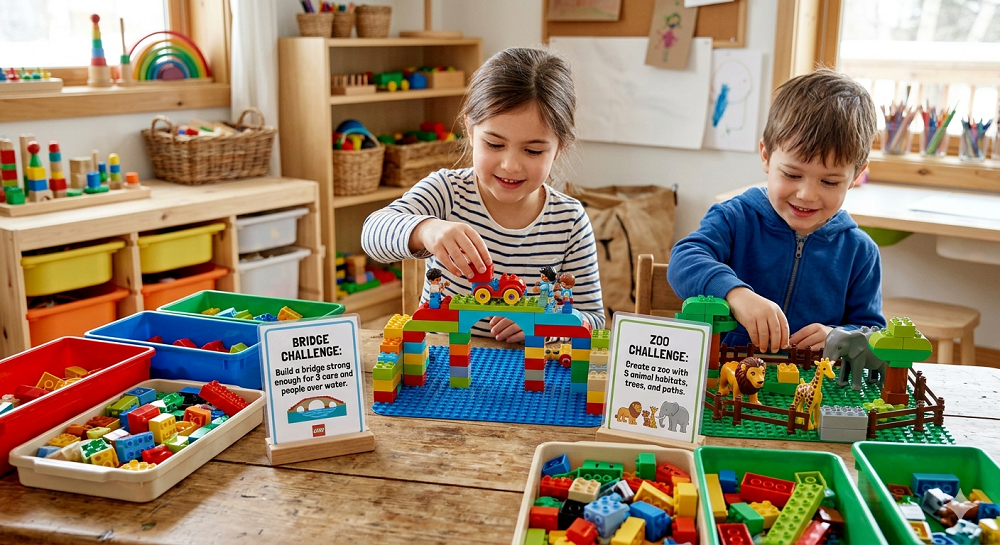
I know. Everyone says LEGO. You’ve heard it. But here’s what most parenting articles miss: unstructured LEGO time is the part that falls apart fast. Kids dump the bin, stare at it, build one thing, knock it over, and then come find you. I’ve been there. It is not the magical educational experience the box implies.
What actually extends LEGO play by an order of magnitude is introducing a structured challenge with a time element. Set a timer for twenty minutes and give them a creative brief. Build the tallest freestanding tower. Build something that can survive being bumped by a pillow. Build a vehicle that has exactly four wheels and can carry a coin from one end of the coffee table to the other.
The timer piece sounds counterintuitive — aren’t we supposed to let kids have open-ended play? Yes, eventually. But the challenge structure gives them a launchpad, and once they’re launched, they often keep going long after the timer goes off. Sarah, who was my most easily distracted child, would stay locked in for over an hour once she had a specific goal in mind. The challenge gives their brain a hook to grab onto.
For younger kids (ages two to five), Duplo is your best friend. The pieces are large enough that building feels satisfying quickly, so they get the dopamine hit of “I made something” without the frustration of fiddly small pieces. Don’t force the transition to regular LEGO before they’re ready — some kids aren’t ready until six or seven, and that’s completely fine.
3. Marble Run Builds
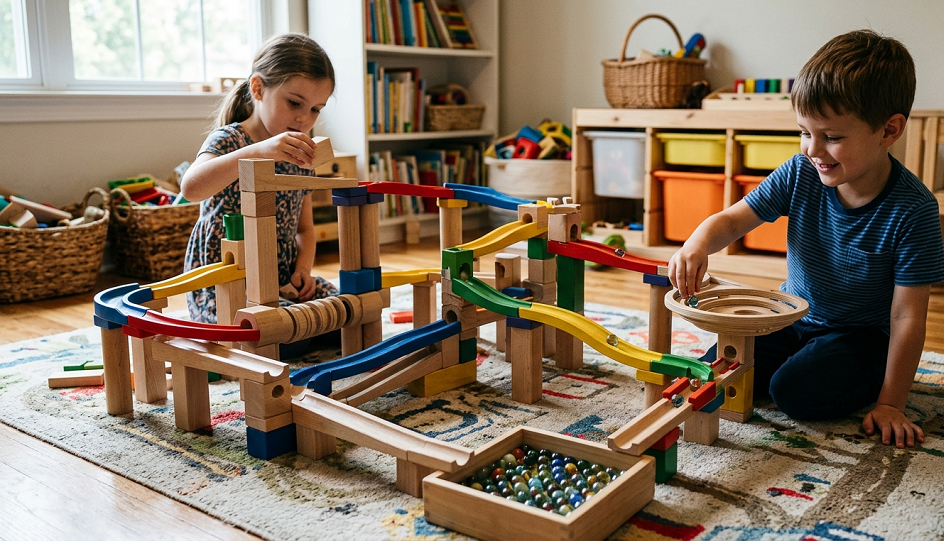
The Indoor Construction Toy That Actually Earns Its Shelf Space
Marble runs are one of the few toys I will tell you, without any hesitation, are worth every penny. Most toys in that price range are pure fluff. Marble run sets are legitimately different because the play changes every single time. You can dismantle it and build it an entirely new way, and the laws of physics keep the feedback honest — either the marble rolls, or it doesn’t. There’s no arguing with gravity.
The construction aspect here is genuinely complex. Kids have to think about angles, sequence, and cause-and-effect in a really hands-on way. Leo struggled with abstract reasoning as a young kid but could spend a full afternoon troubleshooting why his marble kept stopping at the third turn. That kind of thinking is hard to teach directly. Marble runs make it feel like play.
Buy a set that has more pieces than you think you need. The limitations of a small set will frustrate older kids fast. My go-to recommendation is anything with at least 70 pieces, ideally with a few funnel or spiral elements to mix up the challenge. And keep the marbles in a zip-lock bag — I say this from bitter, barefoot experience.
Expect the first few builds to be chaotic and short-lived. The payoff comes around the third or fourth session, once kids understand the basic mechanics. By then, they’ll be designing builds independently and you’ll just be the person they call over to watch the marble complete the run successfully.
4. Spaghetti and Marshmallow Tower Building
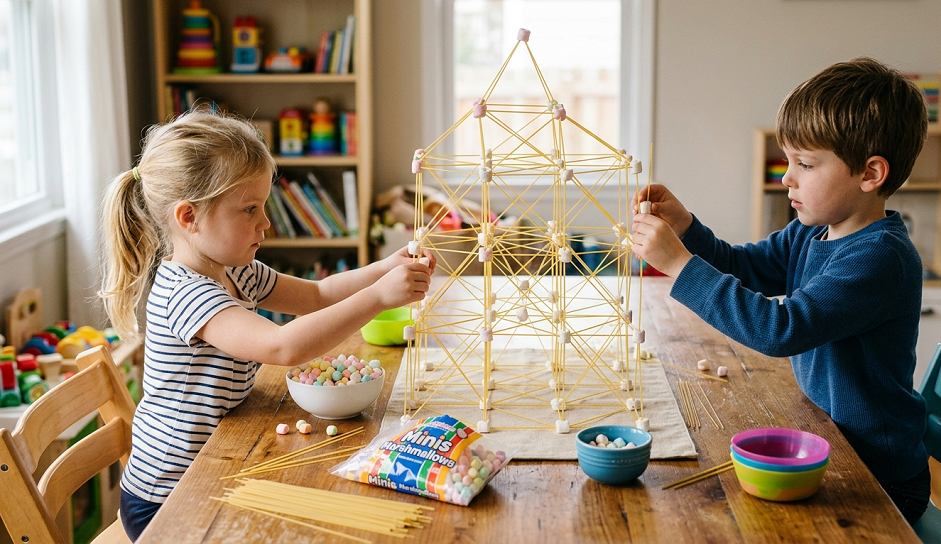
The Kitchen Pantry STEM Activity That Never Gets Old
This one looks like a mess waiting to happen, and I won’t lie to you — it kind of is. But it’s a manageable mess, and the payoff in engagement is enormous. The premise is simple: using only dry spaghetti sticks and mini marshmallows (or regular ones cut in half), can you build the tallest freestanding structure possible?
What makes this construction challenge genuinely riveting for kids is that the materials are unpredictable. Spaghetti snaps. Marshmallows squish. Kids have to learn to be gentle with a material that doesn’t behave the way they expect, and that adjustment is a really important lesson disguised as a pasta activity. Maya once had a full-on meltdown at age six when her tower collapsed for the third time. Instead of rebuilding it for her, I sat down on the kitchen floor next to her and said, “Okay, what do you think went wrong?” That turned into one of my proudest parenting moments — she figured it out herself.
Set a time limit of about thirty minutes and then compare heights. If you have multiple kids, this becomes a natural low-stakes competition. If you only have one child, build one yourself alongside them. Kids are incredibly motivated by the idea of beating a parent.
Clean-up tip: do this at the kitchen table with a sheet underneath. Spaghetti fragments on a hardwood floor are basically invisible landmines for bare feet.
5. Indoor Fort Construction with Real Blueprints
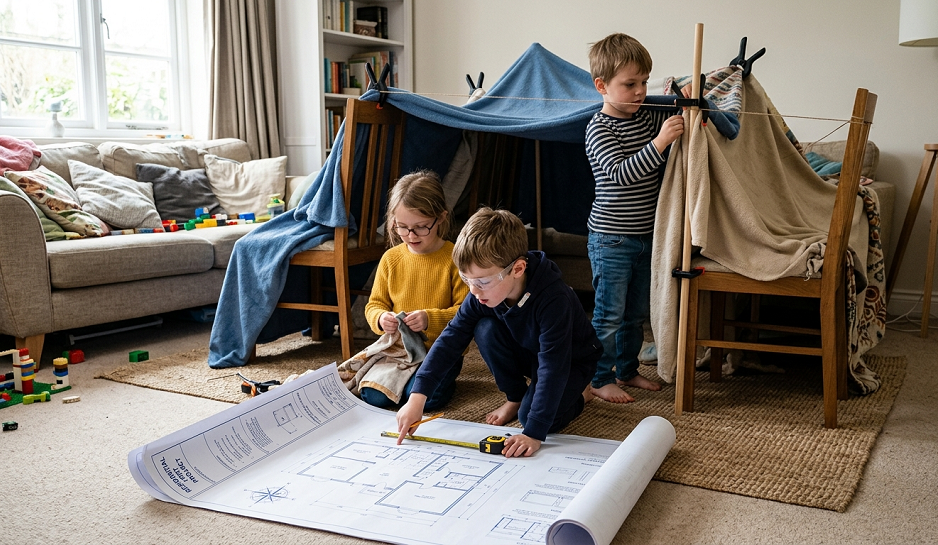
Elevating Blanket Forts from Chaos to Craft
Every kid builds blanket forts. But I’ve found that the difference between a fort that holds up for twenty minutes and one that becomes the activity for an entire rainy afternoon is planning. Specifically: drawing a blueprint first.
Before a single cushion gets moved, sit down together and sketch out what the fort will look like. Where are the walls? Where’s the entrance? Is there a “secret back exit”? Does it need a window? Kids who are old enough to hold a pencil can do this, and it transforms the activity from impulse-driven chaos into an actual construction project with a beginning, middle, and end.
You’ll be amazed at how seriously kids take the building process when they have a plan to refer back to. Leo, at age seven, built a fort with three distinct “rooms” off a center hallway because he’d drawn it out on graph paper first. He was in that fort for the better part of a rainy Saturday. I slid sandwiches through the “mail slot” (a gap between two cushions) at lunchtime.
The materials matter more than people think. Fitted sheets don’t slip off couch backs the way flat sheets do. Binder clips or large clothespins to anchor fabric to furniture edges are worth keeping in a dedicated “fort box.” Tension rods between door frames can give you a real structural anchor point for a much more impressive final product.
6. Magnetic Tile Construction (Ages 3–10)
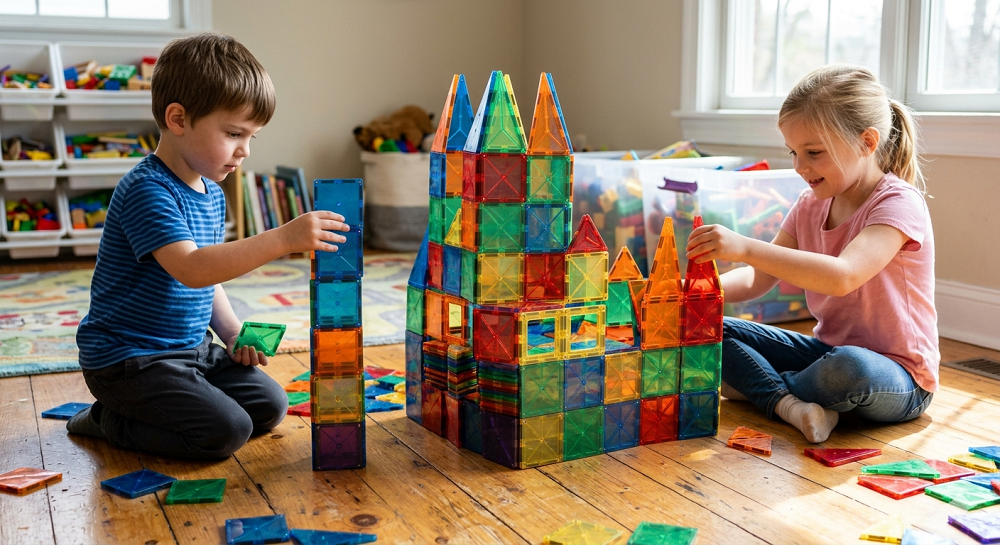
The Building Toy That Works Across the Widest Age Range
If you have small children and you haven’t discovered magnetic tiles yet, consider this your formal introduction. Brands like Magna-Tiles, Picasso Tiles, and similar products use flat geometric shapes with magnets in the edges, so pieces snap together at angles to create three-dimensional structures.
What I love about these — and I mean actually love, not just “they’re good for development” love — is that there is no wrong way to use them. A three-year-old stacks flat pieces in a satisfying clack-clack-clack rhythm. A seven-year-old builds a geodesic dome. A ten-year-old figures out how to make a functioning ball-roll track. The same set, three completely different experiences. I got a lot of mileage out of ours across all three kids.
The challenge add-on that turns this into a focused construction activity: give them a photo of a famous building and ask them to recreate it. The Eiffel Tower. The Pyramids. A lighthouse. They won’t get it perfectly right, and that’s fine — the attempt is where all the learning happens. Sarah once spent a solid hour trying to replicate the Sydney Opera House with curved tile pieces, and though the final result looked more like a lopsided crown, she was fiercely proud of it.
7. Newspaper Architecture Challenges
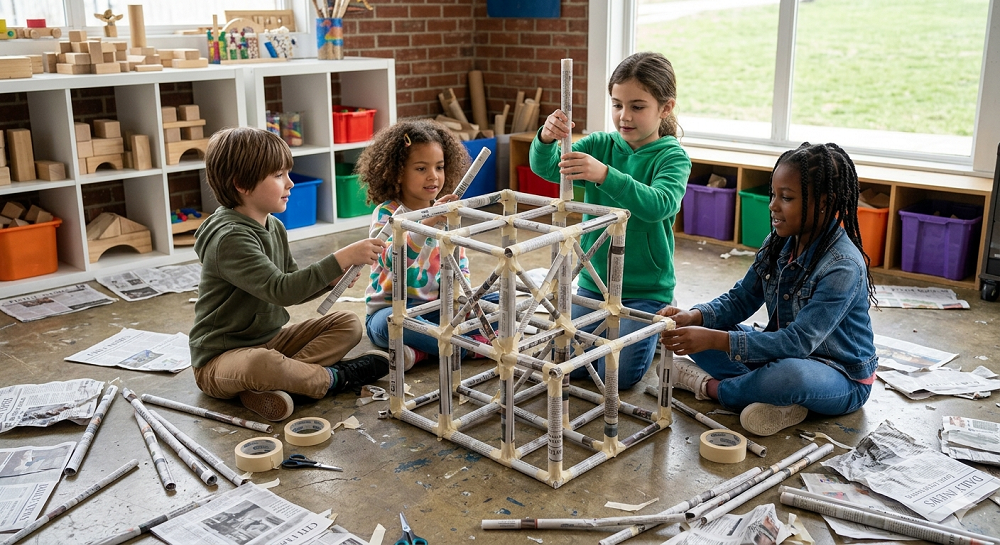
The Zero-Cost Construction Activity Most Parents Overlook
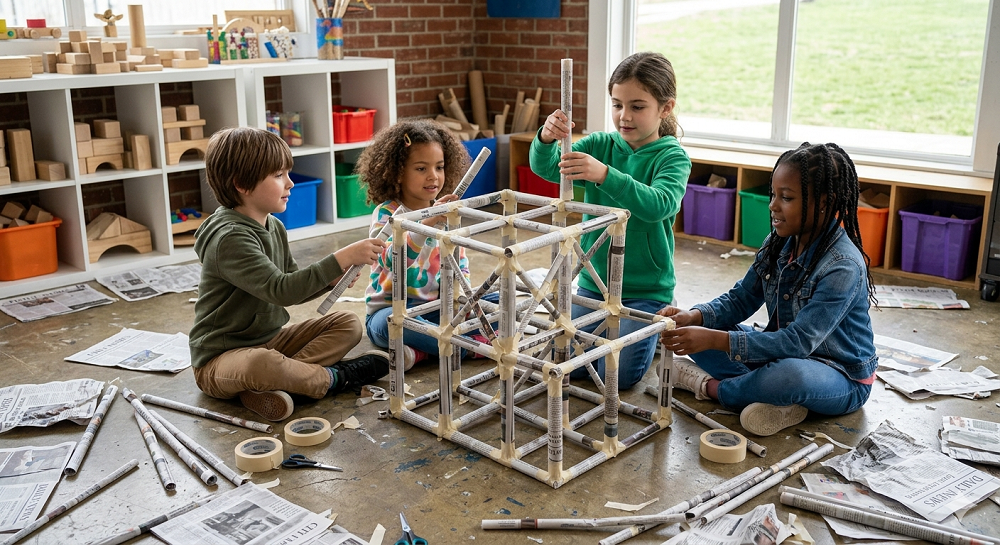
Here’s one that I genuinely feel is underrated and underused: newspaper. Old magazines work too. A stack of yesterday’s paper, some tape, and a challenge can occupy a surprisingly determined kid for hours.
The classic challenge is to build a chair strong enough to support a stuffed animal using only newspaper and tape. Once that’s mastered, scale up: a table. A bridge. A tower taller than the kid themselves. The material is so cheap and abundant that failure has zero cost, and that freedom to fail without consequence is genuinely liberating for kids who are perfectionists or easily frustrated.
To build effectively with newspaper, kids quickly discover they have to roll it or fold it into tubes and beams rather than using flat sheets. That discovery — that structure comes from shape, not just material — is an engineering principle that shows up in real-world construction constantly. It’s the same reason hollow steel beams are stiffer than solid bars of equal weight.
I don’t want to oversell this. With kids under five, this mostly just becomes tearing paper, and that’s fine too — it’s still satisfying and sensory. But from around age six upward, newspaper challenges can get genuinely elaborate and impressive.
8. Wooden Block Free Build with Photo Documentation
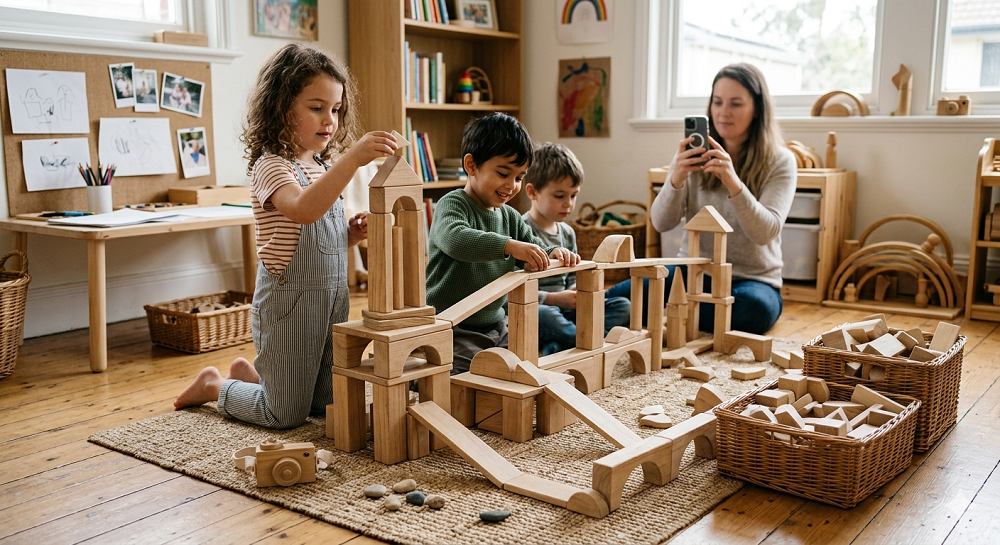
How to Make an Old Standby Feel Brand New Again
Wooden unit blocks are a classic for a reason. The satisfying weight, the clean edges that stack true, the way a carefully balanced structure can reach truly impressive heights — there’s nothing quite like them. But if your kids have had wooden blocks for a while, they may have moved past the wide-eyed wonder phase and into the “I’m bored of these” phase. The fix is surprisingly simple.
Give them a phone or camera and tell them to photograph their best creation when they’re done. The knowledge that their work will be documented changes the experience. Suddenly they’re not just building — they’re building something worth recording. Leo started building with a level of deliberateness and care that genuinely surprised me the first time I tried this. He spent an extra twenty minutes adding decorative detail to a castle tower because “it needed to look good in the picture.”
Make a habit of printing a few favorites and pinning them up somewhere visible. That wall of their construction achievements becomes a source of real pride, and pride is one of the most powerful motivators in a child’s internal toolkit.
9. Recycled Material “Invention” Workshop
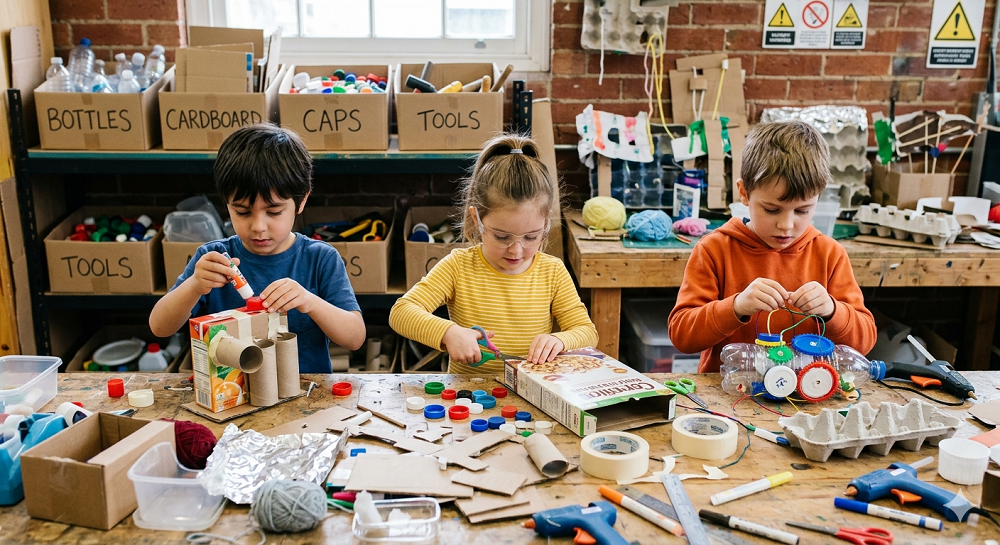
Turning Your Recycling Bin Into a Maker Space
Every toilet paper roll, every plastic bottle, every egg carton, every rubber band — they all go in the “invention box.” This is a concept I borrowed from a teacher friend of mine, and it became one of the most reliably engaging rainy day activities I ever introduced in my house.
The setup is simple: you keep a large box or bin in a closet and toss in clean recyclables and oddments throughout the week. On rainy days, the box comes out and the challenge goes on the whiteboard: “Invent something useful.” It doesn’t have to actually work. It just has to have a purpose.
My kids built everything from a “rain detector” (a plastic bottle with a hole in the bottom held over a jar — technically it works) to an “alarm system” made of stacked tin cans connected with string, to Maya’s masterpiece: a fully operational hand-cranked conveyor belt built from cardboard tubes, rubber bands, and the handles off a broken bag. That last one actually functioned. I was quietly stunned.
The key to making this work is fighting the urge to help too much. Your job is to sit nearby, offer tape when asked, and say “hmm, interesting idea” a lot. The moment you take over problem-solving, you’ve stolen the most valuable part of the activity.
10. Tape Architecture on the Floor
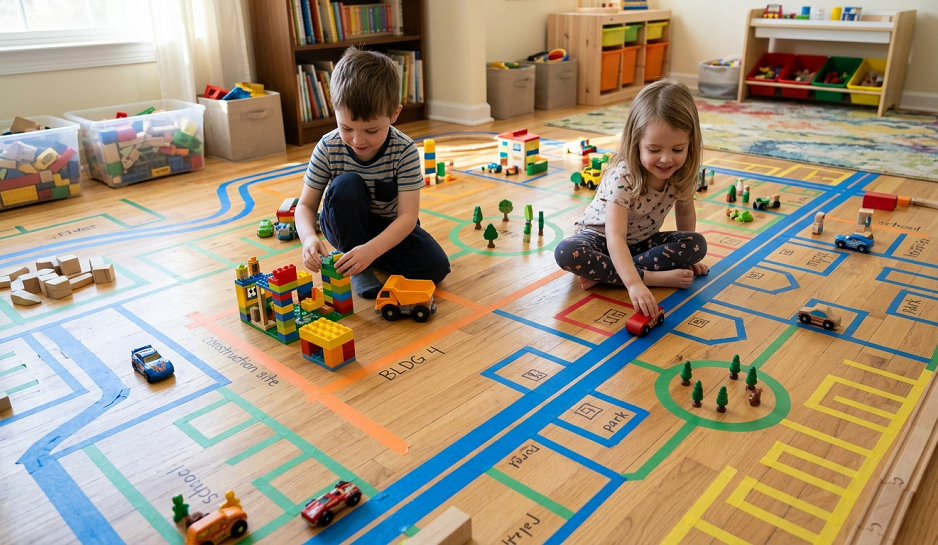
The Surprisingly Engrossing Activity That Turns Your Living Room Into a City
This one requires a bit of masking tape and a willingness to have your floor temporarily look like a blueprint. Using tape, create the outline of a city — streets, buildings, parks, a river — directly on the floor. Then hand over small objects (blocks, toy cars, plastic animals, paper folded into buildings) and let kids inhabit and build within the city.
The construction element here is in the layering. Kids design their own additions to the city, decide where the new hospital goes, negotiate with siblings about whether the park can be moved. It’s cooperative building, spatial reasoning, and creative play all rolled into one activity that can genuinely occupy a full afternoon.
For an older child working solo, give them a “budget.” Each roll of tape is $100. Each block is $50. They have to plan their city within a budget before they start building. That one constraint alone adds a whole new dimension of strategic thinking that will keep a seven-to-ten-year-old genuinely engaged.
Cleanup is just peeling tape up — much easier than it sounds, especially if you use the low-adhesion “painter’s tape” blue variety. It won’t damage hardwood floors or most carpet.
Real Talk: What’s Not Worth Your Time (Or Theirs)
I promised you honesty, so here it is.
Pre-packaged “STEM kits” marketed for rainy days are, in my experience, a total waste of money about 70% of the time. They come with just enough pieces to build the one thing shown on the box, and then the activity is over. There’s no flexibility, no creative extension, and kids often feel deflated when the prescribed build is complete and there’s nothing left to explore. Save your money for a second bag of LEGO or a better marble run set.
Screen-based “building games” like Minecraft are genuinely great for some kids and some days — I’m not here to shame anyone’s digital choices. But they are not a substitute for physical construction play, and I’d encourage keeping them separate. The tactile, cause-and-effect feedback of real materials — the marshmallow that squishes, the spaghetti that snaps, the tower that actually falls — builds something in a child’s brain that a screen simply cannot replicate.
Expecting perfection from first attempts will derail every single one of these activities. The first marble run will have gaps. The first cardboard bridge will collapse. The first spaghetti tower will be a leaning, drooping disaster. That failure is the activity. If you treat it as the enemy instead of the point, you’ve missed the whole game. Tell them what I told mine: “Every engineer’s first version is broken. The second one is better. Let’s figure out why.”
Parting Wisdom: You’re Not Failing, You’re Just on the Rainy Version
Rainy days feel relentless when you’re in them. The walls close in, the kids are loud, and every activity you try seems to have a shelf life of about eleven minutes. I know. I lived it.
But here’s what I want you to hold onto: none of these activities require you to be a crafty parent, an organized parent, or a parent who has it all together. They require cardboard, tape, spaghetti, and a willingness to sit on the floor next to your kid and say “okay, let’s try again.”
The mess is part of it. The noise is part of it. The collapsed towers and the marshmallows stuck to the table are part of it. You’re not failing because your house looks like a construction zone on a rainy Tuesday. You’re raising a builder.
And builders make messes. That’s how you know they’re working.
Now I want to hear from you: What’s your go-to rainy day activity when the kids are bouncing off the walls? Have you tried any of these construction challenges? Drop your ideas, your disasters, and your wins in the comments below — I read every single one, and some of the best activities in my repertoire came straight from this community.