
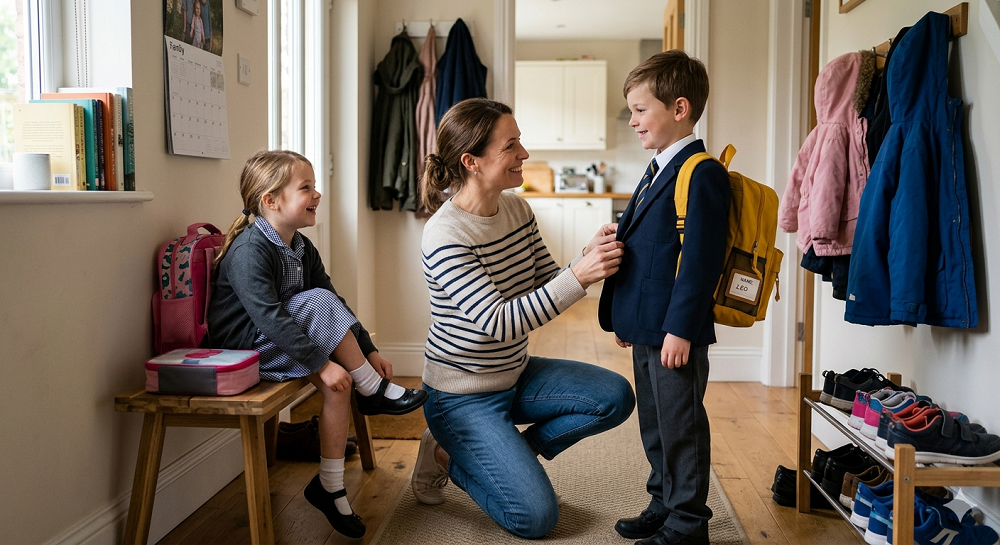
The alarm goes off. Someone is already crying. Another one can’t find their left shoe. The third one — your “easy” kid — has decided today is the day to protest breakfast entirely. You haven’t even brushed your teeth.
Sound familiar?
For years, mornings in my house were survival mode. Three kids, two school buses, one overwhelmed parent, and approximately zero plan. I spent the better part of a decade genuinely believing that chaotic mornings were just the price of admission for having a full house. I was wrong.
The shift didn’t happen overnight — pun fully intended. It happened slowly, through a lot of trial, a lot of error, and one particularly terrible Tuesday when Maya, then seven, walked into school wearing one snow boot and one ballet flat because I had simply given up. That was the morning I decided something had to change.
What I discovered is that mornings don’t have to be a battle. They can actually set a tone — a good tone — for the entire day. Not just for your kids, but for you. And the habits that make the biggest difference aren’t elaborate or Instagram-worthy. They’re simple, consistent, and deeply human.
Here are the seven morning habits that genuinely transformed how our days started — and how they ended.
1. Wake Up Before Your Kids — Even Just 20 Minutes Earlier

Why Those 20 Minutes Are Non-Negotiable
I know. You’re rolling your eyes. Every parenting article tells you to wake up early, and every exhausted parent knows that advice feels like a personal attack. But hear me out — this isn’t about becoming a 5 AM wellness guru with a matcha latte and a meditation cushion. This is about reclaiming twenty quiet minutes that belong entirely to you.
When Sarah was in middle school, Leo was in diapers, and Maya was in that delightful “threenager” phase, I started setting my alarm for just 20 minutes before anyone else stirred. I didn’t exercise. I didn’t journal. I sat with a cup of coffee and stared out the window like a woman who had her life together. That’s it.
And it worked. Those 20 minutes meant I had already processed the day’s schedule, taken a few deep breaths, and — crucially — entered parenting mode by choice rather than by ambush. When Leo woke up wailing or Maya came padding down the hall at 6:15 AM, I wasn’t startled out of sleep and reactive. I was already awake, already calm, already present.
Here’s what I’ve found to be completely true: a reactive parent and a proactive parent can have the exact same number of problems in a morning, but only one of them feels in control. Being awake first is the simplest way to be proactive. The math is uncomfortable but undeniable — your children will wake up whether you’re ready or not. You might as well be ready.
Start with just 15 minutes if 20 feels impossible. Set the coffee maker the night before. Keep your phone outside the bedroom so getting up doesn’t feel optional. Do whatever works for your life. But protect this time fiercely, because everything else on this list works better when you begin here.
2. Establish a Visual Morning Routine Chart for Young Children
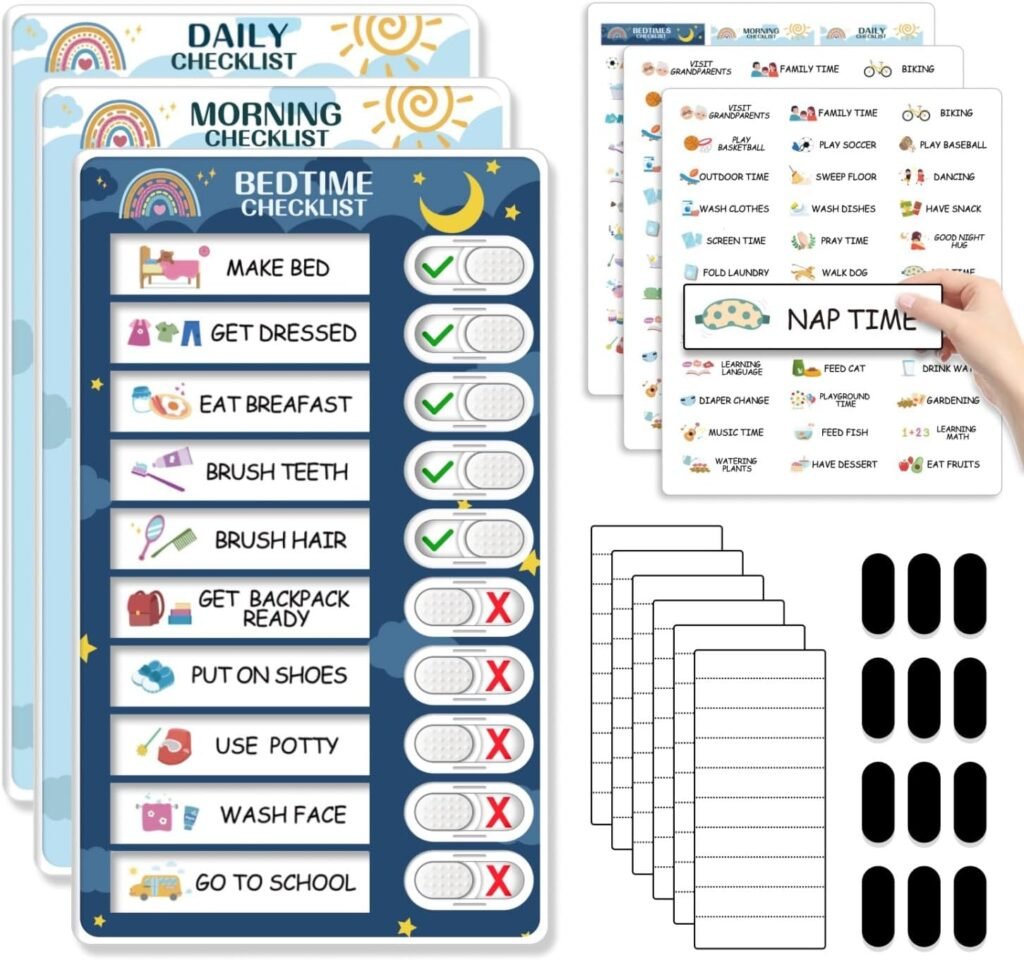
Stop Repeating Yourself — Let the Chart Do It
For about four years, I repeated the same seven instructions every single morning. “Brush your teeth. Get dressed. Eat your breakfast. Don’t forget your backpack. No, you can’t bring the stuffed dinosaur. Yes, you have to wear socks.” I was a broken record, and my kids were very talented at pretending the record player didn’t exist.
A visual morning routine chart changed everything, and I wish I had used one from the start. This isn’t a new idea — child development experts have been recommending them for decades — but the key is making it theirs, not yours. I took a Saturday afternoon with each kid and we made their charts together. Maya drew little pictures. Sarah used magazine cutouts. Leo, who was four at the time, mostly just stuck stickers everywhere and felt extremely important.
The chart itself is not magic. What’s magic is that it transfers authority. When Leo didn’t want to put on shoes, I stopped being the villain. The chart was the villain — or rather, the neutral third party. “What does your chart say?” is so much less confrontational than “I have told you seventeen times to put on your shoes.” Kids respond to ownership. When they helped make the chart, they had ownership. And ownership, I found, is the secret ingredient in cooperation.
Update the chart as kids grow. What works for a five-year-old won’t work for a ten-year-old. Sarah eventually moved from a picture chart to a simple handwritten checklist she kept on her desk. Maya, forever the creative one, turned hers into a decorative poster she was genuinely proud of. The form matters less than the function: a consistent visual anchor that signals “this is the sequence, and it doesn’t change.”
A quick side note on this: the chart also works remarkably well for mornings when you’re running late and emotions are high. When a child is dysregulated, they respond better to pointing at a picture than to verbal instructions. It reduces the emotional temperature of the whole exchange, and that’s a gift for everyone.
3. Build a “Connection Moment” Into the First Five Minutes
A Hug Before the Hustle Is Not Soft — It’s Strategic
This one surprised me more than any other habit on this list. I used to think that affection and mornings were incompatible — mornings were for logistics, and hugs were for bedtime. I was completely wrong, and I’ve since found the research to back it up.
Children’s cortisol levels — their stress hormone — naturally spike in the morning. This is biological, and it means your child is literally more anxious, more reactive, and more emotionally fragile between 6 and 8 AM than at almost any other time of day. A brief moment of genuine physical connection — a hug, a hand on the shoulder, sitting together for two minutes — helps regulate their nervous system before the chaos of the day begins.
I started doing what I call the “morning landing.” Before any instructions, before any schedule talk, before I handed anyone a bowl of cereal, I sat down with each child and just checked in. Not interrogation-style (“how are you feeling? are you ready for today? did you pack everything?”). Just presence. Eye contact. A hug if they wanted one. Sometimes thirty seconds, sometimes two minutes. It costs almost nothing in time, and the return on investment is enormous.
What I noticed within two weeks was striking. Kids who had that connection moment were measurably easier to transition through the rest of the morning. They were less likely to melt down over small things — the wrong spoon, the socks that felt “too tight,” the juice cup that was the wrong shade of purple. This isn’t coincidence. A child who feels seen at the start of the day has a fuller emotional tank, and a fuller tank means more resilience for the inevitable small frustrations.
Does this mean every morning will be sunshine and cooperation? Absolutely not. Leo once burst into full tears during our connection moment because he dreamed that he couldn’t find me. But I was right there, which was actually the best possible outcome for that particular morning. Connection doesn’t prevent big feelings — it just gives those feelings a safe place to land.
4. Prepare the Night Before — Specifically These Three Things
Future-You Is Depending on Present-You
I’ve tried every version of morning prep, and I’ve landed firmly on the belief that a “successful morning” is mostly assembled the night before. The families I know who consistently have calm mornings aren’t more disciplined or more gifted at parenting. They’ve just outsourced the decision-making to the previous evening, when everyone is fed, rested, and not running for a bus.
Three things, specifically, make the biggest difference:
Clothes. Full outfits, including shoes, laid out or hung the night before. This sounds simple and it is. What it eliminates is enormous: the “I can’t find my…” crisis, the argument about whether a Halloween costume is appropriate school attire, and the ten minutes of staring into a closet while time evaporates. When my kids were small, I did this for them. When they were old enough, I taught them to do it themselves. By age six, this was non-negotiable in our house.
Lunches and backpacks. Packed, closed, by the door. Not on the counter. Not “mostly done.” By the door, ready to grab. I’ve found that any prep left “mostly done” has roughly a 70% chance of being forgotten entirely. The backpack by the door is a physical cue that the morning has an endpoint and a purpose.
The schedule check. Five minutes, just you, looking at the next day. Does anyone have a field trip? A permission slip due? A show-and-tell item? A friend coming over after school? This is where so many morning disasters are born — in information that existed the night before but was never processed until the clock was already against you.
The night-before prep is a gift from the parent you are at 9 PM to the parent you’ll be at 7 AM. Those two people are in very different emotional states, and the 9 PM version has a responsibility to be generous.
5. Eat Breakfast Together — Even If It’s Just Ten Minutes

The Table Is a Tool, Not a Chore
I’ll be honest: for a long stretch of years, “family breakfast” in our house meant everyone eating cereal in different rooms at different times while I answered emails. It was efficient. It was also, I now realize, a missed opportunity every single day.
Sitting together at the table — even for ten minutes, even with toast and orange juice, even when it’s rushed — does something that no other morning habit can replicate. It creates a brief moment of shared humanity before everyone scatters. It says, without anyone having to say it out loud, “we are a unit, and we start the day as a unit.”
The conversations that happen at a ten-minute breakfast table are different from conversations that happen in the car or at bedtime. They’re low-stakes and unhurried in spirit, even when the clock is ticking. I heard about Sarah’s friendship worries, Maya’s anxiety about a test, and Leo’s inexplicable obsession with how trains are steered — all at breakfast, all in tiny doses that added up to me actually knowing my children.
Breakfast together also regulates the morning pace. When everyone is at a table, you’re all in the same physical space and subject to the same time constraints. It naturally limits the drifting — the child who wanders off to look at something, the one who disappears to “get something” and is never seen again until the bus horn honks. The table is a gathering point, and gathering points are powerful in a household that tends toward chaos.
If your family’s schedule genuinely doesn’t allow for a sit-down breakfast, even two minutes of overlap — two people at the counter, passing each other toast — counts. The goal isn’t perfection. The goal is contact.
6. Use Transition Warnings, Not Commands
“Five More Minutes” Is a Parenting Superpower
This habit has saved me more arguments than I can count, and it costs absolutely nothing. It’s simply this: before a transition — leaving the house, ending screen time, stopping play to come to breakfast — give a warning. “We’re leaving in five minutes.” “Breakfast is in two minutes.” “Time to wrap up in five.”
Children, especially young children, live almost entirely in the present tense. The future is abstract to them in a way that’s genuinely neurological, not manipulative. When you walk into a room and announce “time to go — shoes on now,” you’re not just interrupting their activity. You’re asking their brain to make an instant leap from deep present-focused engagement to future-oriented action. That leap is hard, even for adults. For a four-year-old, it can feel catastrophic.
Transition warnings change the emotional experience of a command. They’re not a negotiation — I want to be clear about that. “We’re leaving in five minutes” does not mean “we might leave in five minutes if you feel ready.” It means what it says. But it gives the child’s brain a runway, a small but real window to complete the mental transition from “I am playing” to “I am preparing to leave.”
When my kids were small, I paired the warning with a physical cue: I’d appear in their line of sight and use a hand signal. Two fingers up meant two minutes. It sounds silly, but it worked because it was consistent. Consistency is everything with young children. They don’t need creativity from us as much as they need predictability.
As kids get older, the transition warning evolves into something closer to collaborative scheduling. By the time Sarah was ten, I could say “we need to leave by 8:15” and she’d manage her own time. That skill — self-managing toward a deadline — didn’t appear from nowhere. It was built through years of being given transition warnings that trained her to understand time as a real constraint with real consequences.
7. End the Morning on a Positive Send-Off — Every Single Time
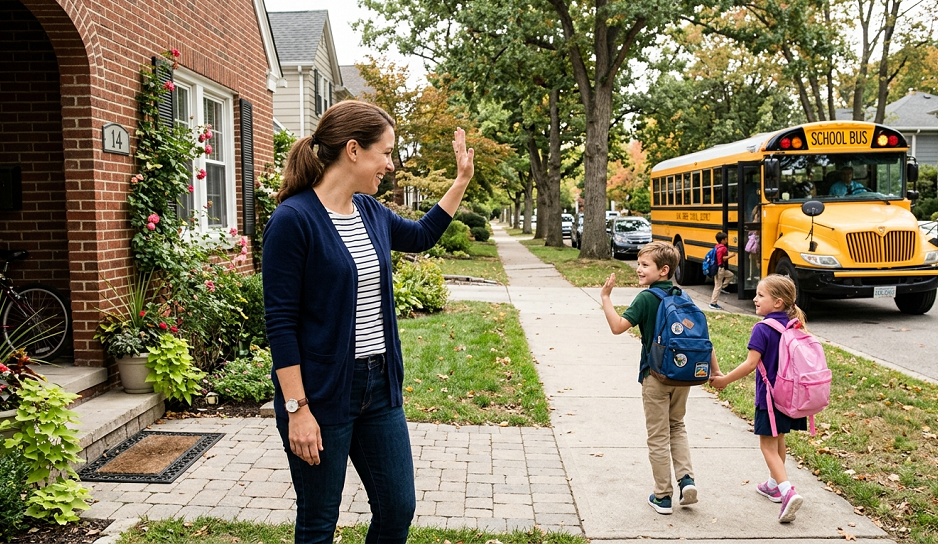
The Last Thing They Hear Matters More Than You Think
This one sounds almost too small to matter. It’s not. The last thing your child hears from you before they walk out the door — before they enter a world that will not always be kind, a classroom where they may struggle, a social landscape that can be genuinely brutal — matters enormously.
I made a rule for myself years ago: whatever happened during the morning, however rough the getting-ready process was, the send-off would be positive. Not fake-positive, not performatively cheerful. Just genuine, specific, and warm. “Have a great day, buddy — you’ve got this.” “I love you, see you tonight.” “Good luck on that test — you studied hard.” Something that said: I see you, I believe in you, and I’m on your side.
This was hardest on the worst mornings — the mornings when someone had cried, or something had been said in frustration, or we’d run late and I’d snapped. Those are the mornings when the send-off matters most. Because a child who leaves the house after a difficult morning, having had the last interaction with their parent be warm and affirming, carries something different in their chest than a child who leaves in the cold aftermath of a conflict.
You don’t have to resolve everything before they go. You just have to make sure they know the relationship is okay. “We’ll talk about it tonight — I love you, have a good day.” That sentence has done more for my kids’ sense of security than any elaborate resolution. It says: we’re fine, this is fine, go.
Real Talk: What Doesn’t Work (And Isn’t Worth the Effort)
The Morning Habits That Sound Great But Don’t Deliver
I’ve tried things that looked great on paper and were a total waste of time in real life. Sunrise alarm clocks for children, for instance — genuinely, I spent $40 on one for Leo and he slept straight through it for three weeks and then used it as a prop for his Lego city. Skip it.
I’ve also found that elaborate reward charts for morning routines backfire within about two weeks. The novelty wears off, the sticker stops being motivating, and then you’ve introduced an expectation that you now have to maintain indefinitely or deal with the fallout of removing it. Simple and consistent beats elaborate and exciting every time.
The biggest thing I’d tell you to abandon: the idea that every morning can be perfect. I’ve seen parents — and I’ve been this parent — so committed to the “calm morning routine” ideal that a deviation becomes a crisis. The shoe that can’t be found, the spilled juice, the unexpected meltdown over nothing — these aren’t failures of your routine. They’re just life, happening in the morning instead of the afternoon.
The goal of a morning routine is not perfection. It’s a container — a structure loose enough to flex but strong enough to hold. When something goes sideways, the routine is what you return to, not what you’re punished by.
The Wrap-Up: Parting Wisdom From Someone Who Has Been in the Trenches
Here’s what I want you to take away from all of this:
The parents who have the calmest, most connected mornings aren’t the ones with the most time, the most help, or the easiest children. They’re the ones who decided — deliberately and imperfectly — to do a few small things consistently. That’s it. That’s the whole secret.
You are not failing. You are learning what works in your specific home, with your specific children, in your specific life. Some of these habits will fit like a glove. Some won’t work at all and that’s okay, because parenting is not a one-size-fits-all sport. Take what’s useful, leave what isn’t, and give yourself the same grace you’d give a good friend who’s just trying their best.
Mornings will still be messy sometimes. Kids will still be irrational about socks. Someone will forget something important on a Thursday. That’s parenthood. But inside that chaos, there is room — there is always room — for connection, consistency, and a small amount of calm.
Start with one habit. Just one. Do it for two weeks. See what shifts.
Now I want to hear from you: Which of these habits resonates most with your family’s mornings — and is there something you’ve tried that I haven’t mentioned here? Drop your thoughts, questions, or hard-won wisdom in the comments below. This community grows best when we learn from each other.
Written by Lennah Evans for GentleParenting101.org — where we believe firm boundaries and soft hearts aren’t opposites. They’re the whole point.