
Every morning, somewhere in the world, a parent is standing in the hallway holding a tiny sock while their toddler sits on the floor crying because the sock “feels wrong.” The tags are itchy. The pants are backwards. The shoes are on the wrong feet — again. And you’re already seven minutes late.
I’ve been that parent. Three times over.
With my oldest, Sarah, I spent the better part of her third year doing what I now call the “gentle coercion loop” — asking nicely, asking less nicely, bribing her with a banana, and ultimately dressing her myself while she went limp like a protest noodle. With my son Leo, I tried sticker charts, reward jars, and a whole Pinterest board of “fun ways to get dressed.” Most of it was a total waste of time, even if it looked like the easier option. It wasn’t until Maya — my youngest and, bless her heart, my most stubborn child — that I finally cracked the code.
Visual routine charts.
Not the laminated “Good Morning Routine” posters you find at big box stores that try to cover everything from waking up to brushing teeth. I mean specific, targeted, toddler-level visual guides built around the single task of getting dressed. The difference those charts made in our mornings was almost embarrassing. I wish I’d discovered them sooner.
If your toddler is between 2.5 and 5 years old and morning dressing feels like a daily hostage negotiation, this article is for you. Here are seven visual routine charts that genuinely work — and a few honest notes about what doesn’t.
1. The Simple Step-by-Step Photo Chart for Toddler Dressing Independence
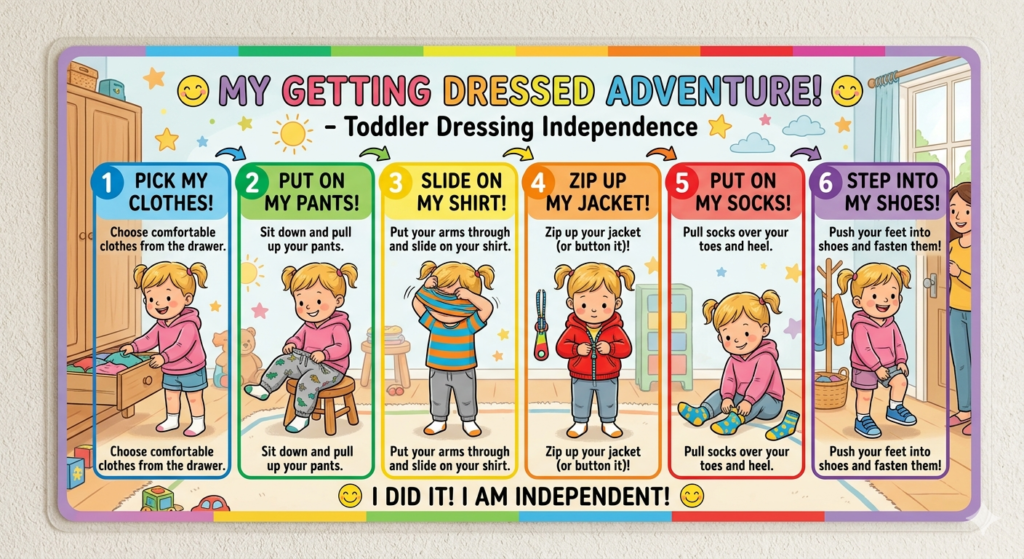
The most effective chart I ever made for Maya cost me nothing except twenty minutes and my phone camera. I photographed her — her, specifically — doing each step of getting dressed in the correct order. Underwear first. Then pants. Then socks. Then shirt. Then shoes.
I printed the photos, laminated them (a $20 laminator from an office supply store is one of the best parenting investments I’ve ever made), and hung them at her eye level on the back of her bedroom door. Nothing fancy. Just her own face, her own clothes, her own sequence.
Here’s why this works so powerfully: toddlers are deeply egocentric, and I mean that in the most neutral, developmental sense. They are wired to pay attention to themselves. When the chart features them, engagement skyrockets. I’ve found that charts with generic cartoon characters get ignored after three days. Charts with photos of your actual child get used for months.
Make sure each photo shows the action mid-process, not just the finished result. A photo of Maya pulling her shirt over her head is more instructive than a photo of her standing there fully dressed. And keep the sequence to no more than six steps. Toddler working memory is small. Respect it.
Once the chart is up, step back. Your job isn’t to narrate every step — it’s to point to the chart when your toddler looks at you for direction. “What does the chart say next?” is a sentence that will save your sanity more times than you can count.
2. The Color-Coded Body Map Chart for Preschool Morning Routines
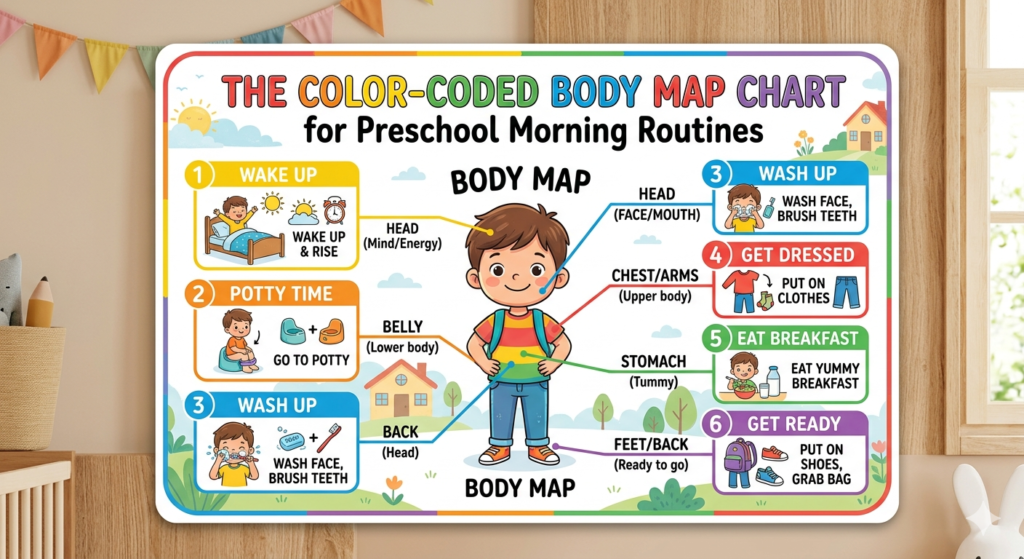
This one is particularly brilliant for children who are still building their understanding of sequencing and body awareness. A body map chart is exactly what it sounds like: a simple outline of a child’s body with each clothing item illustrated on the correct body part, color-coded by the order in which it goes on.
Red for the first item (underwear). Orange for the second (pants or skirt). Yellow for the third (socks). Green for the fourth (shirt). Blue for shoes.
You can find free printable body map templates online, or draw one yourself if you’re artistically inclined (I am decidedly not, which is why I found a template). The color-coding is the key feature here. It taps into something toddlers understand intuitively — color order — even when the concept of “first, second, third” is still fuzzy.
I’ve found that adding a simple number in the corner of each color section reinforces the sequence without overwhelming the chart. One small circle with a “1” on the underwear section. A “2” on the pants. You get the idea.
What I particularly love about this chart is how it supports kids who get lost midway through the task — which is basically all of them. When Leo would get distracted and forget whether he’d already put on socks, he could look at the chart, find the color he recognized, and figure out where he was. It gave him a re-entry point into the task without needing to call for me.
Hang this one at eye level inside the closet door, right where the clothes live. Proximity matters enormously with toddlers.
3. The “I Can Do It” Checklist Chart with Velcro or Magnetic Pieces
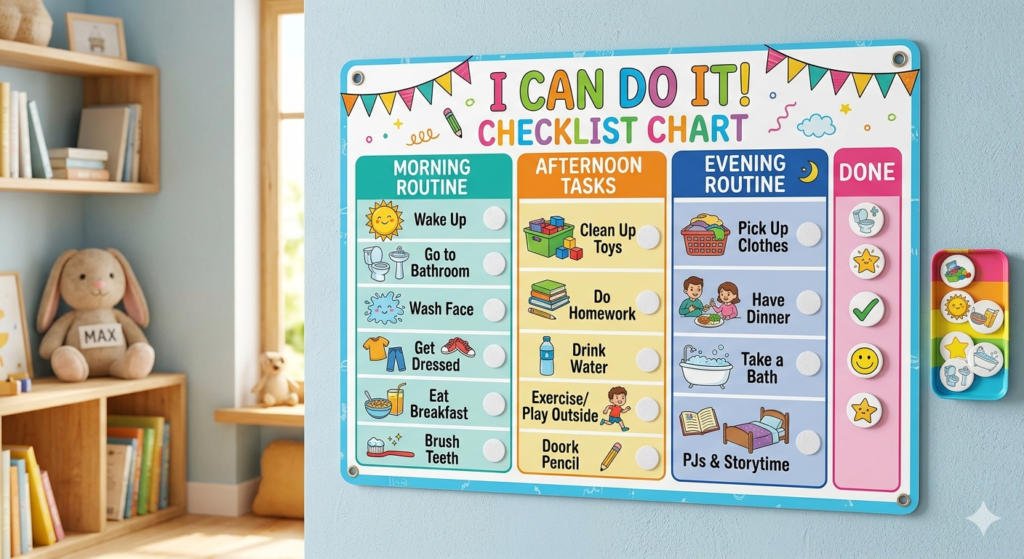
Toddlers are completers. Give a two-year-old a row of matching shapes and watch what happens. They will sort every single one before they consider stopping. That same drive toward completion is exactly what makes a tactile checklist chart so effective for building toddler dressing routines.
The idea is straightforward: create a chart where each step of the dressing routine is represented by a small image or icon attached with Velcro or a magnet. When your child completes a step, they physically move the piece — from the “to do” column to the “done” column, or flip it over, or slide it to a finished pocket.
The physical act of moving the piece is the reward. You don’t need a sticker. You don’t need a treat. The click of the magnet or the satisfying peel of the Velcro is dopamine enough for a three-year-old.
I’ve found the Velcro version tends to outlast the magnetic one for this age group, simply because little hands find the texture more satisfying to manipulate. Magnetic charts are faster to set up, but the pieces can be frustrating for kids who don’t have the fine motor control to place a small magnet precisely.
When Sarah was in her “I want to do everything myself” phase — which lasted approximately three years, so, you know, standard — this chart was the thing that let her feel fully independent without me anxiously hovering to make sure she didn’t forget her shoes. She could see the whole task laid out. She could track her own progress. And when she moved that last piece over to the “done” side, the look on her face was worth every minute of cutting and laminating.
4. The Weather-Based Visual Chart for Teaching Toddlers to Choose Appropriate Clothing
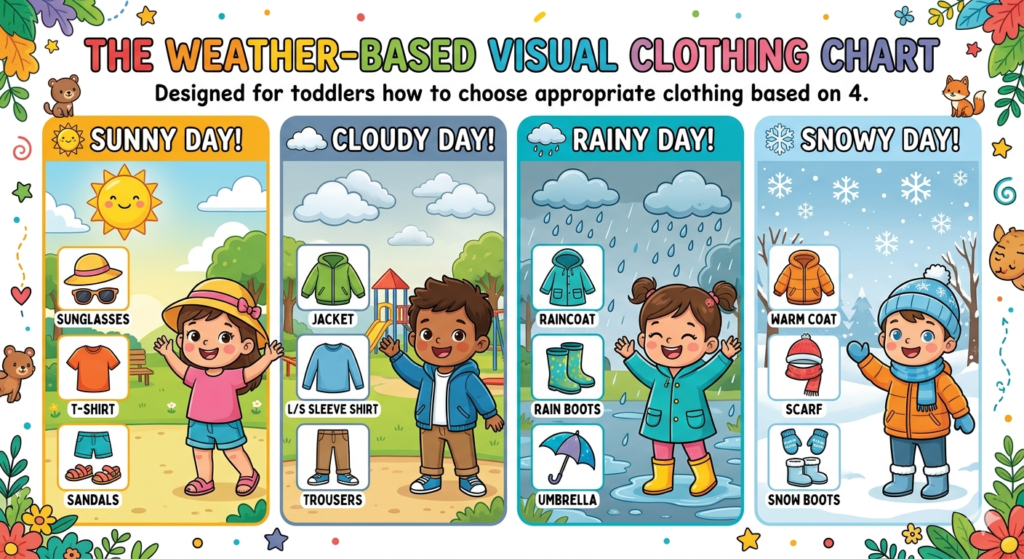
This is where visual routine charts become genuinely multi-functional, because they stop being just about order and start being about decision-making. A weather-based chart teaches your toddler to connect what they see outside with what they should wear — a skill that, if I’m honest, some adults still haven’t fully mastered.
The chart has two sides: a “today’s weather” section where your child (or you, together) places a symbol for the weather — sun, clouds, rain, snow — and a corresponding “what to wear” section that shows what types of clothing match that weather condition.
I’m not suggesting you let a three-year-old dress themselves for a blizzard based entirely on a chart. Parental review is still very much on the table. But what this chart does is shift the framing from “because I said so” to “because the chart says cold weather means warm layers.” It externalizes the logic. Suddenly you’re not the arbitrary rule-enforcer. You’re a fellow reader of the chart.
The secret to making this work is keeping the weather categories broad and the clothing images unambiguous. Don’t put six types of precipitation. Sun or clouds. Rain. Cold. That’s enough. Three-year-olds do not need meteorological precision.
I also recommend building in a small “pick one” section where your child can choose between two appropriate options — two acceptable shirts, two pairs of pants. Choice within limits is one of the most powerful tools in toddler autonomy, and a visual chart makes those limits concrete and non-negotiable without any arguing from you.
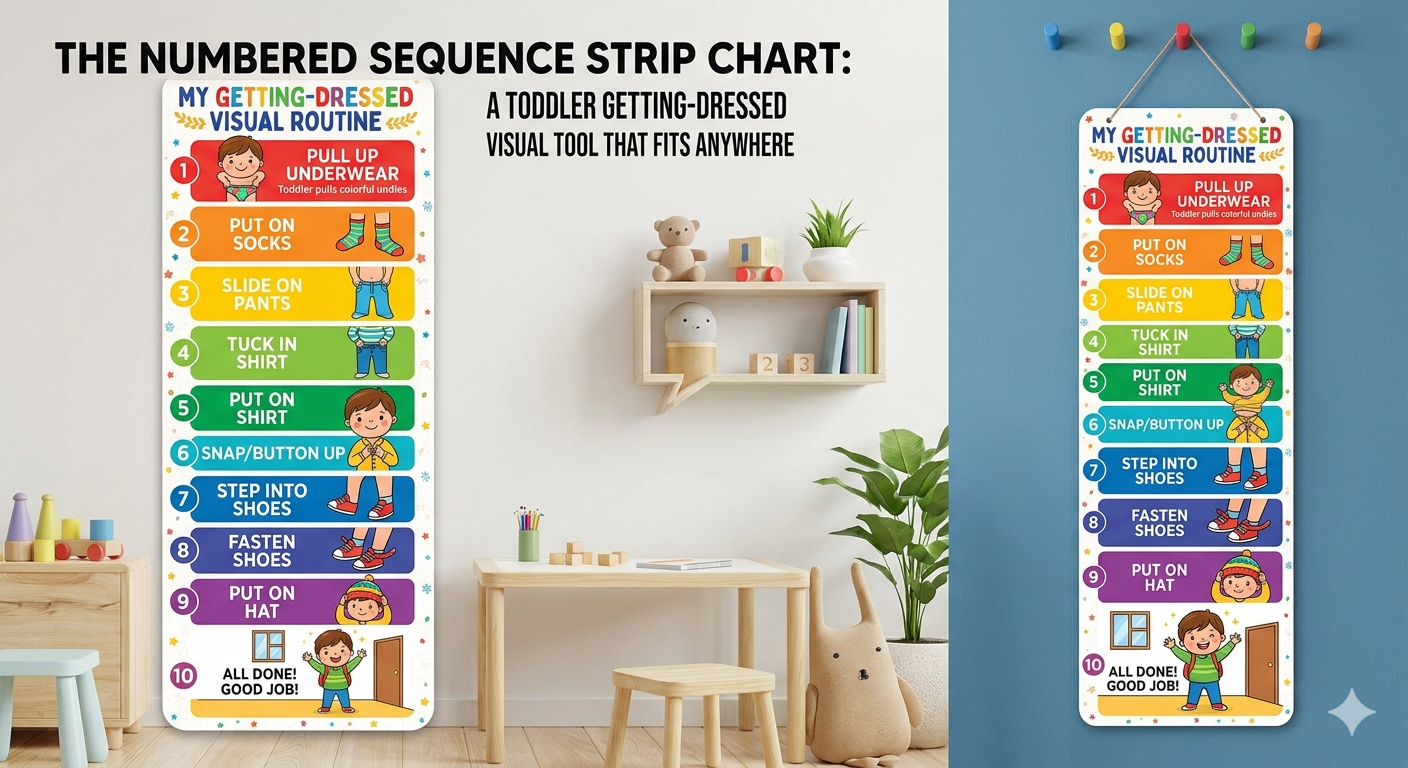
5. The Numbered Sequence Strip Chart: A Toddler Getting-Dressed Visual Tool That Fits Anywhere
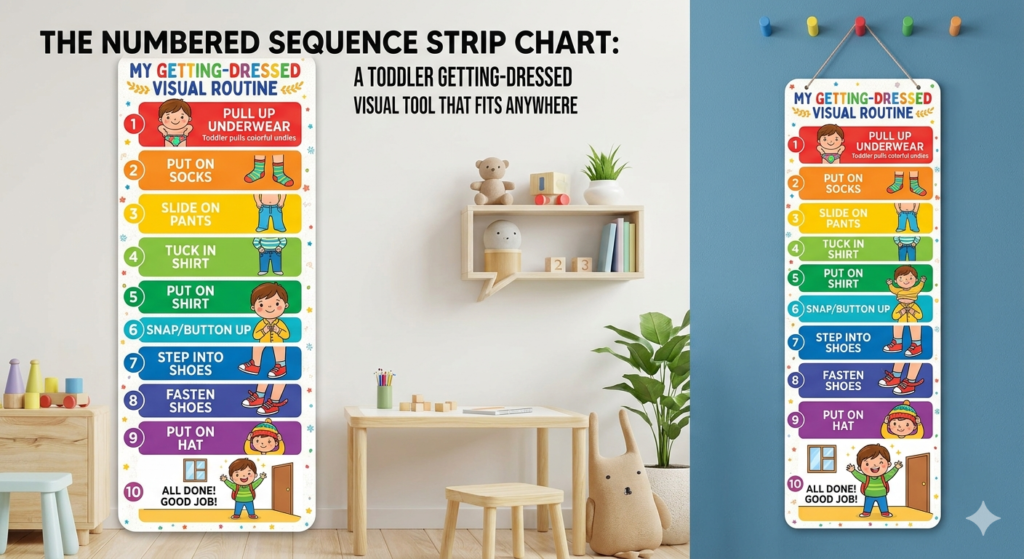
Not every family has wall space. Not every bedroom has a closet door that works as a display area. Not every toddler will pay attention to a large chart when they can barely hold their own attention for more than ninety seconds. For those situations, the numbered sequence strip is my go-to recommendation.
A sequence strip is a horizontal or vertical strip of images — think the size of a bookmark or a wide ruler — that shows the dressing steps in numbered order. It can be taped to the edge of a dresser, stuck to the wall at baseboard height, or even laminated and stored in a small basket of clothes.
The small size is actually a feature, not a limitation. I’ve discovered the hard way that bigger isn’t always better when it comes to visual tools for toddlers. A chart that’s too large can feel overwhelming. A strip that shows six clear steps in a contained, manageable format is easier for a young child to track from start to finish.
With Leo, I made a sequence strip that lived in his clothes basket. Every morning I’d set out his clothes the night before, tuck the strip on top, and let him work through it independently. He genuinely thought of it as a “list” — he’d tap each picture as he completed it, which was both adorable and effective. The portability also meant it came with us on trips and visits to grandparents’ houses, which kept the routine consistent even when the environment changed.
Use thick cardstock, laminate it, and add a single ring hole at the top so it can hang from a hook. Waterproof is your friend.
6. The “Getting Dressed” Story Chart: Visual Narrative Routines for Toddlers Who Love Books
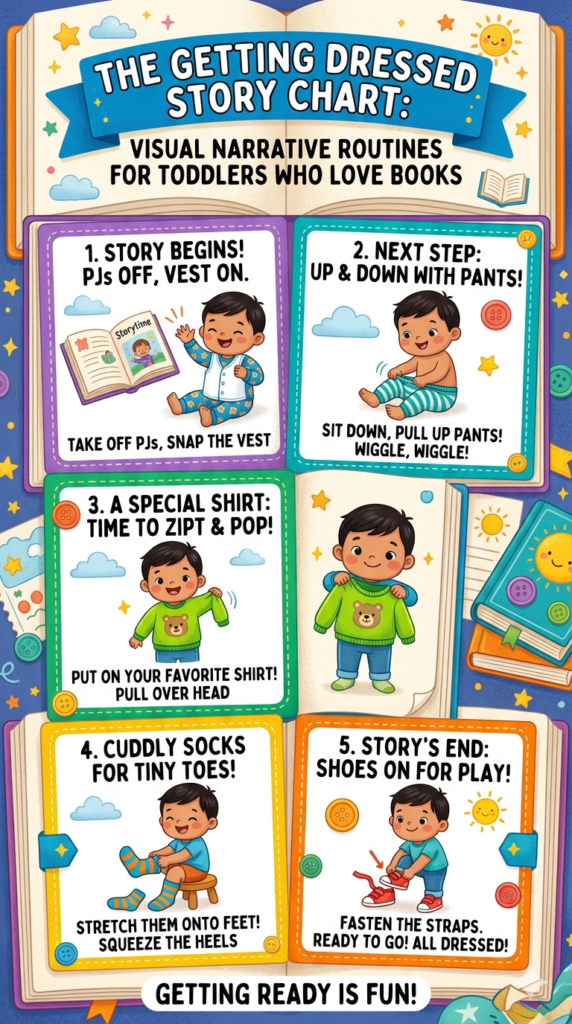
Some toddlers are not chart kids. My Sarah was emphatically not a chart kid. She ignored every single visual aid I tried until I made one that told a story. If your toddler is a book lover — the kind of kid who has memorized their favorite picture books and requests them repeatedly at bedtime — a story-format chart might be the breakthrough you’re looking for.
A story chart turns the dressing sequence into a mini narrative. Instead of Step 1 / Step 2 / Step 3, it reads more like: “First, Bear puts on his cozy underwear. Then, Bear pulls up his warm pants…” Each step has an illustration or photo, and the language is narrative rather than instructional.
You can create this as a small staple-bound booklet, a printed mini-book, or even a page in a clear plastic sleeve. The point is that it reads like a book, because for some children, stories are the most compelling format for information.
I’ll be honest: this takes more effort to create than a simple photo chart. But if you have a story-driven kid, the payoff is significant. Maya used to carry her “getting dressed book” around the house as if it were a prized possession. She’d “read” it to her stuffed animals. She’d explain the steps to anyone who would listen. And in the process, she internalized the sequence so thoroughly that the book became optional within a few weeks.
A quick side note: you can find children’s books specifically about getting dressed at most libraries — titles that follow a character through their morning routine. Reading these at bedtime primes the concept even before you introduce the chart. It’s a gentler, indirect way to normalize the skill before making it a daily expectation.
7. The “First/Then” Visual Board for Toddlers Who Resist Getting Dressed
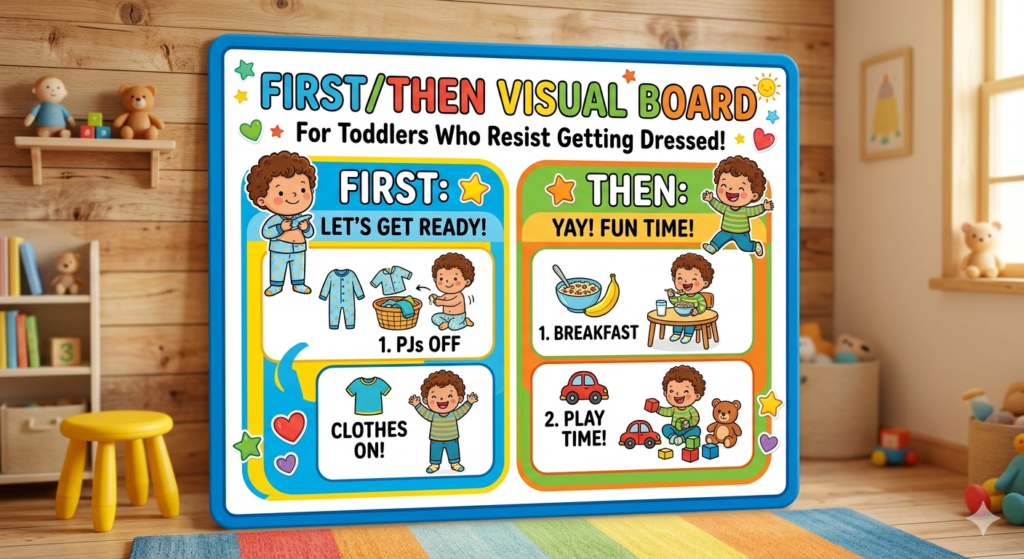
Every list like this needs at least one tool for the truly resistant child — the child who isn’t just disorganized or easily distracted, but who actively refuses to get dressed because they don’t want the morning to begin, or they don’t want to go wherever they’re going, or they simply have very strong opinions about autonomy and today is not the day.
I’ve been there. Maya had a six-week stretch at age three and a half where getting dressed was a full-scale negotiation every single morning. I tried every gentle redirection in my toolkit. What finally worked was radically simplifying the ask with a First/Then board.
A First/Then board is exactly two images. “First: get dressed.” “Then: breakfast” (or park, or the activity your child loves). No sequence of seven steps. No elaborate chart. Just the immediate obstacle and the immediately desirable reward on the other side of it.
The power of this tool is in its restraint. You’re not asking a resistant child to engage with a multi-step process. You’re asking them to cross one bridge to get to something good. For children who are dysregulated, overwhelmed, or simply oppositional in the morning, a simpler visual demand is more achievable than a complex one.
Make the “then” image something genuinely motivating — not vague praise, but a specific thing your child cares about. If breakfast means nothing to your kid but the playground does, use the playground image. If they’re wild about a particular show or toy, use that. The chart is only motivating if the “then” is genuinely motivating.
I still keep a First/Then board in the back of my parenting toolkit even now, years after my kids are grown. It’s the tool I recommend most often to parents of toddlers who are in a developmental “no” phase, because it meets resistance with gentleness and clarity rather than escalation.
Real Talk: What Doesn’t Work and What’s Not Worth Your Time
I want to save you the months I spent trying things that looked promising and delivered nothing.
Elaborate reward charts with too many components. If the chart requires your toddler to earn five stars to get a small prize, you’ve already lost. Toddlers live in the present tense. Delayed rewards that stretch across multiple days require executive function they simply don’t have yet. Immediate, tangible satisfaction — moving a magnet, completing a strip — will always outperform a star chart for this age group. I learned this the expensive way, after buying a very cute magnetic reward chart that Sarah used enthusiastically for four days and then completely ignored.
Charts you make without your child’s input. This is the big one. A chart you create in isolation and then present as “the new rule” will meet resistance almost every time. A chart you make with your toddler — where they pick the photos, help place the images, test the Velcro — is a chart they feel ownership over. The difference in buy-in is enormous. Yes, it takes longer. Yes, they will want to put the shoes step before the underwear step and you’ll have to gently redirect. It’s still worth it.
Charts that live in a drawer. This sounds obvious, but the chart has to be visible and accessible during the task itself. A laminated chart folded up on the dresser is not helping anyone. Eye-level placement in the exact location where getting dressed happens is non-negotiable. If you move rooms to get dressed, the chart moves with you.
Over-praising the chart instead of using it. I’ve watched parents (and I’ve been this parent) spend so much energy celebrating the chart itself — “Isn’t this such a cool chart?! Look at all the pictures!” — that the child associates it with performance rather than function. The chart is a tool, not a trophy. Use it matter-of-factly, refer to it practically, and let your toddler develop a working relationship with it rather than a performance one.
Parting Wisdom
Here’s what I want you to carry with you: the fact that your toddler can’t get dressed independently yet is not a reflection of your parenting, their intelligence, or anything you’ve done wrong. Dressing independence is a developmental milestone that involves sequencing, fine motor skills, body awareness, and enough self-regulation to stay on task. That’s a lot for a small human who discovered their own kneecaps roughly eighteen months ago.
Visual routine charts work because they externalize the task. They take the demand out of your mouth — where it can feel like pressure, conflict, or another opportunity for a power struggle — and put it on a neutral, non-threatening surface. The chart isn’t tired. The chart isn’t running late. The chart isn’t frustrated. It just shows what comes next.
Start with one chart. Pick the type that best matches your child’s learning style and your morning context. Give it at least two weeks before you evaluate whether it’s working. And be patient with yourself in the in-between time, because it will feel awkward and effortful before it feels natural.
You are not failing. You’re figuring it out, one morning at a time — just like the rest of us.
Have you tried a visual routine chart with your toddler? Which type worked best for your family, or which ones flopped spectacularly? Drop your experience in the comments below — I read every single one, and I’d love to hear what’s actually happening in your morning. And if you have a chart idea I haven’t covered, share it. This community is the best resource any of us have.